
Your Home Was the First Robot
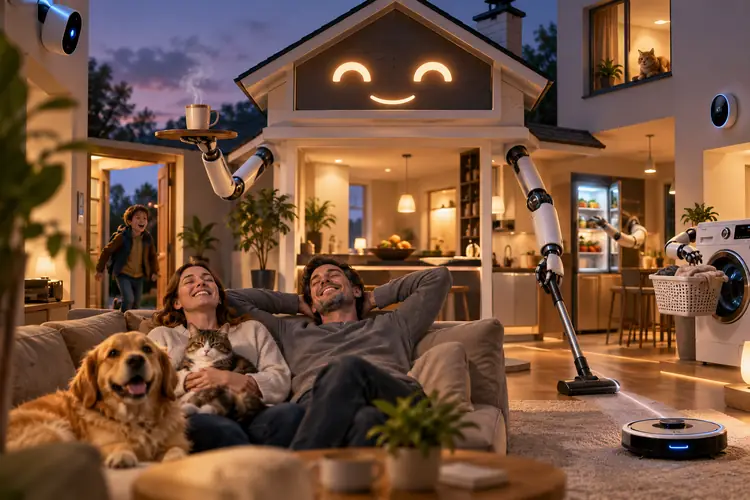
For most of human history, houses were remarkably unintelligent. They kept out rain. They kept in heat. They provided somewhere to sleep, eat, argue, raise children, and accumulate things we promised ourselves we would eventually throw away.
Then something strange happened.
The house started paying attention. It learned whether anyone was home. It noticed when a door opened. It measured temperature, humidity, electricity consumption, smoke, water leaks, and movement. It learned to turn lights off, adjust heating, lock doors, and watch the driveway.
We called this a smart home.
But economically, something more interesting was happening.
We were building one of the first robots most people would ever own.
A Robot That Doesn't Look Like One
When people hear the word robot, they usually imagine a machine with arms, legs, and perhaps an unsettlingly cheerful face. But a robot doesn't necessarily need a body. At its simplest, an intelligent machine needs three things:
**sensors to understand what is happening,
software to decide what to do,
and devices capable of acting on that decision.**
A modern smart home increasingly has all three. A motion detector sees you enter a room. A thermostat measures temperature. A smart meter watches electricity consumption. A camera recognizes activity outside.
Then software connects those observations with actions. The lights come on. The temperature changes. The door locks. The blinds close. The security system activates. No humanoid robot walks through the hallway. The hallway itself has become part of the robot.
That distinction matters because it points toward something much larger than smart homes.
It is the basic architecture of the Internet of Things.
Convenience Was Only the Beginning
The first sales pitch for the smart home was mostly convenience. Why walk across the room to turn off a lamp when your phone can do it? This was impressive for about fifteen minutes.
The more interesting economic proposition appeared when connected devices stopped simply obeying commands and started making small decisions.
Consider heating and cooling. A traditional thermostat essentially asks one question:
What temperature did the human choose?
A smarter system can ask many more. Is anybody home? Which rooms are occupied? What is the weather outside? When will the residents probably return? How quickly does this particular house lose heat? What does electricity cost right now?
Suddenly the thermostat isn't merely a switch. It is allocating a scarce resource — energy — under changing conditions.
That sounds suspiciously like economics.
And the same principle can spread across the house. An EV can charge when electricity is cheaper. A battery can store solar power and release it later. Appliances can potentially shift some consumption away from expensive periods. Water sensors can detect leaks before a small problem becomes an expensive renovation.
The smart home therefore begins to optimize not just comfort but money, energy, and risk.
The House Becomes an Economic Agent
Imagine coming home at 6 p.m. Your electric car plugs in. The old house does nothing. A sufficiently connected house could ask: Does the car really need to charge now? Perhaps electricity is expensive at 6 p.m. but cheaper overnight. The car isn't needed until 7 a.m. The home battery still has power. Solar panels may generate electricity again tomorrow. So the system waits.
The homeowner doesn't negotiate with the electricity market. The house effectively does it on the owner's behalf.
Now multiply this by millions of homes. That is where a gadget story becomes an economic story. Homes consume enormous amounts of electricity. Heating, cooling, water heating, appliances, and increasingly EV charging all place demands on the grid. If some of that demand becomes flexible, a smart home can do something that a traditional house cannot: respond to prices.
Your washing machine probably doesn't care about economics. But one day its software might.
The $10 Sensor That Can Save Thousands
Some of the least glamorous smart-home devices may also make the most economic sense.
Take a water-leak sensor. There is nothing futuristic about it. It sits quietly near a pipe, washing machine, or water heater and waits for something bad to happen. If it detects water, it can send an alert. More sophisticated systems can trigger a shutoff valve.
The economic logic is beautiful. A cheap sensor is being used to prevent a potentially very expensive loss.
The same principle applies to smoke detectors, security systems, electrical monitoring, and equipment diagnostics. This is an important shift in how households manage risk. Traditionally, we often discover problems after they become expensive. A connected home tries to discover them while they are still cheap.
That idea will become much more important when we leave the house and enter factories, power plants, and transportation networks. A machine that can warn you before it breaks is economically different from a machine that simply breaks.
And Then Things Get Weird
Of course, humanity rarely invents a useful technology without eventually asking it to do something ridiculous. The smart-home industry is no exception.
We already have robot vacuum cleaners that map rooms rather than wandering randomly. Some newer designs are even experimenting with ways to deal with stairs.
There are beds packed with sensors and adjustable air chambers that respond to sleeping position.
There are smart toilets capable of analyzing aspects of what their users leave behind.
There are refrigerators that attempt to keep track of food.
Lighting systems can imitate natural daylight.
Robotic lawn mowers quietly patrol gardens.
And companies continue chasing the old science-fiction dream of a domestic robot that can eventually handle laundry, cleaning, and other chores. The fascinating part is that some apparently absurd ideas may eventually become normal.
A century ago, telling someone that a machine would wash their clothes automatically would have sounded extravagant. Today, a house without a washing machine in much of North America would seem inconvenient.
The dividing line between luxury and infrastructure moves surprisingly quickly.
What Do Homeowners Actually Want?
Probably not fifty-seven apps.
This may be the biggest lesson of the first smart-home era. Consumers don't really want smart devices. They want outcomes. They want the house comfortable when they arrive. They want lower energy bills. They want to know that the garage door isn't mysteriously open at midnight. They want a water leak stopped before the basement becomes a swimming pool. They want elderly parents to live independently for longer without feeling constantly watched. And ideally, they don't want to spend Saturday afternoon discovering why the smart light bulb refuses to speak to the smart switch.
That interoperability problem has been important enough to produce Matter, an industry standard designed to make devices from different ecosystems work together more easily.
The economic significance is easy to overlook. Standards reduce friction. And when friction falls, markets can grow.
But Who Owns the House's Data?
There is another side to this story. A traditional house knows almost nothing about you. A smart house potentially knows when you wake up, when you leave, which rooms you occupy, how much electricity you consume, when you return, and perhaps even how you sleep.
That information can be enormously useful. It can also be enormously valuable. So the smart-home revolution creates a question that will follow us throughout the Internet of Things:
Who owns the data produced by the things you own?
If you buy a thermostat, you clearly own the thermostat. But what about years of data describing how your family uses it?
If your car records thousands of observations every day, who owns those?
If an insurer can reduce risk using information from household sensors, how should that value be divided?
The connected economy doesn't merely create new products. It creates new property rights that society hasn't completely figured out yet.
The House Was Just the Experiment
Smart homes can sometimes look like a collection of amusing gadgets. That misses the bigger story. The home became a laboratory for connecting the physical world to the digital one.
First we connected computers. Then phones. Then televisions. Then thermostats, cameras, locks, cars, appliances, meters, and almost anything else manufacturers could persuade us to connect.
Once an object can sense its environment and communicate, it becomes part of something larger. A refrigerator is no longer only a refrigerator. A car is no longer only a car. A building is no longer only a building. They become nodes in an enormous network of physical objects producing information about the real world.
That network is the Internet of Things.
And the economic consequences become much larger once the same logic leaves our kitchens and enters factories, warehouses, farms, hospitals, transportation systems, and power grids.
The smart home was not the destination. It was the prototype.
We thought we were teaching the house to turn off the lights.
We were actually teaching the physical world how to talk.