
Will AI Take Your Job — Or Make You More Valuable?
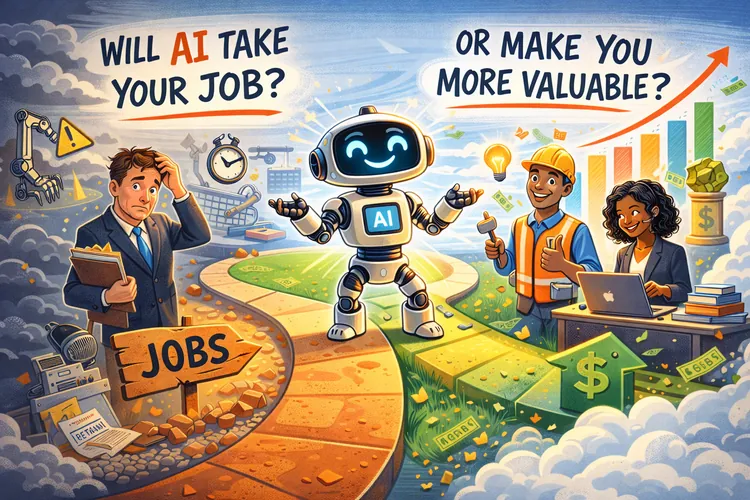
Whenever a new technology appears, the same question quickly follows:
Will this destroy jobs?
People asked it when factories were built.
They asked it when computers entered offices.
And today they ask it again about artificial intelligence.
The concern is understandable. AI can already write text, generate images, summarize documents, and even write computer code.
So the fear is simple:
If a machine can do my work, why would anyone need me?
But history suggests the real story is usually more complicated.
Technology Usually Replaces Tasks — Not Entire Jobs
One of the most important insights from modern economics is that technology rarely replaces entire professions.
Instead, it replaces specific tasks inside jobs.
Take accountants as an example.
Decades ago, accountants spent enormous amounts of time doing calculations manually. Then spreadsheets appeared.
Programs like Excel automated the calculations.
Did accountants disappear?
No. Their work simply changed. They spent less time calculating and more time analyzing, advising clients, and interpreting financial data.
Artificial intelligence may follow a similar pattern.
The Jobs Most Exposed to AI
That said, some professions are more exposed to AI than others.
Jobs that rely heavily on routine information processing are especially vulnerable.
These may include:
- basic legal research
- routine coding tasks
- data entry
- simple financial analysis
- standard customer support
In these fields, AI can often complete the most repetitive tasks quickly.
But even here, the story isn’t simply about replacement.
It is often about productivity.
If one worker can now do the work of two, companies may not need as many people in that specific role.
But at the same time, the lower cost of those services may increase demand.
And increased demand can create new jobs.
The Jobs AI Struggles With
Interestingly, many jobs that require physical skills, human interaction, or unpredictable environments are much harder to automate.
For example:
- electricians
- plumbers
- nurses
- construction workers
- emergency responders
These roles involve complex physical tasks and real-world judgment that machines still struggle to replicate.
This creates a strange situation in modern economies.
Highly educated office jobs may sometimes be easier for AI to assist — or partially automate — than certain skilled trades.
The Rise of the “AI-Powered Worker”
For many professionals, the most likely future is not replacement but augmentation.
Imagine a lawyer who can instantly analyze thousands of legal precedents.
A software engineer who can generate code prototypes in seconds.
A teacher who can create personalized lesson plans for every student.
In these cases, AI acts like an extremely fast assistant.
The human still provides judgment, creativity, and responsibility.
But the speed of work increases dramatically.
In many industries, this may lead to a new kind of professional:
the AI-powered worker.
Why New Jobs Always Appear
Every technological revolution has eliminated some jobs.
But it has also created new ones that were previously unimaginable.
Before the internet, nobody worked as:
- social media managers
- app developers
- cybersecurity analysts
- cloud computing engineers
Millions of people now work in these fields.
Artificial intelligence is already creating new roles as well.
Companies are hiring:
- AI trainers
- prompt engineers
- machine learning auditors
- AI safety specialists
Entire industries may emerge around technologies that barely exist today.
The Real Risk: The Speed of Change
If technology always creates new jobs, why do people worry?
Because transitions can be painful.
When technological change happens slowly, workers have time to adapt, retrain, and move into new roles.
But if change happens very quickly, entire industries can be disrupted in just a few years.
The biggest challenge of the AI economy may not be job destruction itself.
It may be how fast workers, companies, and education systems can adapt.
And that leads directly to another question.
Even if AI makes the economy more productive and creates new jobs, the benefits may not be distributed equally.
Some people may gain enormously.
Others may struggle to keep up.
Which brings us to the next issue in our series:
AI and economic inequality.