
Why Pawn Shops Never Disappeared
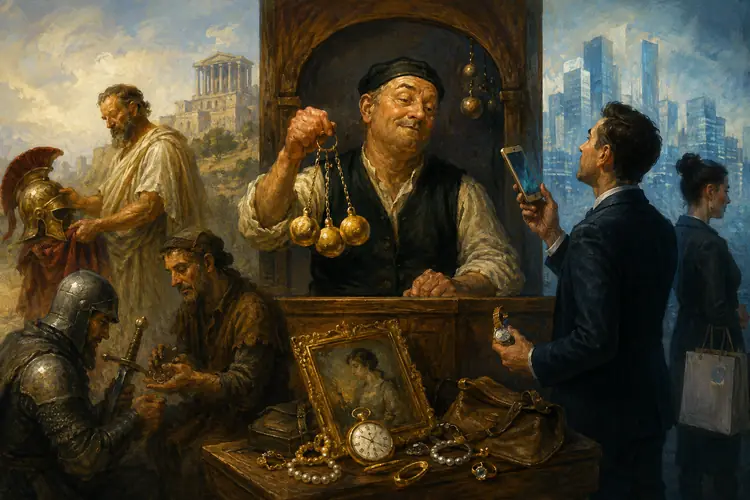
Have you ever walked past a pawn shop and wondered how a business that seems centuries old still survives in the age of smartphones, digital banking, and instant online payments?
At first glance, pawn shops look like relics from another era. We live in a world where you can transfer money with a tap, apply for a loan without leaving your couch, and even invest in stocks from your phone. Yet the familiar three golden balls still hang outside pawn shops in cities around the world.
Why?
The answer reveals something surprisingly important about economics—and about human nature.
A Business Older Than Modern Banking
Pawn lending is one of the oldest financial services in history.
Long before credit cards, checking accounts, or even paper money became common, people needed temporary access to cash. Farmers had bad harvests. Merchants waited for customers to pay. Craftsmen needed materials before they could sell finished products.
Many owned valuable possessions but had no ready money.
The solution was simple: leave something valuable as collateral, receive cash immediately, and buy the item back later by repaying the loan.
This basic idea proved remarkably durable.
Versions of pawn lending existed in ancient China, Greece, and Rome. The concept appeared independently in many civilizations because it solved a universal problem: how to turn property into cash without selling it permanently.
Good economic ideas often survive because they answer permanent human needs.
Pawn lending is one of them.
---
Why "Pawn Shops" Are Called Lombards
The story becomes even more interesting in medieval Italy.
During the Middle Ages, merchants and bankers from the Lombardy region became famous throughout Europe for providing financial services. Their reputation became so widespread that, in many countries, businesses offering secured loans became known simply as "Lombards."
Even today, many languages still use a word derived from "Lombard" to describe pawn shops.
The famous symbol of three golden balls is also centuries old. While historians debate its exact origin, it became associated with merchants, moneylenders, and later pawn brokers across Europe. The buildings changed. The currencies changed. The technology changed.
But the basic business remained remarkably recognizable.
Why Banks Never Replaced Them
Many people assume pawn shops exist because some people cannot qualify for bank loans.
That is only part of the story.
Banks and pawn shops solve different problems. A bank studies the borrower. A pawn shop studies the object.
When a bank considers lending money, it asks questions about your income, employment, credit history, debts, and ability to repay.
A pawn shop asks only one essential question: "What is this item worth if nobody comes back for it?"
That difference changes everything.
The loan depends primarily on the value of the collateral—not on the customer's financial history.
For someone who needs cash immediately, this simplicity can matter more than obtaining the lowest possible interest rate.
The Price of Speed
Economics teaches that every advantage comes with a cost.
Fast service usually costs more than slow service. Convenience often costs more than inconvenience.
Pawn shops illustrate this principle perfectly.
A traditional bank loan may require paperwork, identity verification, income checks, waiting periods, and approval processes.
A pawn loan can sometimes be completed within minutes.
That speed has value. Just as people willingly pay extra for express shipping or emergency medical care, borrowers sometimes pay more for immediate access to cash.
The higher cost is not simply the price of money. It is also the price of certainty, speed, and flexibility.
Why the System Rarely Disappears
Many businesses disappear because technology makes them obsolete.
Video rental stores largely vanished. Film cameras became niche products. Phone booths almost disappeared.
Pawn shops did not. Why?
Because technology changed how money moves—but not why people suddenly need it.
Unexpected medical bills still arrive. Cars still break down. Businesses still experience temporary cash shortages. Families still face emergencies.
Economic uncertainty has not disappeared simply because banking apps became more convenient.
As long as people occasionally need immediate liquidity, some version of pawn lending is likely to survive.
More Than Money
There is another reason pawn shops continue to exist.
Sometimes people do not want to sell an item forever. A wedding ring may have sentimental value. A family heirloom may represent generations of memories. A musical instrument may be essential for someone's profession.
Selling such items can feel permanent.
Using them as collateral creates another possibility: solving today's financial problem while preserving the chance to recover something meaningful tomorrow.
Economically, collateral reduces risk. Psychologically, it preserves hope.
That combination is surprisingly powerful.
An Uncomfortable Reputation
Pawn shops have never enjoyed an elegant image. Movies often portray them as dark, desperate places where people make bad decisions.
Reality is usually more complicated. Like any financial business, some pawn shops operate responsibly while others do not. Some customers borrow wisely. Others borrow impulsively.
The institution itself is neither virtuous nor immoral. It is simply a financial tool.
A hammer can build a house or break a window. The value depends on how it is used.
The same is true of financial instruments.
Why They Will Probably Outlive Us
Every few decades, someone predicts the end of pawn shops.
Credit cards were supposed to replace them. Then online banking. Then mobile payments. Then financial technology startups.
Yet pawn shops remain.
Not because they resist progress, but because they solve a problem that modern technology has never eliminated.
The form may evolve. More transactions may begin online. Artificial intelligence may improve valuation. Digital identity systems may simplify paperwork.
But whenever someone owns something valuable and temporarily needs cash, the basic economic logic remains unchanged.
That logic is older than modern finance—and remarkably difficult to replace.
The Quiet Lesson
Pawn shops remind us that successful financial institutions are not always the newest or the most sophisticated. Sometimes they are simply the ones that continue solving the same human problem generation after generation.
Technology changes. Currencies change. Governments change. Human uncertainty does not.
And as long as uncertainty exists, some businesses that seem old-fashioned will quietly remain part of the modern economy.
Not because the world failed to move forward. But because certain economic ideas were already remarkably good to begin with.