
Why Oil Refuses to Die
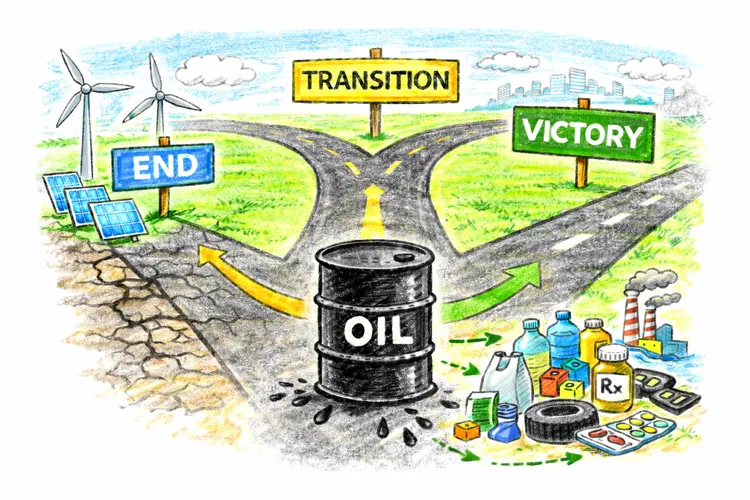
Every few years, oil is declared finished.
Too dirty.
Too political.
Too old for a modern economy.
And yet, it keeps coming back—not as a villain, not as a hero, but as something far more stubborn: infrastructure.
Oil doesn’t survive because it wins arguments.
It survives because it’s embedded.
The Mistake We Keep Repeating
Most debates about oil share the same hidden assumption:
If something replaces oil in one place, oil must disappear everywhere else.
That assumption feels logical.
It’s also wrong.
Oil is not a single use case. It’s a system that connects:
- energy,
- materials,
- logistics,
- manufacturing,
- and everyday consumption.
Replacing oil is not like switching apps.
It’s like rebuilding a city while people still live in it.
Oil Doesn’t End. It Repositions.
History is full of confident endings that never arrived.
Oil was supposed to fade when:
- coal-powered electricity expanded,
- nuclear energy promised abundance,
- renewables became cheaper,
- electric vehicles entered the mainstream.
Each time, oil didn’t vanish.
It changed weight inside its own portfolio.
Less here.
More there.
Less gasoline in some regions.
More petrochemicals, aviation, heavy transport, and industrial feedstocks elsewhere.
That’s not stagnation.
That’s adaptation.
The Quiet Power of Embedded Systems
Oil doesn’t dominate because it’s perfect.
It dominates because it’s already everywhere.
Roads assume asphalt.
Planes assume jet fuel.
Factories assume petrochemical inputs.
Supply chains assume plastics, lubricants, packaging, and synthetic materials.
You can remove oil from one corner of the system.
Removing it from all corners at once is a different problem entirely.
This is why transitions take decades, not election cycles.
About Prices (Briefly)
Yes, oil prices fluctuate.
Yes, they react to shocks, expectations, and headlines.
But prices are signals—not verdicts.
They tell you where stress is today, not whether the system itself is about to disappear tomorrow.
That story belongs elsewhere.
Why Binary Thinking Fails
Public conversations about oil often collapse into two camps:
- “Oil is dying.”
- “Oil is eternal.”
Both are wrong.
Oil is not immortal.
But it is not fragile either.
It is resilient, because it adapts faster than narratives about it.
The real mistake is expecting a clean ending to a messy system.
The Final Takeaway
Oil refuses to die not because it’s unbeatable—but because it’s useful in too many ways at once.
Understanding oil means letting go of simple finales and embracing uncomfortable timelines.
Not an end.
Not a victory.
Just a long, uneven transition.
That’s the oil story most people don’t want—
and the one the world actually lives with.