
Why Oil Prices Are So Hard to Predict — and What 2026 Forecasts Tell Us
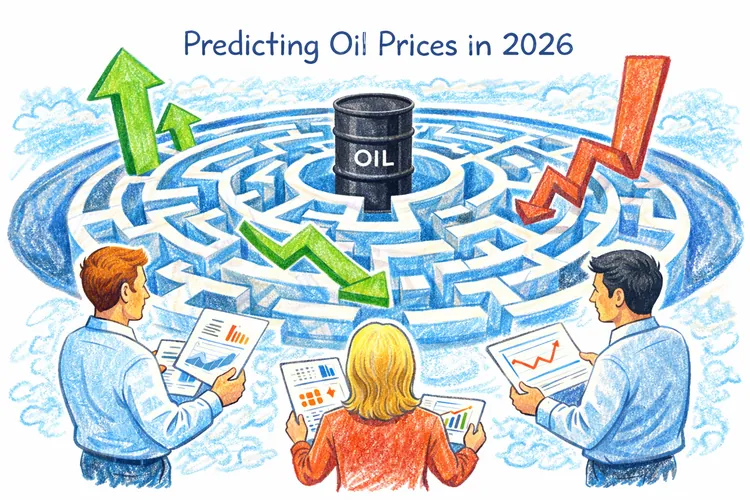
Oil — one of the most traded and watched commodities on the planet. Its price affects:
- gasoline and heating costs,
- national budgets of oil-producing countries,
- stock markets,
- consumer prices globally.
Yet despite all the data, models, and expert forecasts, predicting oil prices remains extraordinarily difficult.
Why?
1. A tangled web of supply and demand
Oil markets are influenced by a complex mix of factors:
Supply side
- production decisions by OPEC+,
- output from the U.S. shale industry,
- global disruptions (wars, strikes, sanctions),
- production returns from countries like Venezuela.
Demand side
- economic growth slowdowns or accelerations,
- seasonal demand swings,
- technology and energy transitions.
These don’t move in neat, predictable curves — they shift with geopolitics, policy, and the economy.
2. Forecasts differ — and often disagree
Analysts and agencies publish a range of projections for 2026 oil prices. They differ significantly.
Analyst forecasts
- A Reuters poll of 31 analysts projected Brent crude averaging ~$62 per barrel in 2026.
- Other industry forecasts suggest a range from ~$55 to $65 depending on supply and demand dynamics.
Major institutions
- The U.S. Energy Information Administration (EIA) projects Brent around $55–56 per barrel in 2026 — down from 2025.
Bank views
- Some financial houses have put their forecasts near similar ranges, although specific models can differ modestly.
Even within professional forecasts, the spread of expectations is wide, showing that experts do not share a single view.
3. Things can turn on a dime
Price outlooks can change rapidly due to events no model can fully predict:
- geopolitical tensions (e.g., Middle East risks supporting prices),
- policy shifts affecting output or sanctions,
- sudden changes in demand patterns,
- unexpected production boosts or cutbacks.
A forecast that looks solid today may be outdated tomorrow.
4. Models don’t capture human behavior
Many oil price predictions derive from economic models, statistics, or supply-demand fundamentals. But oil markets are also markets of sentiment:
- traders react to headlines,
- investors reposition on macro fears,
- expectations themselves shape prices.
These dynamics are hard to quantify.
What does all this mean for 2026?
Most professional forecasts suggest that 2026 oil prices may be lower than in 2025, with estimates clustering around the low $50s to low $60s per barrel.
But look closely:
- Estimates vary by $10–15 per barrel — a wide band proportionate to recent average prices.
- Some forecasts assume stable conditions; others include geopolitical risk premiums.
- Extreme situations (major supply disruptions, wars, or sudden demand drops) can push prices outside consensus ranges.
That uncertainty is not a flaw of forecasting — it’s a reflection of the real world.
The cautious conclusion
The reason oil prices are so hard to forecast is not a lack of skill or data. It’s that oil markets are shaped by hundreds of moving parts — from geopolitics to inventory levels, from corporate strategies to consumer behavior.
A best guess is useful — but it is just that: a guess.
Forecasts tell us something about expectations and scenarios — not certainties.
And in a world where events can shift quickly, the smartest strategy is often to treat forecasts with caution, not certainty.