
Why Gold Still Matters
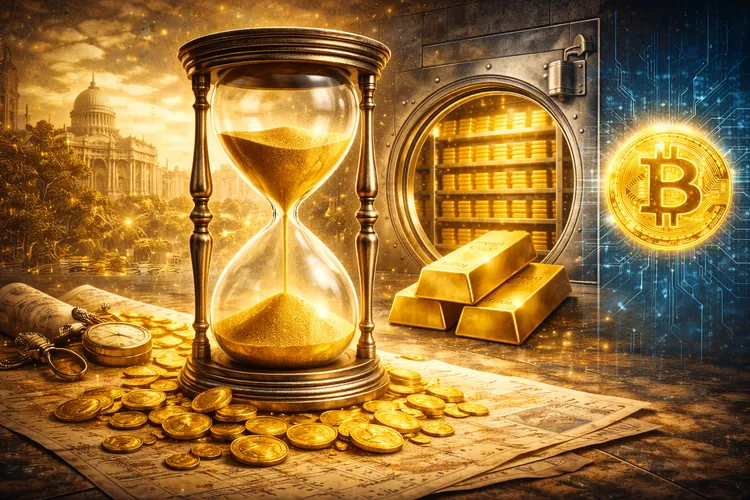
Gold is no longer money.
It does not anchor currencies.
It does not dictate exchange rates.
It does not constrain governments.
And yet, it never left the stage.
That alone makes it worth understanding.
Gold Outlived Its Own System
Gold once defined money.
Then the world moved on.
Modern economies needed flexibility, credit expansion, countercyclical policy, and financial depth that a finite metal could not provide.
Gold stepped back.
But it didn’t disappear.
Instead, it changed roles.
From money → to reserve.
From currency → to collateral of trust.
From system → to signal.
Few assets survive losing their primary function.
Gold did.
The Three Layers of Gold
By now, we’ve seen that gold operates simultaneously on three levels.
1️⃣ Physical
It is a rare, durable, highly conductive metal with unique properties.
It exists outside balance sheets.
It does not degrade, default, or disappear.
2️⃣ Institutional
Central banks hold more than 35,000 tons of it.
Not because they plan to reintroduce the gold standard,
but because no financial architecture is trusted completely.
Gold is institutional caution made tangible.
3️⃣ Psychological
Gold reacts to fear, uncertainty, and confidence cycles.
It does not predict collapse.
But it reflects discomfort.
In that sense, gold functions as a sentiment barometer for the global system.
What Gold Is Not
Gold is not:
- a productive asset
- a yield generator
- a growth engine
It does not innovate.
It does not compound like equity.
It does not expand like credit.
Gold simply persists.
That persistence is its entire proposition.
Why It Still Commands Attention
In a world built on:
- leverage
- digital money
- expanding balance sheets
- interconnected risk
gold remains one of the few assets that:
- carries no liability
- depends on no issuer
- requires no algorithm
It is analog in a digital system.
And paradoxically, that makes it modern.
The Deeper Pattern
Every financial era believes it has outgrown gold.
And every era eventually rediscovers why gold never fully leaves.
Not because it replaces the system.
But because it stands slightly outside it.
Gold does not compete with modern finance.
It coexists with it.
The Final Takeaway
Gold matters not because we live in the past.
It matters because even in the most advanced financial architecture ever built,
uncertainty still exists.
Gold is not money anymore.
It is memory.
A reminder that systems change, currencies evolve, policies shift —
but trust remains finite.
And as long as trust is finite, gold will remain relevant.
Not dominant.
Not central.
But never irrelevant.