
Why Gold Became Money (Without Anyone Voting for It)
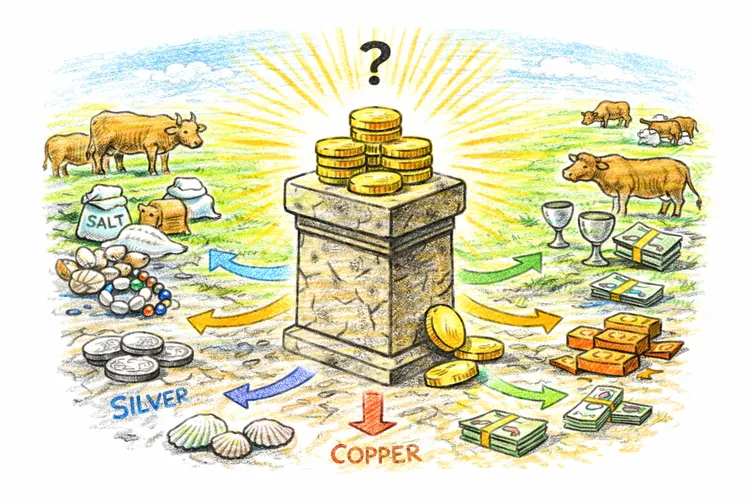
Gold didn’t become money because someone declared it so.
No constitution.
No central bank.
No law.
Long before modern states existed, gold was already doing the job that money is supposed to do: store value, move it across time, and make it recognizable to others.
That alone should make us pause.
Money Before Governments
For most of human history, money wasn’t designed. It emerged.
Different societies experimented with many candidates:
- shells
- salt
- cattle
- beads
- silver
- copper
Most failed.
Gold didn’t.
Not because it was mystical—but because it was physically exceptional.
The Physics of Trust
Gold has a rare combination of properties that are almost tailor-made for money:
- Scarcity, but not extreme scarcity
Gold is rare enough to be valuable, but common enough to circulate. Even today, all the gold ever mined is estimated at roughly ~210,000 metric tons—which would fit into a cube about 22 meters on each side. Small in volume, enormous in value.
- Durability
Gold doesn’t rust, corrode, or decay. A gold coin buried for 2,000 years looks… like a gold coin.
- Divisibility
It can be melted, recast, split, and recombined without losing value.
- Uniformity
One ounce of pure gold is identical to another ounce of pure gold—no branding required.
- High value density
A small amount carries significant purchasing power, making storage and transport practical.
These are not aesthetic qualities.
They are engineering features.
Why Not Something Else?
Silver came close—and often served as everyday money—but it was:
- bulkier
- more volatile in supply
- and more sensitive to new discoveries
Other metals corroded.
Organic materials decayed.
Paper came much later—and required trust in an issuer.
Gold required trust in physics, not institutions.
That’s why it worked across cultures that never met, never traded directly, and never agreed on anything else.
Gold as a Market Solution
Seen through a market lens, gold was an early coordination equilibrium.
People accepted gold because:
- others accepted gold
- and everyone knew why
No enforcement was needed.
Gold solved a market problem before economics had a name.
The First Big Takeaway
Gold didn’t become money because it was chosen.
It became money because it outperformed every alternative at doing what money needs to do.
Only much later did states step in—minting coins, setting standards, and eventually trying to control what gold had already become.
That’s where the next chapter begins.
In the next post, we’ll look at the moment when gold stopped being just money—and became a system.