
Why Fewer People Are Having Kids — And Why the Economy Cares
Ask your grandparents how many kids were in their family.
Three? Four? Maybe more.
Now ask the same question today.
One. Two. Or none.
Something has clearly changed.
The Quiet Decline
Across developed countries, birth rates have been falling for decades.
In the United States:
- about 3.6 births per woman in 1960
- around 1.6 today
In Canada:
- roughly 1.4
To keep the population stable, a country needs about 2.1.
We are well below that.
It’s Not Just a Choice — It’s a Calculation
Having children has always been a personal decision.
But today, it’s also an economic one.
Consider the costs:
- housing
- childcare
- education
- healthcare
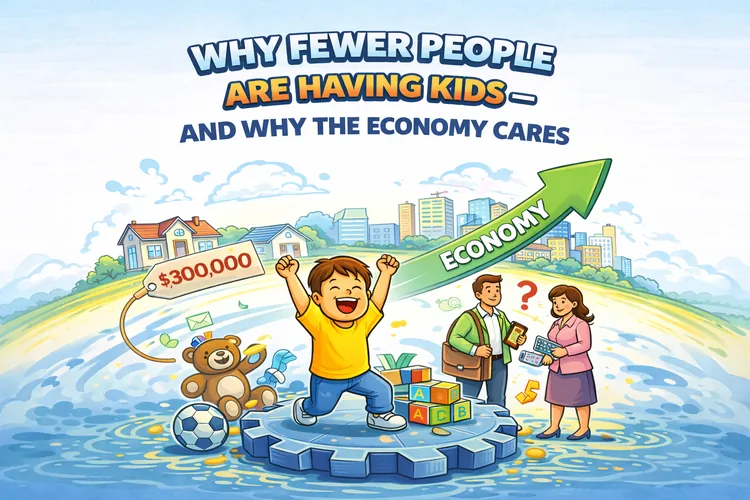
In the U.S., raising a child to age 18 can cost over $300,000.
That’s not a small lifestyle change.
That’s a major financial commitment.
The Housing Factor
Here’s one of the biggest shifts:
Housing.
In many cities, buying a home has become significantly harder.
- higher prices
- higher mortgage rates
- limited supply
When space becomes expensive, families become smaller.
It’s not always about preference.
Sometimes it’s about square meters.
Time Is Also a Cost
It’s not just money.
It’s time.
People today:
- study longer
- start careers later
- delay marriage
The average age of first-time mothers has increased in both the U.S. and Canada.
By the time many feel financially stable…
There’s less time left for having multiple children.
A Different Lifestyle
There’s also a cultural shift.
Previous generations often saw children as a natural part of life.
Today, people have more options:
- careers
- travel
- personal goals
Children are still valued — but they are no longer assumed.
And when something is optional, it becomes selective.
The Economic Ripple Effect
Fewer children today means fewer workers tomorrow.
And that feeds directly into the issues we’ve already seen:
- aging populations
- labor shortages
- pressure on pension systems
Demographics move slowly.
But once trends are set, they are hard to reverse.
Can Governments Change This?
Many countries have tried.
- tax benefits
- childcare subsidies
- parental leave policies
Some help at the margin.
But none have fully reversed the trend.
Why?
Because the decision to have children is influenced by:
- economics
- culture
- expectations
- personal priorities
And those are harder to change than tax rates.
The Big Question
Here’s the paradox:
Modern economies are more advanced than ever.
People are wealthier, healthier, and live longer.
And yet…
They are having fewer children.
A Thought to Leave With
If raising a child becomes more expensive…
And life offers more alternatives…
Then fewer people will choose it.
And that leads to a deeper question:
*Can an economy keep growing…
if the next generation keeps shrinking?*