
Why Economic Forecasts So Often Miss the Mark
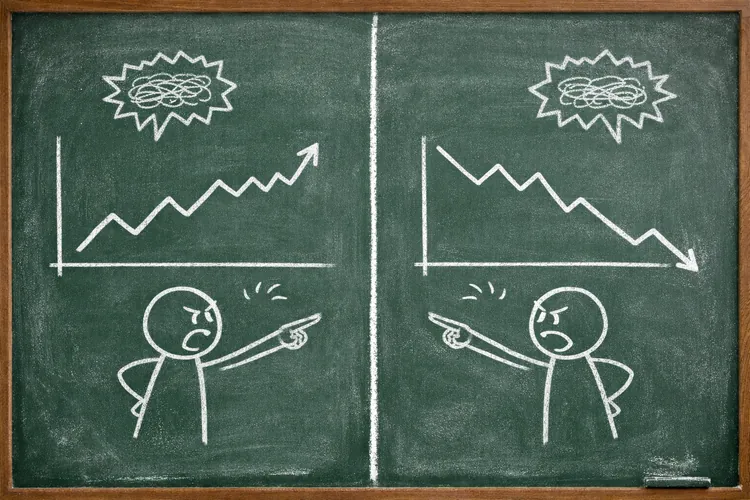
Every year the same ritual repeats.
Banks publish forecasts.
Analysts appear on television.
Institutions release projections for growth, inflation, and recessions.
And then reality refuses to cooperate.
The common explanation is that something unexpected happened:
a crisis, a geopolitical shock, a pandemic.
But the deeper issue lies elsewhere.
Economic forecasts do not only predict the future.
They influence it.
If people hear that a recession is coming, they delay spending.
If companies expect slower growth, they cut investment.
If investors fear a crash, they sell — sometimes triggering one.
Forecasts create feedback loops.
The prediction changes behavior.
Behavior changes outcomes.
This makes clean evaluation of forecasts nearly impossible.
Unlike physics, economics cannot run controlled experiments.
You cannot rewind a society and test the same policy twice.
This is why economic debates never fully disappear.
Different schools are not just arguing about equations.
They are arguing about human behavior and social priorities.
Uncertainty is not a flaw.
It is a structural feature of economics.
Certainty may sound reassuring.
But in economics it can also be misleading.