
Why Does a Robot Need Legs? The Billion-Dollar Bet on Humanoids
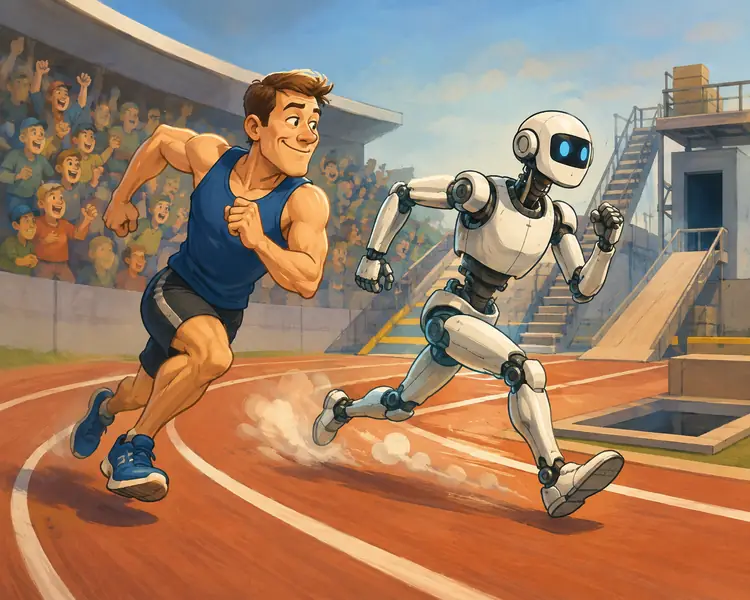
Imagine spending billions of dollars to build a machine that can walk on two legs, climb stairs, pick up a box, open a door — and occasionally fall over.
At first glance, this seems like a strange engineering choice. Wheels are cheaper. Conveyor belts are faster. Industrial robotic arms are more precise. A forklift can carry far more weight than a humanoid robot ever will.
So why are some of the world's most ambitious technology companies trying to build machines that look suspiciously like us?
The answer has less to do with science fiction than with economics.
The world is already designed for humans. And that may make the human body one of the most valuable industrial standards ever created.
The World Was Built Around Us
Look around almost any workplace.
Doors have handles positioned for human hands. Stairs are designed for human legs. Shelves are built around human height. Tools fit human fingers. Warehouses, factories, kitchens, hospitals and offices all assume that the worker moving through them has roughly the same physical dimensions.
For traditional automation, this creates a problem. If you want robots to operate efficiently, you often have to redesign the environment around them. Factories install conveyor belts. Warehouses create special navigation lanes. Robotic arms are bolted into fixed positions. Safety cages separate machines from people.
This works extremely well when millions of identical operations must be performed. But it can also be expensive and inflexible.
The humanoid idea reverses the equation. Instead of rebuilding the workplace for the robot, build a robot that can use the workplace we already have.
That is the economic argument for legs.
Why Not Just Put It on Wheels?
For many jobs, wheels are clearly better. A warehouse robot carrying packages across a flat floor does not need knees. A delivery robot rolling along a sidewalk does not need to imitate a human gait. A factory arm welding the same joint thousands of times does not need a head.
Humanoid robots become interesting when the environment is complicated. A machine with approximately human proportions could theoretically walk between workstations, climb stairs, carry objects, operate tools and move through spaces originally designed for people.
Even more important, the same robot might eventually perform different tasks. That is the real promise. Traditional industrial automation is usually specialized. A machine may be extraordinarily good at one operation and nearly useless at another.
A successful humanoid would be closer to general-purpose physical labor.
Move boxes this morning. Load a machine this afternoon. Reorganize inventory tomorrow.
The value is not necessarily that it performs any one task better than a specialized robot. The value is flexibility.
The Race Is Already Expensive
That possibility explains why companies are pouring money into humanoid robotics.
Tesla is developing Optimus. Figure is working on general-purpose humanoids and has tested robots in automotive manufacturing. Agility Robotics has developed Digit for logistics and industrial work. Boston Dynamics is pushing its electric Atlas toward factory deployment. Chinese companies including Unitree and a rapidly growing ecosystem of robotics startups are competing aggressively on both capability and price.
The investment thesis is enormous. If humanoids can eventually perform even a fraction of the physical tasks currently performed by humans, the potential market would not be measured simply against today's robotics industry. It would be measured against the global labor market.
That is a much bigger number. And it explains why investors can become excited long before the robots themselves become economically useful.
When a Robot Runs Faster Than Usain Bolt
Sometimes technological progress arrives as a spreadsheet. Sometimes it arrives running down a track.
In August 2026, a Chinese humanoid robot called Lightning, developed by Honor, ran 100 meters in a preparatory test in 9.32 seconds.
Usain Bolt's human world record, set in Berlin in 2009, is 9.58 seconds. Lightning reached a reported peak speed of 14.5 meters per second.
Then things became even more interesting. At the World Humanoid Robot Games in Beijing, Tiangong Ultra completed an official 100-meter race in 9.39 seconds, while Lightning finished in 9.47 — meaning both machines were faster than Bolt's human record. A year earlier, Tiangong Ultra had needed 21.50 seconds to cover the same distance. That improvement is remarkable.
But there was also a wonderfully symbolic detail. After running faster than the fastest human in history, the robots had trouble stopping and crashed into padded barriers. In one image, you can see both the promise and the problem of humanoid robotics.
Extraordinary performance does not yet mean practical competence. A factory owner is unlikely to care whether a robot can beat Usain Bolt. He will care whether it can pick up the right component 10,000 times, work safely next to employees, recover from mistakes and return tomorrow without requiring an engineering team.
The race track creates headlines. Reliability creates businesses.
The Real Race Is Cost per Hour
This is where the economics becomes much less glamorous.
Suppose a humanoid robot costs $100,000. That number alone tells us almost nothing. How many hours can it work? How often does it require maintenance? How much supervision does it need? How long does its battery last? How quickly can it learn a new task? What happens when something unexpected appears in its path?
And perhaps most importantly: how productive is it compared with the human worker it is supposed to complement or replace?
Chinese manufacturers are already demonstrating humanoids at prices ranging from relatively inexpensive research platforms to machines costing tens of thousands of dollars or more.
Yet commercial adoption remains limited, and many current robots are still being purchased for research, demonstrations and data collection rather than ordinary productive work.
This is why the headline price of a robot can be misleading. The number that matters is closer to: cost per useful hour of autonomous work.
A $30,000 robot requiring constant human supervision may be expensive.
A $100,000 robot capable of reliably working thousands of hours with little supervision may be cheap.
AI May Be the Missing Piece
For decades, robotics had a strange problem. The mechanical side became increasingly impressive, but robots remained remarkably bad at dealing with ordinary uncertainty.
A traditional robot likes a predictable world. The object is here. The machine is there. The movement follows this path. Repeat.
Humans operate differently. We see a box in the wrong place and simply move around it. We recognize unfamiliar objects. We understand instructions. We improvise.
This is where artificial intelligence could fundamentally change the economics of robotics. Computer vision helps machines understand their surroundings. Large AI models can interpret instructions. Reinforcement learning allows robots to improve complex movements. New embodied-AI systems attempt to connect perception, reasoning and physical action.
The goal is no longer simply to program every movement. It is to tell the machine what needs to be accomplished. If that works reliably, humanoid robots become much more valuable because the cost of adapting them to new jobs could fall dramatically.
AI gives the robot something resembling a brain. Robotics gives AI a body.
The combination is what makes the current moment different.
The Factory Comes Before the Kitchen
Science-fiction movies usually place humanoid robots in homes.
Economics suggests they will probably arrive at work first.
A factory is structured. Tasks repeat. Floors are predictable. Companies can calculate productivity. Expensive equipment can operate many hours per day.
A home is chaos. Children leave toys on the floor. Furniture moves. Pets behave unpredictably. Every kitchen is different. And consumers are unlikely to pay industrial prices for a machine that occasionally fails to load the dishwasher.
That is why factories, warehouses and logistics centers are such important testing grounds. Companies across the sector are already testing humanoids in manufacturing and logistics, where tasks are repetitive enough to automate but environments are still designed largely around human workers.
The robot butler may come eventually. The robot warehouse worker has a much clearer business case.
The Billion-Dollar Question
So why does a robot need legs?
Technically, it often doesn't. Economically, however, legs may give a machine access to something enormously valuable: the infrastructure of the human world.
We have spent centuries building factories, warehouses, hospitals, shops and homes around the dimensions and capabilities of the human body. A sufficiently capable humanoid could potentially enter that enormous installed base without requiring us to rebuild everything around it. That is the bet.
But investors should remember the difference between technological achievement and economic productivity. A robot can dance. A robot can run. A robot can now cover 100 meters faster than Usain Bolt.
All of that is impressive. But the humanoid revolution will not truly begin when a robot wins a race against a human. It will begin when a business looks at a human worker and a machine, calculates the cost of performing the same task — and discovers that the robot makes economic sense.
That finish line may matter far more than the one Lightning just crossed.