
Who Wins in a Warmer World?
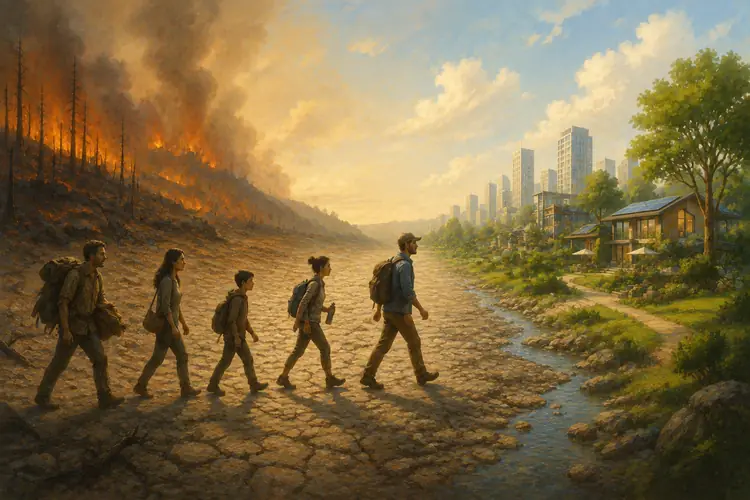
Talking about winners from global warming feels uncomfortable.
Climate change is associated with floods, fires, droughts, heat waves, and enormous economic losses. Asking who might benefit can sound cynical.
But economics is rarely a story in which everyone moves in the same direction.
When oil prices rise, consumers lose while producers gain. When interest rates increase, borrowers suffer while some savers benefit.
Climate change works in a similar way. A warmer world will impose substantial costs. But those costs will not be distributed evenly. Neither will the opportunities.
Some regions may become less attractive. Others may gain relative value. Some industries will lose markets. Others will discover entirely new ones.
So there is an uncomfortable economic question hiding behind the climate debate:
Who might actually benefit?
Geography Is Becoming an Economic Asset
Geography has always shaped economic success. Natural harbors created trading cities. Fertile land created agricultural regions. Oil transformed deserts into strategic assets. Mild climates attracted people and investment.
Climate change adds another variable to this equation. Temperature.
It can affect agricultural productivity, energy demand, water availability, wildfire exposure, insurance costs, and even where people want to live.
Imagine two similar cities. One faces recurring fires, extreme heat, water shortages, and rapidly rising insurance premiums.
The other faces fewer of these problems. Even if both remain prosperous, their relative economic attractiveness can change.
Climate is becoming part of the balance sheet.
Canada Presents an Interesting Paradox
Few developed countries illustrate the complexity better than Canada.
Warming creates serious risks: wildfires, floods, infrastructure damage, changing ecosystems, and problems for northern infrastructure built on permafrost.
But Canada's geography may also create some relative advantages. Longer growing seasons could benefit agriculture in certain regions. Some agricultural activity may gradually shift northward. Heating demand could decline, although cooling demand would rise. Changing Arctic conditions could affect transportation and resource development. And some Canadian cities could become relatively more attractive compared with hotter or more water-stressed parts of North America.
That does not mean Canada simply "wins" from global warming. Its losses could be enormous. But economics is about relative changes. If the cost of living and doing business rises sharply in one place and less sharply in another, the second place has gained a competitive advantage.
Sometimes winning simply means losing less.
America May Reprice Its Own Map
The United States is particularly interesting because its geography is so diverse.
Florida combines valuable coastal property with hurricane and flood exposure. The Southwest combines rapid population growth with extreme heat and water constraints. California combines extraordinary economic productivity with wildfire and water risks.
Meanwhile, parts of the Midwest, Northeast, and northern states face different climate profiles. For decades, Americans have moved toward warmer regions. Air conditioning helped make that possible. But the calculation changes if homeowners must add expensive insurance, higher cooling bills, water constraints, or repeated disaster risks to the cost of sunshine.
People rarely migrate because a climate model tells them to. They move when the economics of daily life changes. Climate migration may therefore begin quietly: a family simply decides that its next house should be somewhere else.
Real Estate May Notice First
Property markets are especially sensitive because they convert expectations about the future into prices today.
Imagine two $700,000 homes. One has affordable insurance, reliable water, manageable temperatures, and relatively low disaster exposure. The other faces increasingly expensive insurance and growing flood, fire, or heat risk. Even if both houses are perfectly safe today, should they still have the same value? Eventually, probably not.
Climate risk does not need to destroy a property to reduce its price. It only needs to change what buyers are willing to pay. Some of the largest climate-related transfers of wealth may therefore happen without a disaster.
Capital may simply begin moving from riskier property markets toward safer ones.
Agriculture Will Move Too
Farmers have always adapted to climate. They change crops, planting dates, seeds, irrigation systems, and farming methods.
A warmer climate could accelerate this process. Some regions may suffer lower yields because of extreme heat or water shortages. Others could gain longer growing seasons or become suitable for crops that previously struggled there.
But warmer does not automatically mean better. Agriculture also needs suitable soil, reliable water, transportation, machinery, labor, and access to markets.
You cannot simply move Iowa's agricultural economy hundreds of miles north and expect everything else to follow.
Climate may redraw the agricultural map.
Economics will determine whether anyone can farm that new map profitably.
There Is Money in Adaptation
Perhaps the clearest winners will not be countries at all.
They will be businesses. Hotter summers increase demand for air conditioning, heat pumps, insulation, and efficient building systems. Water scarcity increases the value of irrigation, recycling, monitoring, and water-management technologies. Wildfires create demand for detection systems, fire-resistant construction, forest management, and risk analysis. Flooding increases demand for drainage, barriers, pumps, engineering, forecasting, and resilient infrastructure. And insurers, banks, governments, and property owners will increasingly want better information about risk. Satellites, sensors, weather models, artificial intelligence, and property-level climate analysis could become valuable parts of a growing adaptation economy.
There is an irony here: the more expensive climate risk becomes, the more valuable the ability to manage it becomes.
Water and Electricity Become More Valuable
A warmer world also changes the economics of basic resources.
Cooling demand can surge during heat waves, placing additional pressure on electrical grids. That makes reliable generation, transmission, storage, and grid resilience more valuable.
Water may become equally important. Agriculture needs it. Cities need it. Semiconductor factories need it.
Many industrial facilities and power systems depend on reliable supplies. Companies choosing locations traditionally focus on taxes, labor, transportation, energy, and access to customers.
Increasingly, they may also ask: Is there enough water? Is electricity reliable? Can the property be insured? Can infrastructure survive extreme weather?
The winning geography of the future may not simply be where taxes are lowest. It may be where essential systems remain dependable.
Beware of the Word "Winner"
There is an important danger in this argument.
Finding beneficiaries from climate change does not mean the overall economic effect is positive. If a hurricane destroys $10 billion of property and generates $2 billion in additional business for construction companies, builders may benefit. Society has not.
Canada could gain agricultural opportunities in some areas while losing billions to fires and infrastructure damage elsewhere.
An air-conditioning company might enjoy record sales because millions of households are spending more simply to remain comfortable.
The existence of winners does not erase the losses. It tells us something else: economic shocks redistribute value.
And climate change may create one of the largest geographical redistributions of value in modern history.
The Great Repricing
Perhaps the best way to understand the economics of a warmer world is as the great repricing. Insurance risk is repriced. Coastal property is repriced. Water is repriced. Agricultural land is repriced. Electricity reliability is repriced. And eventually geography itself may be repriced.
Some places that once looked extraordinarily valuable may become less attractive because maintaining homes, businesses, and infrastructure there becomes increasingly expensive. Other regions may gain relative value.
Companies that reduce climate risk may build large new businesses. Families may gradually change where they live. Capital will follow.
This will not happen overnight. Markets usually redraw maps one mortgage, one insurance policy, one factory, one farm, and one investment decision at a time.
That may be the most important economic lesson of climate change. The world does not have to become uninhabitable for warming to transform the economy. It only has to change the relative price of living and doing business in different places. And once prices change, behavior follows.
So perhaps the great economic question of a warmer world is not only "How much will climate change cost?"
It is:
What becomes more valuable — and what becomes less valuable — when climate itself changes the price of geography?