
Who Really Moves Markets: Governments, Billionaires, or Crowds?
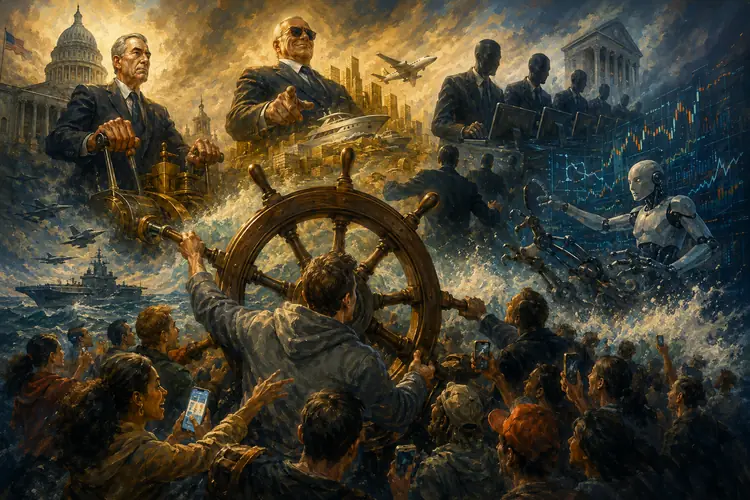
For centuries, people have searched for the hidden hand behind economic events. When markets rise unexpectedly, someone must be pulling the strings. When prices surge, someone must be benefiting. When crashes happen, someone must have seen them coming.
The idea is appealing because it simplifies an incredibly complicated world. If one group controls everything, then the economy becomes easier to understand.
Find the people in charge, and you've solved the mystery. But after examining conspiracy theories, financial scandals, and the business of attention, we arrive at a different question:
Who actually moves markets?
Governments? Billionaires? Banks? Algorithms? Or ordinary people?
The answer is both simpler and more unsettling than many would like.
The Government's Giant Hand
If you ask investors who moves markets, many will immediately point toward governments. And they have a good reason.
Governments influence taxes. They influence regulation. They influence spending. They influence trade policy.
And central banks influence perhaps the most important economic variable of all: the cost of money.
When the Federal Reserve changes interest rates, billions of dollars move around the world within minutes.
Mortgage rates change. Corporate borrowing costs change. Investment decisions change.
Entire industries can become more attractive—or less attractive—almost overnight.
That sounds like enormous power. Because it is.
Yet even governments face limits. Politicians cannot order people to spend money confidently. Central banks cannot force businesses to invest.
Governments can influence incentives. They cannot completely control outcomes.
History is full of examples where markets ignored political intentions.
The Billionaire Theory
Many people believe markets are controlled by a small group of wealthy individuals.
This theory is understandable. The wealthiest investors possess resources that ordinary citizens can barely imagine. A billionaire can move more money before breakfast than most people will earn in a lifetime.
Large investment funds manage trillions of dollars. Major corporate leaders influence entire industries. When famous investors speak, financial news channels listen. When they buy, markets notice. When they sell, markets react.
Influence is real. But control is another matter entirely.
If billionaires truly controlled markets, financial history would look very different.
They would never lose money. They would never make mistakes. They would never disagree with one another.
Reality shows the opposite. Even the world's most successful investors frequently make bad decisions.
Markets have a remarkable ability to humble powerful people. Money creates influence. It does not create omnipotence.
The Institutions Nobody Sees
Perhaps the most underestimated force in modern markets is not governments or billionaires. It is institutions.
Pension funds. Insurance companies. Mutual funds. Index funds. University endowments. Sovereign wealth funds.
These organizations rarely appear in conspiracy theories. They are not exciting. They rarely make headlines.
Yet collectively they control enormous amounts of capital.
In many cases, they are not trying to beat the market. They are simply following rules.
Buying. Selling. Rebalancing. Managing risk.
Millions of tiny decisions made by thousands of institutions can move markets far more than any dramatic secret meeting.
The irony is that some of the largest forces in finance are also the least visible.
Then Came the Algorithms
For most of human history, markets were driven entirely by people.
Today, machines play a growing role.
Algorithmic trading systems now execute enormous volumes of transactions. Some buy based on momentum. Some react to news. Some follow mathematical models. Some simply exploit tiny price differences.
The important point is that many modern market movements occur faster than human beings can think.
An algorithm does not care about political ideology. It does not care about fairness. It does not care about conspiracy theories. It responds to signals.
And when thousands of algorithms react simultaneously, market movements can appear almost supernatural.
To an outside observer, it may look like somebody is secretly pulling the strings. In reality, nobody may be fully controlling the process.
Not even the people who built the algorithms.
The Most Powerful Force of All
Yet there is one force that repeatedly surprises governments, billionaires, institutions, and algorithms alike.
Crowds. Human beings. Ordinary people.
Economists often describe markets as rational. History repeatedly disagrees.
People become optimistic. People become fearful. People become greedy. People become enthusiastic.
And when large groups experience the same emotion at the same time, markets can move dramatically.
The dot-com bubble. The housing boom. Cryptocurrency manias. Meme stocks.
In each case, crowd psychology played a central role. The crowd is fascinating because it is both powerful and unpredictable. No single person controls it.
Yet once a collective mood forms, even powerful institutions may struggle to resist it.
Social Media Changed the Crowd
Crowds have always mattered.
But social media changed their speed.
A rumor that once took months to spread can now reach millions of people in minutes.
An opinion can become a movement overnight. A joke can become an investment thesis. A tweet can influence markets. A viral video can influence consumer behavior.
The crowd has not become smarter or less emotional. It has become faster.
And speed changes everything.
Market psychology that once unfolded over years can now unfold in days.
Sometimes hours. Occasionally minutes.
Why Markets Often Look Rigged
This brings us to an uncomfortable observation.
Markets often look manipulated even when nobody is fully controlling them.
Imagine the following:
Governments change incentives. Billionaires move capital. Institutions follow rules. Algorithms execute trades. Millions of people react emotionally. Social media accelerates everything.
The resulting market movement may appear coordinated. It may even look designed. Yet no single actor created it.
The complexity itself creates the illusion of control.
Humans naturally search for a mastermind.
Reality often provides only interaction.
The Problem With Looking for One Villain
One reason conspiracy theories remain attractive is that they offer a clear target.
A villain. A culprit. A hidden group.
But economic reality rarely works that way.
Markets are not chessboards. Nobody sits above them moving every piece.
Markets are closer to giant ecosystems. Millions of participants pursue different goals simultaneously. Sometimes their interests collide. Sometimes they align. Sometimes they create outcomes nobody intended.
The result can be frustrating.
Because uncertainty is harder to accept than control.
So Who Really Moves Markets?
Governments matter. Billionaires matter. Institutions matter. Algorithms matter. Crowds matter.
Each influences the system.
None completely controls it.
That may sound like an unsatisfying conclusion. Many readers would prefer a single answer. A single group. A single explanation.
But economics rarely offers such simplicity.
The market is not controlled by one force. It is shaped by countless forces interacting at the same time.
That complexity is not evidence of a conspiracy.
It is evidence that modern economies are among the most complicated systems ever created.