
Who Really Controls Oil: Markets, Maps, or OPEC?
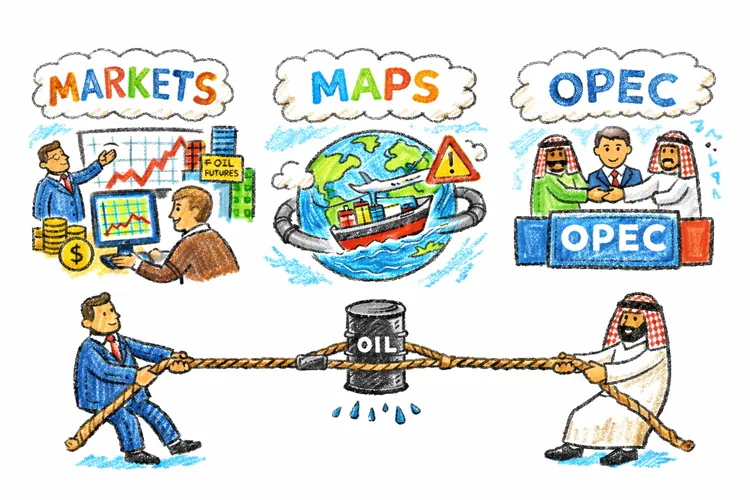
If oil were just another commodity, prices would be boring.
Supply meets demand. Buyers buy. Sellers sell. End of story.
But oil prices are anything but boring. They jump on rumors, twitch on headlines, and sometimes soar or crash without a single barrel physically disappearing.
That’s because oil is not controlled by one thing.
It lives at the intersection of markets, maps, and coordination. And none of them works alone.
Markets: The Story We Like to Tell
The clean version goes like this:
Oil prices are set by supply and demand.
This is not wrong.
It’s just radically incomplete.
Yes, traders buy and sell futures. Yes, prices move every second. Yes, expectations matter.
But markets don’t move oil.
They move claims on oil.
The physical barrels still have to come out of the ground and reach someone who can use them.
Which brings us to the part markets can’t abstract away.
Maps: The Part Markets Can’t Ignore
Oil is heavy. Liquid. Flammable. Inconvenient.
It does not teleport.
It flows through:
- pipelines that take years to build,
- ports that can handle only certain ships,
- narrow sea routes that have no realistic substitutes.
This is where maps quietly overpower markets.
A disruption in a single geographic bottleneck can:
- delay millions of barrels,
- force tankers to take longer routes,
- raise transportation costs without changing “supply” on paper.
Nothing fundamental has changed in spreadsheets.
Everything has changed on the map.
Markets react instantly.
Maps react slowly.
Prices reflect the tension between the two.
Then reality reminded everyone that oil still obeys geography.
In recent months, tensions around the Strait of Hormuz once again demonstrated how fragile the global oil system really is.
The Strait of Hormuz is not just another shipping route. It is one of the narrowest and most important energy chokepoints on Earth. A massive share of globally traded oil passes through it every single day, including exports from Saudi Arabia, Iraq, Kuwait, the UAE, and other Gulf producers.
And unlike financial markets, geography does not offer an easy “refresh button.”
When Iran threatened to restrict or disrupt traffic through the strait — and when shipping risks in the region suddenly rose — oil prices reacted immediately across the entire world.
Not because global oil reserves disappeared overnight.
Not because humanity suddenly ran out of crude.
But because markets understood something simple:
if the map becomes unstable, supply on paper stops feeling real.
A few naval incidents, military tensions, or insurance concerns around one narrow stretch of water were enough to push traders into panic mode.
Tankers suddenly looked vulnerable.
Shipping costs jumped.
Insurance premiums surged.
Delivery schedules became uncertain.
Nothing had physically “run out” yet.
But oil markets do not wait for an actual shortage.
They price fear before shortages happen.
This is exactly why geography still quietly dominates the oil system in ways many modern investors underestimate.
A trader in New York can buy oil futures in milliseconds.
An algorithm in London can react to headlines instantly.
A hedge fund can reposition billions of dollars before breakfast.
But none of them can move the Strait of Hormuz.
And that is the uncomfortable truth beneath modern energy markets:
for all our digital sophistication, global oil still depends on a few physical corridors that cannot be replaced quickly.
The world likes to imagine oil as a global fluid market where barrels naturally flow wherever prices are highest.
Reality looks more like a giant logistical maze built around vulnerable bottlenecks.
And when one country sitting on one narrow passage decides to challenge that system, oil stops behaving like a normal commodity.
Suddenly the map becomes more powerful than the market.
Which, ironically, is exactly what this chapter has been trying to say all along.
OPEC: Not a Cartel, Not a Company — A Coordination Machine
Now enter the most misunderstood actor in the oil world: OPEC.
OPEC is often described as:
- a cartel,
- a price-setter,
- or a villain with a phone call away from higher gas prices.
Reality is less cinematic—and more interesting.
OPEC doesn’t “control” oil the way a company controls production. It coordinates intentions among countries whose interests often diverge.
Its real power comes from two things:
- Concentration — a large share of global production sits within a relatively small group of countries.
- Signaling — when these countries speak together, markets listen.
Even more important today is the broader OPEC+ framework, which extends coordination beyond OPEC itself.
This is not command-and-control.
It’s managed uncertainty.
And it works not because everyone always complies—but because markets believe coordination mostly holds.
Who Wins the Tug of War?
So who really controls oil?
- Markets set prices fast, but trade abstractions.
- Maps constrain reality, but move slowly.
- OPEC/OPEC+ tries to smooth volatility through coordination, with mixed success.
None of them wins outright.
Oil prices emerge from the friction between:
- what traders expect,
- what geography allows,
- and what producers promise.
When all three align, markets feel calm.
When they don’t, prices swing—and explanations multiply.
The Second Big Takeaway
If oil prices feel irrational, it’s because you’re looking at only one layer.
Oil is priced in markets, shaped by maps, and nudged by coordination.
Ignore any one of these, and the story stops making sense.
In the next post, we’ll dismantle another comfortable illusion:
Oil is not fuel. It’s a portfolio.
And once you see what a barrel actually becomes, a lot of “energy transition” debates start sounding very different.