
Who Builds the Robots — and Who Controls the Robot Economy?
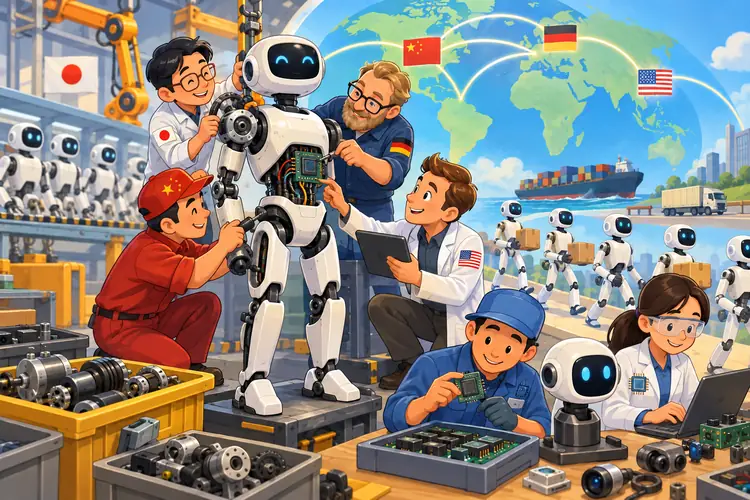
Ask who builds cars, and the answer seems easy. Toyota builds Toyotas. Ford builds Fords.
Ask who builds a robot, and things get complicated.
The company whose name is printed on the machine may assemble it. But its motors, gears, sensors, chips and software may come from different suppliers — and its artificial intelligence from somewhere else entirely.
A modern robot is less like a single product and more like a small industrial ecosystem. Which raises a bigger question:
Who actually controls the robot economy?
A Robot Is a Supply Chain With Arms
The mechanical arm gets most of the attention.
Economically, however, it is only the visible part. A robot needs servo motors to move, precision reducers to control force, encoders to measure position, cameras and sensors to perceive its surroundings, and semiconductors to provide computing power. Then come software, integration and maintenance. And increasingly, AI.
This means several businesses are hiding inside what we casually call "the robotics industry."
One company builds the robot. Another supplies critical components. Another integrates it into a factory. Another may provide the intelligence determining what it can do.
Selling the finished machine does not necessarily mean capturing most of its economic value.
Japan Built an Early Lead
For decades, Japan has occupied a remarkable position in industrial robotics.
Companies such as FANUC, Yaskawa and Kawasaki became major suppliers to automotive, electronics and other manufacturers around the world.
Japan had almost ideal conditions for robotics: advanced manufacturing, relatively high labor costs, strong engineering capabilities and an aging population. It also developed expertise in precision components. That matters because robots require extraordinary accuracy. A tiny error repeated through several moving joints can become a large error at the end of an arm.
The glamorous part of robotics may be the machine picking up a box. The valuable part may sometimes be the component hidden inside its elbow.
Germany Built Around the Factory
Germany developed another powerful robotics ecosystem around something it already understood exceptionally well: industrial machinery. Companies such as KUKA became closely connected with automobile manufacturing and factory automation.
This illustrates an important feature of the robot economy. Robots rarely arrive alone. They become part of systems containing conveyors, machine tools, cameras, safety equipment and software. Making all those pieces work together can be as important as manufacturing the robot itself. A brilliant machine that cannot communicate with the production line is not very useful.
In robotics, integration is part of the product.
Then China Changed the Scale
And then there is China.
In 2024, China installed roughly 295,000 industrial robots — 54% of all new installations worldwide. More than two million industrial robots were already operating in Chinese factories.
But another number may be even more important. Chinese manufacturers supplied 57% of robots sold in their domestic market in 2024, up dramatically from their share a decade earlier.
China is therefore doing two things simultaneously. It is the world's largest user of industrial robots. And it is increasingly building those robots itself.
That creates a powerful feedback loop. Huge domestic demand gives manufacturers scale. Scale can lower costs. Lower prices make robots economical for more businesses. More applications create more demand.
Robotics then becomes not merely a tool for automating Chinese manufacturing.
It becomes another Chinese manufacturing industry.
America Has a Different Strength
The United States presents almost the opposite picture.
Nearly 394,000 industrial robots were operating in U.S. factories in 2024, but much of America's traditional robot hardware is imported, particularly from Japan and Europe.
Does that mean America is losing the robot economy? Not necessarily.
The next generation of robotics may depend increasingly on software, semiconductors and artificial intelligence — areas where American companies have substantial strengths.
Tesla is developing Optimus. Figure is pursuing general-purpose humanoids. Boston Dynamics continues developing advanced mobile robots. American technology companies are also central to AI computing.
That creates an interesting division. Japan became powerful in robotics through hardware. China is building enormous strength through manufacturing scale. The United States may try to capture more value through intelligence.
The New Robot Has a Brain
This could reshape the competitive map. Traditional industrial robots repeat predefined movements.
The emerging ambition is different. A robot should see an unfamiliar object, understand an instruction, decide what to do and adapt when something changes.
If that becomes reliable, software will represent a much larger share of the machine's value. Think about smartphones. The physical device matters enormously. But much of the economic power surrounding smartphones comes from chips, operating systems, applications and cloud services.
Robotics may evolve in a similar direction. One company could build the body. Another could supply the chips. Another could provide the AI model. Another might operate a platform through which thousands of robots learn.
The most valuable robotics company of the future may not necessarily manufacture robots.
The Hidden Battle Is Over Standards
There is another layer of control that receives less attention: standards and platforms.
Imagine factories filled with robots from different manufacturers, but many of them using the same software platform, AI models or development tools.
Whoever controls that layer could become extremely influential.
We have seen versions of this before. Microsoft built enormous power around the operating system. Google created Android. Apple combined hardware, software and services into one ecosystem. Robotics has not yet settled into an equivalent structure.
That makes today's competition especially interesting. Companies may not simply be competing to sell machines. They may be competing to define the operating system of physical work.
Who Wins When Robots Become Commodities?
Now imagine robots becoming much cheaper. That sounds wonderful for manufacturers. But history offers a warning.
As hardware matures, products often become standardized. Competition increases. Prices and margins fall. Economic value can migrate elsewhere — toward specialized components, software, AI, services or companies operating enormous fleets of machines. A $100,000 robot is sophisticated capital equipment. A $20,000 robot available from ten competing manufacturers begins to look more like a commodity.
If that happens, building robots could become less profitable precisely as using robots becomes more profitable. We may even see companies selling robot labor rather than robots: instead of buying a machine, a warehouse could pay for 10,000 hours of automated work.
Then the business starts to look less like manufacturing equipment and more like hiring labor.
The Real Robot Race
So who controls the robot economy?
Today, there is no single answer. Japan remains important in industrial robots and precision engineering. Europe retains major strengths in machinery and factory automation. China combines extraordinary manufacturing scale with the world's largest domestic robot market. The United States has major strengths in AI, computing and a new generation of robotics companies.
But the most important competition may eventually be less between countries than between layers of the robot economy.
Hardware. Components. Chips. Software. AI. Integration. And perhaps, eventually, robot labor itself.
The company that builds the robot may put its name on the machine. But history suggests that the greatest fortunes are not always made by the company that builds the box.
Sometimes they are made by whoever controls what makes the box useful.
And as robots become more intelligent, that distinction may become the most important part of the robot economy.
Advertisement
728 x 90