
Which World Cup 2026 Host Cities Will Win — and Which Won’t?
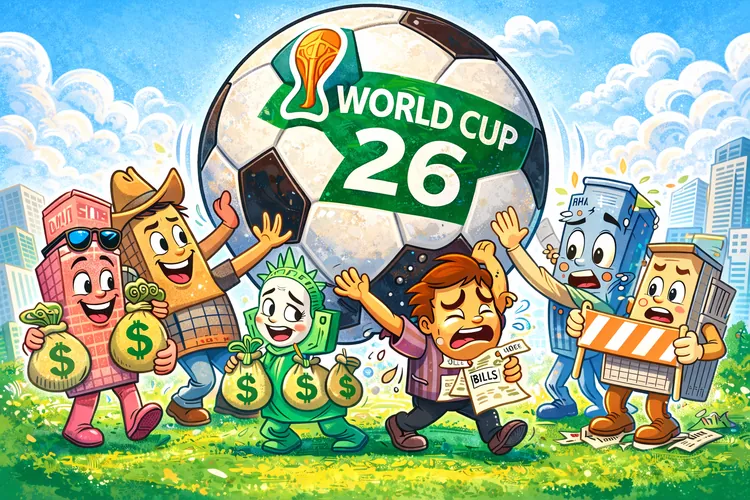
Mega-events don’t “boost the economy” evenly.
They shift spending, concentrate attention, and create winners and losers — often within the same city.
The map: one tournament, many economies
The 2026 FIFA World Cup is spread across 16 host cities in three countries.
United States (11):
Atlanta, Boston, Dallas, Houston, Kansas City, Los Angeles, Miami, New York/New Jersey, Philadelphia, San Francisco Bay Area, Seattle.
Canada (2):
Toronto, Vancouver.
Mexico (3):
Guadalajara, Mexico City, Monterrey.
The two big levers: matches and “moment”
Not all games are equal.
A group-stage match brings visitors.
A knockout match changes everything:
- more urgency,
- longer stays,
- higher spending,
- stronger media focus.
Two key signals:
- The Final → New York/New Jersey (MetLife Stadium)
- Most matches → Dallas (9 games)
This doesn’t guarantee profits — but it concentrates the biggest spending spikes.
The likely “big winners”
Cities built for tourism + scale:
- New York/New Jersey → Final + global attention
- Los Angeles → global brand + event machine
- Miami → high-spend visitors
- Dallas + Houston → scale + logistics
- Toronto + Vancouver → strong demand + limited substitutes
These cities are positioned to capture premium spending.
The “steady winners”
Strong metros with solid execution:
- Atlanta, Philadelphia, Seattle, San Francisco Bay Area
- Kansas City (smaller, but concentrated event footprint)
They may not dominate headlines — but can generate consistent local gains.
Mexico’s cities: high upside, different risks
Mexico City, Guadalajara, Monterrey:
Upside:
- tourism inflows,
- international visibility,
- domestic spending concentration.
Risks:
- security costs,
- infrastructure pressure,
- public service load.
The uncomfortable truth
Some cities may host — but not truly “win”.
Why?
- rising security and operating costs,
- crowding-out of regular tourists,
- restricted access for local businesses,
- limited spillover beyond stadium zones.
A city can run a great tournament…
and still see weak net benefits.
Who actually captures the upside?
Winners are usually:
- hotels and short-term rentals,
- restaurants and nightlife,
- airlines and transport,
- stadium-area vendors,
- sponsors.
Costs often sit with:
- city budgets,
- public agencies,
- small local businesses.
The World Cup doesn’t just create value.
It redistributes it.
A simple way to read the map
- Win big → global cities + late-stage matches (NY/NJ, LA, Miami, Dallas)
- Win steadily → strong metros with good execution
- At risk → cities where costs grow faster than visitor spending
Final thought
The World Cup is not one economic story.
It’s 16 different ones.
Same tournament.
Different outcomes.