
When Robots Got a Brain: AI Changes the Economics of Machines
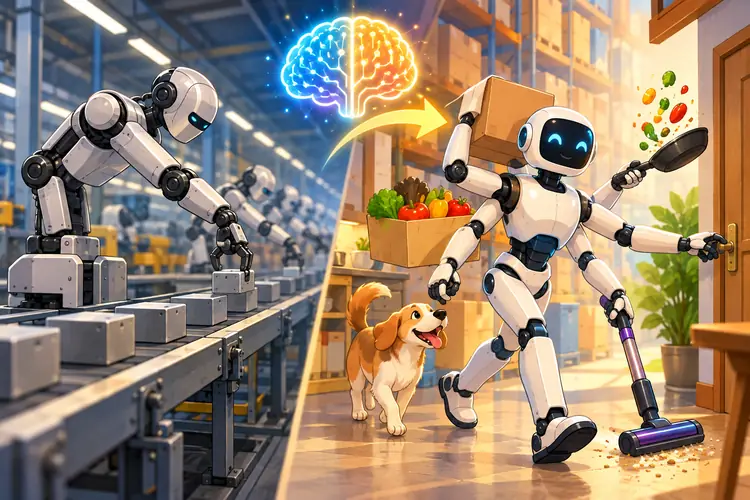
Imagine hiring a worker who can perform one task perfectly, thousands of times a day, without getting tired.
Sounds wonderful.
Now imagine that every time you move a table, change a product, or ask for something slightly different, you need an engineer to reprogram that worker.
Suddenly, the bargain looks less attractive.
For decades, that was the strange economics of industrial robotics.
Robots were extraordinarily good at repeating movements. They could weld, paint, lift, assemble and package products with remarkable precision.
But they had one serious weakness. They didn't really understand what they were doing.
Artificial intelligence is beginning to change that. And the consequences may be much bigger than making robots smarter.
AI could change what makes a robot economically valuable.
The Robot That Couldn't Handle Surprises
Traditional industrial robots thrive in predictable environments.
A component arrives at a specific location. The robot moves its arm along a programmed path, performs an operation and returns to its starting position. Repeat ten thousand times.
This works beautifully in automobile factories. But change the component's position, and the machine may fail.
A human worker would simply adjust. That difference explains why robots conquered some industries while barely entering others.
Factories could justify expensive automation because tasks were repetitive and environments carefully controlled.
Warehouses, farms, construction sites and homes were more difficult. The real world refuses to stay organized.
For traditional robotics, unpredictability was expensive.
Intelligence Changes the Equation
AI offers a different approach.
Computer vision allows robots to recognize objects and interpret their surroundings. Machine learning helps them improve performance using data. Modern AI models can connect visual information, language instructions and physical actions.
Instead of programming every movement, engineers increasingly aim to teach robots how to accomplish goals.
Consider a warehouse. An older robot might need detailed instructions for handling each type of package.
An AI-powered robot could potentially recognize unfamiliar packages, decide how to grasp them and place them in the correct location.
The distinction sounds technical. Economically, it is enormous.
Every hour spent programming a machine costs money. Every production change requiring new engineering reduces flexibility.
If AI makes robots easier to adapt, automation becomes attractive for businesses that previously couldn't justify it.
The robot's hardware might remain exactly the same.
Its economic value could increase dramatically.
The Hidden Cost of Teaching a Machine
There is an important detail often missing from futuristic robot demonstrations.
Teaching a machine is expensive.
Robots need data describing how objects move, how tools work and what happens when actions fail. Collecting that information in the physical world is difficult.
A language model can learn from enormous collections of text.
A robot must learn about gravity, friction, balance, collisions and countless variations in real objects. And mistakes can be costly.
A chatbot producing a wrong answer is annoying. A warehouse robot dropping a heavy package can be dangerous.
This is why researchers increasingly use simulation, reinforcement learning and demonstrations by human operators.
A robot can practice movements in virtual environments before attempting them in reality.
But simulated success does not guarantee real-world reliability.
The physical world remains an unforgiving teacher.
From Specialized Machines to General-Purpose Workers
The traditional robot economy was built around specialization.
A welding robot welded. A painting robot painted. A palletizing robot stacked boxes.
Each machine justified its cost by performing a particular task repeatedly.
AI introduces a more ambitious possibility. What if one robot could perform several different jobs?
Imagine a machine that loads boxes in the morning, sorts products after lunch and prepares shipments in the evening.
The same hardware could serve multiple purposes. That changes the investment calculation. Instead of buying three specialized machines, a business might eventually deploy one adaptable system.
Of course, versatility comes with trade-offs. A general-purpose robot may remain slower or less efficient than a specialized machine.
But businesses don't always need maximum speed. Sometimes they need flexibility.
The economic breakthrough may not be a robot that performs one job perfectly, but one that performs ten jobs well enough.
The AI Companies Enter the Factory
This transformation is attracting companies that historically had little to do with industrial machinery.
NVIDIA is developing robotics simulation and AI platforms. Google DeepMind is researching models that connect vision, language and action. Robotics companies such as Figure, Boston Dynamics and others are exploring increasingly intelligent machines.
The competition is no longer simply about motors, joints and mechanical precision. It is also about software, computing power, training data and AI models.
That could change who captures the profits. The company manufacturing the robot's body may not control the intelligence operating it.
A future robotics industry could resemble the smartphone industry, where hardware, operating systems, chips and software ecosystems compete for economic value.
The question becomes interesting:
Will the most powerful robotics company build robots — or build the intelligence that runs them?
The Economics of Learning
Imagine two factories buying identical robots.
The first robot can perform five tasks.
The second starts with the same five tasks but gradually learns additional ones through software updates and shared training data.
After several years, the machines may have very different economic values. The first remains essentially the product originally purchased. The second may become more capable without replacing its mechanical body.
That introduces something unusual into industrial equipment. Traditionally, machines depreciate as they wear out and newer models appear.
AI-powered machines could potentially improve through software even while their hardware ages.
But this creates another business question.
Who owns the improvements? The factory that purchased the robot? The manufacturer? Or the AI company providing its intelligence?
A robot might become more productive over time while also becoming more dependent on subscriptions, cloud services and proprietary software.
Smarter machines could mean new efficiencies.
They could also mean new forms of dependence.
Intelligence Isn't Free
There is a temptation to assume that adding AI automatically makes robots cheaper.
It doesn't.
Advanced AI requires computing power, sensors, data, software development and continuous testing. Some systems may depend on expensive chips or cloud infrastructure.
There are also cybersecurity risks, unpredictable behavior and liability questions when machines make decisions around people.
A robot that understands instructions but occasionally makes dangerous mistakes is not commercially ready.
And an intelligent robot that requires constant human supervision may offer little financial advantage.
The relevant measure remains familiar:
Cost per useful hour of reliable work.
AI matters economically only when the additional productivity, flexibility or autonomy outweighs its costs.
Intelligence is valuable. But reliability still pays the bills.
When the Physical World Becomes Programmable
Software transformed industries because it could be copied, updated and distributed at relatively low marginal cost.
Physical work has always been different.
Moving a box requires energy. Building a house requires materials. Harvesting crops requires machines operating in unpredictable environments.
AI-powered robotics could begin connecting those two worlds.
A software improvement might eventually make thousands of deployed robots more capable at once.
A new skill could spread through a fleet without every machine being individually reprogrammed.
That possibility is economically powerful. It suggests that part of physical productivity could begin improving at something closer to the pace of software.
Not entirely, of course. Gravity still exists. Machines still break.
And a software update cannot magically give a weak robotic arm the strength to lift a car.
But intelligence could make existing hardware substantially more useful.
The Real AI Revolution May Have Hands
For years, artificial intelligence mostly lived on screens. It generated text, recognized images, recommended products and analyzed information.
Robotics gives AI a way to act in the physical world.
That doesn't mean intelligent robots will immediately replace human workers. The technical obstacles remain substantial, and specialized machines will continue to dominate many tasks.
But the direction is significant. The first industrial robots automated movements. AI-powered robots are beginning to automate decisions about movements.
And eventually, they may perform increasingly complex combinations of physical tasks.
That is where the economics becomes fascinating.
The most important achievement may not be a robot that thinks like a human.
It may be a robot that can understand enough of the world to work without an engineer constantly telling it what to do.
For decades, companies paid for robotic muscles. Now they are beginning to pay for robotic intelligence.
And the combination could make machines valuable in places where robots never made economic sense before.