
When Gold Ruled Money
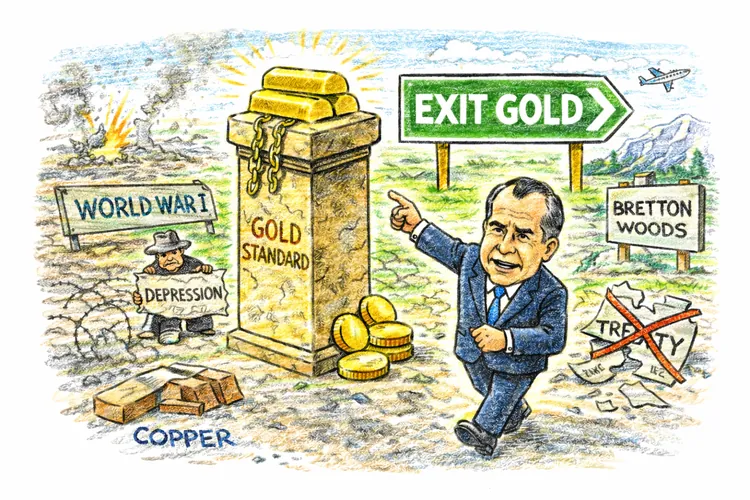
Gold didn’t just become money.
At some point, it became the system.
For roughly a century, the global economy ran on a simple promise:
Paper money could be trusted because it could be exchanged for gold.
That promise shaped trade, constrained governments, and imposed a kind of discipline that modern financial systems no longer recognize.
From Metal to Architecture
By the 19th century, gold had moved beyond coins and vaults. It became the reference point for national currencies.
Under the classical gold standard:
- currencies were defined by a fixed amount of gold
- exchange rates between countries were effectively fixed
- money supply growth was tightly linked to gold reserves
This wasn’t ideology.
It was coordination.
If everyone ties their currency to the same metal, trade becomes simpler, capital flows more freely, and trust scales globally.
Why the Gold Standard Worked
For a long time, it worked remarkably well.
Between the late 1800s and World War I:
- international trade expanded rapidly
- inflation stayed low over long periods
- exchange rate volatility was minimal by modern standards
The system imposed automatic discipline:
- governments couldn’t print money freely
- large deficits required real adjustments
- balance-of-payments problems forced painful but clear responses
In market terms, gold acted as a hard constraint.
The Hidden Cost of Discipline
But discipline has a price.
The gold standard was rigid in a world that was becoming:
- more industrial
- more interconnected
- more politically unstable
When economies slowed, governments couldn’t easily respond.
When banks failed, liquidity was scarce.
When demand collapsed, deflation followed.
Prices and wages had to adjust downward instead.
That adjustment was slow, painful, and politically toxic.
War Changed Everything
World War I exposed the system’s limits.
Wars are expensive.
Gold standards are restrictive.
Governments suspended convertibility, printed money, and borrowed heavily.
After the war, attempts to return to gold were fragile and uneven.
Then came the Great Depression.
In the early 1930s, countries that abandoned gold earlier recovered faster.
Those that clung to it longer suffered deeper contractions.
The market verdict was clear:
The system worked—until it mattered most.
Gold as a Straitjacket
By the mid-20th century, the problem was no longer philosophical. It was practical.
Gold constrained:
- monetary flexibility
- crisis response
- and the ability to stabilize modern economies
As global output grew, gold supply simply couldn’t keep up.
The world had outgrown its monetary anchor.
The Second Big Takeaway
The gold standard didn’t fail because it was irrational.
It failed because it was too rational for a world that had become politically and economically complex.
Gold brought stability—but at the cost of flexibility.
And when stability collided with survival, flexibility won.
In the next post, we’ll look at how and why the world finally walked away from gold—and what replaced it instead.