
What Replaces Oil as the World’s Key Price Signal?
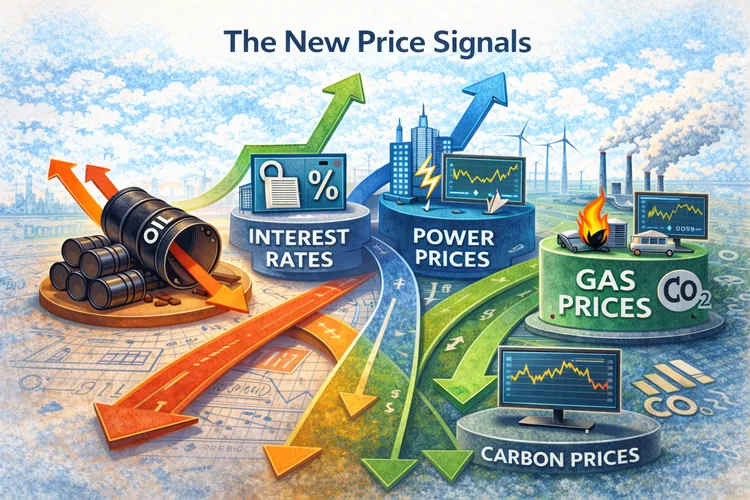
For much of the modern economic era, oil played a unique role.
It wasn’t just a commodity.
It was a global price signal.
When oil prices rose, the world expected:
- higher inflation,
- slower growth,
- geopolitical stress.
When oil prices fell, the opposite followed:
- relief for consumers,
- lower costs for industry,
- looser financial conditions.
Few other prices carried so much information in a single number.
But today that role is no longer guaranteed.
What is a “price signal,” really?
A key price signal does three things at once:
- It affects many sectors simultaneously
- It moves quickly and visibly
- It reflects underlying global constraints
Oil checked all three boxes for decades.
Energy sits at the base of almost everything:
transport, manufacturing, food, logistics, geopolitics.
So one price — a barrel of oil — became shorthand for the state of the world economy.
Why oil’s signaling power is weakening
Oil still matters.
But it no longer dominates in the same way.
Several changes have diluted its role:
- economies are less oil-intensive than before,
- energy mixes are more diversified,
- price shocks are increasingly offset by policy,
- and markets react to more variables at once.
In short: oil is still important — but it is no longer alone.
The contenders for the new global signal
If oil is losing its monopoly, what replaces it?
The answer may not be one price, but several.
1️⃣ Interest rates (and the cost of money)
In recent years, global attention has shifted sharply toward:
- central bank rates,
- bond yields,
- financial conditions.
A small change in rates now affects:
- housing,
- equities,
- currencies,
- government budgets.
In many ways, the price of money has become as influential as the price of energy.
But rates reflect policy decisions as much as fundamentals — which limits their purity as a signal.
2️⃣ Electricity prices
As economies electrify, electricity is moving closer to the center.
Power prices increasingly influence:
- industrial competitiveness,
- data centers,
- transport (via EVs),
- and household costs.
Unlike oil, electricity prices are:
- more local,
- more fragmented,
- and shaped by regulation.
That makes them powerful — but not fully global.
3️⃣ Natural gas and regional energy hubs
Gas has become a critical regional signal:
- Europe watches gas closely,
- Asia watches LNG prices,
- the U.S. focuses on domestic supply.
Gas now transmits stress and scarcity — but in regional waves, not globally unified ones.
4️⃣ Carbon prices and climate constraints
In some parts of the world, carbon pricing is emerging as a new constraint.
Carbon doesn’t just price emissions — it prices future restrictions.
But carbon markets are:
- policy-dependent,
- unevenly applied,
- and still evolving.
They signal direction more than immediate pressure.
So what replaces oil?
Probably not a single successor.
Instead of one dominant price, we are moving toward a signal system:
- energy prices,
- interest rates,
- policy constraints,
- and technology costs interacting at once.
This makes the global economy:
- more complex,
- more fragmented,
- and harder to “read” at a glance.
There is no longer one number that tells the whole story.
Why this matters
When oil dominated, policymakers, investors, and businesses could orient quickly.
Today, decision-making requires:
- more interpretation,
- more scenario thinking,
- and more humility.
The loss of a single, universal signal doesn’t make the world safer or riskier by itself.
It makes it less simple.
The cautious conclusion
Oil is not disappearing.
But its role as the world’s primary economic thermometer is fading.
What replaces it is not a new king — but a crowded dashboard.
And in that world, the biggest risk may not be wrong predictions —
but the belief that there is still one price that explains everything.