
What Happens When You Give People Money for Nothing?
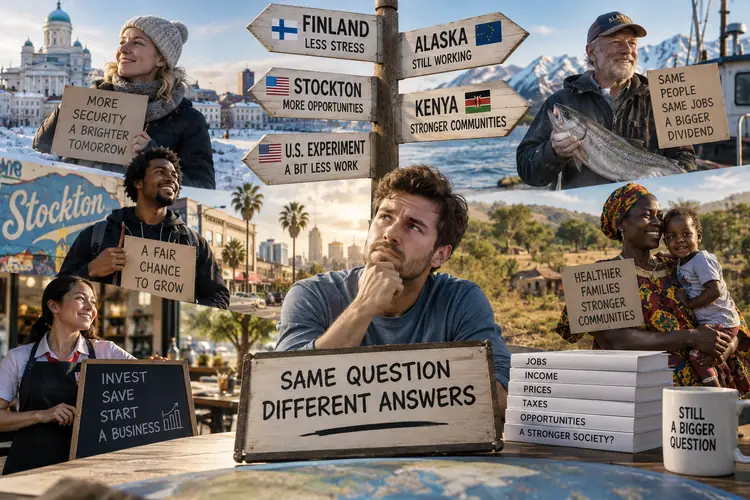
There is a wonderfully simple way to test an economic theory. Stop arguing about it. Try it.
For decades, economists, politicians, and ordinary taxpayers have debated what would happen if people received money without having to work for it.
Would they quit their jobs? Start businesses? Spend everything? Save it? Become happier? Or simply become very comfortable watching Netflix on Tuesday afternoons?
Fortunately, we no longer have to rely entirely on imagination. Governments and researchers have already tried versions of unconditional cash payments in Finland, the United States, Kenya, and elsewhere.
And the results are fascinating. Mostly because they refuse to fit neatly into either side of the debate.
First, a Small Warning
Before declaring that "UBI has been tested," we should clarify something.
Most experiments are not actually universal basic income. Finland gave money to 2,000 unemployed people. Stockton, California, gave $500 per month to 125 residents from lower- and middle-income neighborhoods. A major U.S. experiment run by OpenResearch gave 1,000 lower-income participants $1,000 per month for three years. Alaska distributes an annual dividend to residents from its Permanent Fund. Kenya comes closer to a genuine UBI experiment: GiveDirectly has been studying entire villages, with some participants receiving monthly payments guaranteed for 12 years.
These programs are very different. But together they allow us to test one of the oldest assumptions about human behavior:
If you give people money for nothing, will they stop doing something?
Usually, that "something" means work.
Experiment #1: Will People Stop Working?
Let's start with Finland.
From 2017 to 2018, 2,000 unemployed Finns received €560 per month, unconditionally. They could find a job and continue receiving the money.
The result? Not much happened to employment. During the first year, the basic-income group was no more likely to find work than the control group. Across the experiment, employment effects remained small, although interpreting the second year became more complicated because Finland changed some unemployment rules.
But something else happened. Recipients reported greater life satisfaction, less mental strain, and greater feelings of economic security.
So Finland produced an awkward result for both camps. UBI supporters couldn't claim that free money suddenly pushed thousands of people into jobs. UBI critics couldn't claim that everyone stopped working either. People mostly continued living their lives.
They just seemed somewhat less worried about them.
America Tried $1,000 a Month
Then came a much larger U.S. experiment. OpenResearch recruited thousands of lower-income Americans. One thousand participants received $1,000 every month for three years.
A control group of 2,000 received $50. Now we can ask the dangerous question again:
Did people work less?
Yes. A little. Recipients worked about 1.3 fewer hours per week and were about 2 percentage points less likely to be employed than people in the control group.
That finding matters because it destroys two convenient stories at once. The first story says: "Give people free money and nobody will work." That clearly didn't happen. The second says: "Cash has absolutely no effect on people's willingness to work." That didn't happen either.
People responded to incentives. Of course they did. But perhaps the more interesting question is what they did with the extra freedom. Some could afford to be more selective about jobs. Others reduced their working hours. For some households, cash effectively bought something that rarely appears in economic statistics: time.
And time has a price too.
Sometimes Cash Can Even Help People Work
Stockton produced an apparently different result. Beginning in 2019, 125 people received $500 per month for two years, with no work requirement. After the first year, full-time employment among recipients had risen from 28% to 40%. In the control group, it rose from 32% to 37%.
Researchers reported that the extra financial stability helped some participants take risks necessary to pursue better jobs.
At first glance, this seems to contradict the OpenResearch experiment. But it probably tells us something more useful.
Money changes choices differently for different people.
Give $500 to someone who cannot afford transportation to an interview, and the money may help them get a job. Give it to someone working 60 hours a week, and they may buy themselves a few hours at home. Give it to someone considering training, and they may temporarily work less.
Economists like averages. Human beings insist on being individuals.
Alaska Offers Another Clue
Then there is Alaska. Since 1982, residents have received annual dividends financed by investment earnings from the state's oil-funded Permanent Fund. It isn't enough to live on, so it isn't a full UBI. But it has two important characteristics. It is broad. And it has existed for decades. Researchers studying its labor-market effects found no significant reduction in overall employment, although part-time work increased.
One explanation is especially interesting: people receiving money also spend money, creating additional demand for local businesses. The waiter receives a dividend. Then spends some of it at a store. The store owner receives more revenue. The store hires someone.
Money doesn't simply arrive. It moves. That makes the economics considerably more complicated than "free money makes people lazy."
Then Kenya Changed the Question
Perhaps the most ambitious experiment is happening in rural Kenya. GiveDirectly launched a study covering roughly 200 villages and thousands of people. Some participants receive a small monthly basic income guaranteed for 12 years. Others received payments for two years or a comparable lump sum.
Early results are particularly interesting. People receiving long-term basic income did not simply sit down and stop producing. They invested. They saved. They shifted toward self-employment. Household income increased. Researchers found no decline in total household labor supply.
But another result may be even more important. People behaved differently when they knew the money would continue arriving for years. That makes sense. If I give you $100 today, you may buy groceries. If I promise you $100 every month for the next decade, you may start thinking about a business.
The amount matters. But predictability may matter almost as much.
So Did People Waste the Money?
This is another popular fear. Give people unrestricted cash and surely some will spend it irresponsibly. Some undoubtedly do. Humans have been wasting their own salaries for thousands of years.
But the broader evidence doesn't look much like the stereotype. In the U.S. OpenResearch experiment, recipients increased household spending by at least several hundred dollars per month, particularly on basics such as housing, food, and transportation.
In Kenya, cash transfers have been associated with higher consumption, savings, business activity, and investment. The long-running UBI study also found no evidence that recipients simply responded by working less.
Apparently, when poor people receive money, they often do something surprisingly conventional with it.
They use it to make their lives less poor.
Then Why Not Give Everyone Money?
And here we reach the trap. Small experiments can tell us a great deal about people. They tell us much less about an entire economy.
Imagine giving $1,000 per month to 1,000 Americans. Their landlords don't suddenly assume that every tenant in America has another $1,000. Employers don't redesign the national wage structure. Congress doesn't need trillions of dollars in new taxes. The Federal Reserve doesn't rethink monetary policy.
Now imagine giving that money to nearly every adult in the country.
Everything changes. Taxes change. Government spending changes. Wages may change. Prices may change. Some benefits disappear. Some workers become more selective. Some employers automate faster. Housing demand could rise without housing supply rising equally fast.
An experiment can ask: What happens when this person receives money?
A national UBI must answer a much larger question: What happens when everyone receives money — and everyone knows everyone else receives it too?
Those are not the same experiment.
The Experiment We Haven't Run
So what have we learned?
Probably more than either side would like. Giving people unconditional cash does not appear to cause a mass retreat from work. But money can reduce work somewhat in some settings.
People don't generally appear to waste the money. But cash alone cannot manufacture houses, doctors, schools, or productivity.
Financial security can reduce stress and give people more freedom. But freedom is not free.
Someone still has to finance the system. And perhaps that is the most important lesson from all these experiments. The interesting question is no longer:
"What happens if you give people money for nothing?"
We have tried that. People mostly behave like people. They buy food. Pay bills. Work. Work a little less. Look for better jobs. Start businesses. Save. Take risks. And occasionally make bad decisions — just as people with salaries do.
The real experiment hasn't happened yet. No large developed economy has permanently given every adult enough unconditional income to provide a meaningful economic floor. That experiment would test something much bigger than individual behavior. It would test wages, prices, taxes, work, bargaining power, automation, and ultimately our definition of what income is for.
Maybe the greatest mystery of UBI isn't what happens when people get free money.
It's what happens to capitalism when everyone knows the next check is coming.