
We Are Starting to Rewrite the Human Body
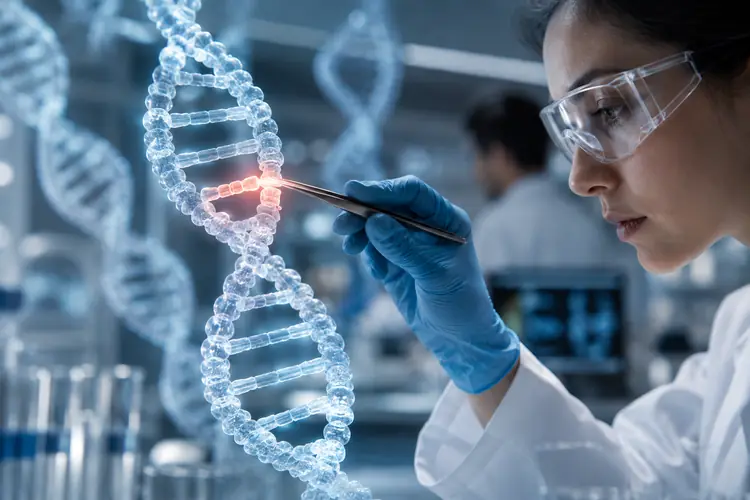
For most of medical history, doctors have worked with the body they were given.
A broken bone could be repaired. An infection could be killed. A failing heart could be supported. But the underlying biological machinery remained largely untouchable.
That is beginning to change.
Medicine is slowly acquiring something it never really had before: the ability to edit the instructions themselves.
And once that becomes possible, the line between medicine and engineering starts to disappear.
A Medicine Designed for One Child
In 2025, an infant was born with a rare genetic disorder called CPS1 deficiency.
A tiny error in his DNA prevented his liver from properly processing nitrogen. In severe cases, the disease has an estimated mortality of around 50% in early infancy.
There was no conventional drug capable of fixing the underlying problem.
So researchers built one.
They identified the child's mutation, designed a customized base-editing therapy to correct it, tested the treatment and received regulatory authorization. The baby received his first infusion at about seven months old.
After treatment, he tolerated more dietary protein and needed less medication to remove nitrogen from his body. No serious adverse events were reported during the initial observation period, although the researchers stressed that much longer follow-up is needed.
The remarkable part is not simply that gene editing worked.
It is that the medicine was designed for one patient.
For decades, pharmaceuticals followed an industrial model: develop one drug, manufacture millions of identical doses, sell them to millions of people.
Biotechnology is beginning to suggest the opposite model.
One patient. One mutation. One medicine.
That sounds less like pharmaceuticals and more like software development.
## CRISPR Has Already Left the Laboratory
The better-known example is sickle cell disease.
The disease is caused by a genetic mutation that produces abnormal hemoglobin. Red blood cells become distorted, blocking blood vessels and causing severe pain, organ damage and shortened lives.
In 2023, the FDA approved Casgevy, the first approved therapy using CRISPR/Cas9 genome editing.
Doctors collect a patient's blood-forming stem cells, edit them in the laboratory and return them after intensive conditioning treatment. The edit allows the body to produce high levels of fetal hemoglobin, reducing the sickling of red blood cells.
In the data supporting the original approval, 29 of 31 evaluable patients — 93.5% — went at least 12 consecutive months without a severe vaso-occlusive crisis.
And the technology is moving quickly. In July 2026, the FDA expanded Casgevy's approval to children as young as two with eligible sickle cell disease or transfusion-dependent beta-thalassemia.
This is an important conceptual shift.
Traditional medicine often manages a disease.
Gene editing tries to change the biological mechanism producing it.
Your Immune Cells Can Be Reprogrammed Too
DNA is not the only thing medicine is learning to engineer. Consider cancer.
Normally, immune cells patrol the body looking for threats. But cancer cells are unusually good at hiding from them.
CAR-T therapy takes some of a patient's T cells and genetically modifies them so they recognize specific targets on cancer cells. The engineered cells are then returned to the patient.
In effect, doctors take part of the immune system, reprogram it and put it back.
CAR-T therapies are now approved for several blood cancers, including certain leukemias, lymphomas and multiple myeloma. In late 2025, the FDA approved the first CAR-T treatment for marginal zone lymphoma.
This is not risk-free engineering. CAR-T can cause serious toxicities, and regulators have required warnings about secondary T-cell malignancies.
But the larger idea is extraordinary.
A cell is becoming something that can be modified, programmed and used as medicine.
Then Comes the Price
Now for the uncomfortable part.
Casgevy entered the U.S. market with a list price of about $2.2 million per patient.
Another gene therapy for sickle cell disease, Lyfgenia, was listed at $3.1 million. And those figures do not capture the entire treatment journey, which can involve months of specialized care, conditioning chemotherapy and hospitalization.
At first glance, this looks absurdly expensive. But there is another way to look at it.
A conventional drug may be relatively cheap because you keep buying it.
A gene therapy may cost millions because, in principle, one intervention can alter the course of a disease for years.
That changes the economics of medicine.
The question is no longer simply:
How much does the drug cost?
It becomes:
How much is decades of disease worth avoiding?
Governments are already being forced to answer that question. The U.S. Centers for Medicare & Medicaid Services has created a model in which participating Medicaid programs can receive discounts and outcomes-based rebates for sickle cell gene therapies.
In other words, part of the economics begins to depend on whether the therapy actually delivers the promised result.
Medicine starts to resemble a long-term financial contract.
From Mass Medicine to Biological Software
The next step may be even more important.
In 2026, the FDA published draft guidance specifically addressing individualized therapies for ultra-rare genetic diseases. The agency also proposed allowing developers of genome-editing therapies to reuse knowledge about established technological platforms rather than rebuilding the entire evidence package from zero for every new genetic target.
That matters because there are thousands of rare genetic diseases.
Developing a conventional billion-dollar drug for a few hundred patients often makes little economic sense.
But imagine a reusable editing platform. Keep much of the delivery system. Keep much of the manufacturing process. Change the genetic target.
The economics begin to resemble a platform rather than a traditional drug factory.
We are nowhere near downloading a DNA patch the way we install a software update. Biology is vastly more complicated, and mistakes can be irreversible.
But the direction is becoming visible.
The Strange New Question
Medicine spent centuries asking:
What drug can treat this disease?
Biotechnology is introducing a different question:
What part of the biological system should we rewrite?
Today, that may mean correcting a mutation, reprogramming an immune cell or modifying a patient's stem cells.
Tomorrow, it may mean repairing damaged tissues, replacing organs or intervening in some of the biological processes associated with aging.
The obstacle is no longer only scientific. It is economic.
We are beginning to discover how to rewrite parts of the human body.
Now we have to figure out what a rewrite is worth — and who gets to pay for it.