
Unemployment: The Human Side of the Economy
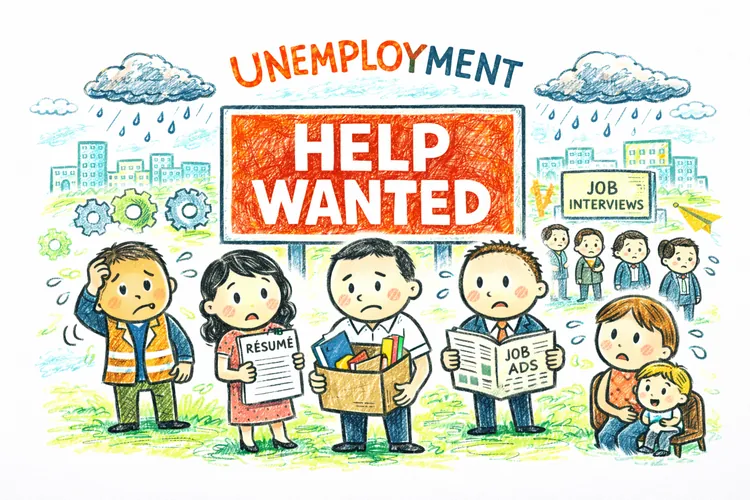
If GDP tells us how much the economy produces, and inflation tells us what prices are doing, unemployment tells us something even more important:
How many people can actually find work.
Behind every unemployment statistic is a human story — someone sending résumés, attending interviews, switching careers, or waiting for the economy to improve.
That is why economists often describe the unemployment rate as the most human economic indicator.
How Unemployment Is Measured
At first glance, measuring unemployment seems simple.
Just count the number of people without jobs.
But in practice, it is more complicated.
To be counted as unemployed, a person must:
- not currently have a job
- be available to work
- have actively searched for work recently
People who are not currently looking for work — such as students, retirees, or discouraged workers — are not included in the unemployment rate.
In the United States, unemployment statistics are produced by the Bureau of Labor Statistics.
In Canada, the data comes from Statistics Canada.
Each month, thousands of households are surveyed to estimate employment conditions across the economy.
What Is a “Normal” Level of Unemployment?
You might think the ideal unemployment rate is zero.
But economists know that some unemployment is unavoidable.
People constantly move between jobs.
They graduate from school, relocate, change careers, or leave positions voluntarily for better opportunities.
This natural turnover in the labor market is called frictional unemployment.
Because of this, economists usually consider 3–5% unemployment to be normal in healthy advanced economies like the United States and Canada.
What Happens During a Recession
During recessions, unemployment can rise rapidly.
When demand falls, companies sell fewer products and services.
Businesses cut costs.
And unfortunately, jobs are often the first thing reduced.
During the 2008–2009 financial crisis, unemployment in the United States rose to around 10%, with similar increases in Canada.
Millions of people suddenly found themselves searching for work at the same time.
Recovering from such spikes can take years.
When There Are Too Few Workers
Interestingly, very low unemployment can create challenges as well.
When businesses cannot find enough workers:
- wages rise quickly
- companies compete for employees
- production costs increase
Higher wages are good for workers.
But they can also contribute to inflation, as companies raise prices to cover higher labor costs.
In recent years, both the United States and Canada have experienced periods where employers complained more about labor shortages than unemployment.
The Labor Market as Musical Chairs
A helpful way to imagine the labor market is as a giant game of musical chairs.
Workers constantly move between chairs — jobs.
Some leave voluntarily.
Others are forced to move when industries shrink or companies restructure.
The goal of a healthy economy is not to freeze everyone in place.
It is to keep the game moving smoothly, with new chairs appearing as the economy grows.
When the music stops for too many people at once, unemployment rises.
Why This Number Matters
The unemployment rate tells economists a great deal about the health of the economy.
When unemployment is low:
- people earn more income
- consumer spending increases
- businesses invest more
When unemployment rises:
- household income falls
- spending slows
- economic growth weakens
That is why monthly unemployment reports often move financial markets and influence government policy.
They offer one of the clearest snapshots of how the economy affects people’s lives.