
The World Runs on Oil — But Not Where It’s Pumped
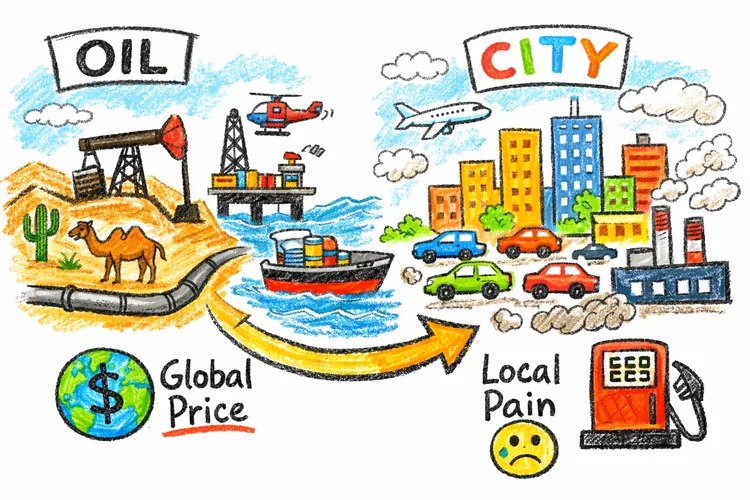
Oil feels omnipresent. It’s in your car, your flight, your groceries, your phone case, your Amazon box. It powers economies, shapes geopolitics, and regularly makes headlines.
And yet, here’s the first paradox of the oil market:
The places that pump oil are usually not the places that run on it.
This mismatch is where almost every misunderstanding about oil begins.
Oil Is Born in the Middle of Nowhere
Most oil is produced far from where most people live.
Deserts. Offshore platforms. Frozen plains. Remote basins that never make it into travel brochures.
This is not an accident. Oil is a geological lottery. It forms where ancient seas once existed, not where modern cities eventually grew.
As a result:
- Some countries sit on oceans of oil but have relatively small populations.
- Others are densely populated, energy-hungry—and sit on almost no oil at all.
The map of oil production looks nothing like the map of global population.
This geographic lottery leads to extreme concentration on the supply side.
Today, just a handful of countries account for a large share of global oil production. The United States is the single largest producer. Saudi Arabia and Russia follow close behind. Add Canada, and four countries alone account for roughly 40% of the world’s oil supply.
But production concentration doesn’t mean consumption concentration.
The world’s largest oil consumers are not deserts or offshore platforms. They are large, urban, industrial economies—led by the United States, China, and India.
The oil map splits cleanly in two: where oil comes from, and where it’s burned.
Consumption Happens Somewhere Else Entirely
Now flip the map.
Oil is consumed where:
- people drive a lot,
- goods are transported long distances,
- factories run around the clock,
- air travel is routine rather than exceptional.
In other words: large, urbanized, industrial economies.
The United States is a great illustration of the paradox. It is one of the world’s largest oil producers—and at the same time, one of its largest consumers.
This alone should already raise a question:
If a country produces “a lot” of oil, why does it still care so much about global oil prices?
The Myth of Energy Self-Sufficiency
Here’s the uncomfortable truth:
Oil markets don’t care about political borders.
Oil is priced globally, even when it’s produced locally.
Why?
Because a barrel of oil extracted in Texas is not competing only with another barrel in North Dakota. It’s competing with barrels from the Middle East, Latin America, Africa, and offshore fields halfway across the world.
Prices are set at the margin. And the margin is global.
So even if a country produces enough oil “on paper,” it still:
- exports certain types of crude,
- imports other types better suited to its refineries,
- and pays prices shaped by events thousands of miles away.
Energy independence sounds comforting. Oil markets are not.
Why Geography Still Wins
Oil is not just a commodity. It’s a physical object.
It has to be:
- extracted,
- gathered,
- transported,
- refined,
- distributed.
Every step depends on geography.
Most oil doesn’t move by accident—it moves by design.
Globally, the majority of internationally traded oil travels by tanker, crossing oceans along a surprisingly small number of major routes.
To understand how fragile this system is, consider this: roughly one-tenth of the world’s seaborne oil trade—millions of barrels every single day—passes through the Red Sea and the Suez Canal.
That’s not a curiosity. It’s a vulnerability.
Oil doesn’t just depend on where it’s produced—it depends on the narrow arteries that keep it moving. A handful of chokepoints quietly carry a disproportionate share of the world’s energy: the Strait of Hormuz, the Bab el-Mandeb Strait, the Suez Canal, and even the Panama Canal. These are not just lines on a map; they are pressure points of the global economy.
If one of them is disrupted—even temporarily—the system doesn’t break instantly, but it bends. Tankers reroute, journeys get longer, insurance costs spike, and supply arrives late. The result isn’t a shortage in the classical sense—it’s friction. And in oil markets, friction is enough to move prices everywhere.
In extreme cases, if multiple routes are compromised, the world doesn’t run out of oil—it runs out of efficiency. And that’s often more dangerous. Because modern economies don’t just need oil. They need it on time.
When something goes wrong along one of these routes, oil doesn’t vanish. It detours—slowly, expensively, and inefficiently. And that friction shows up in prices far from the disruption itself.
A city doesn’t need oil underneath it. It needs oil delivered to it, reliably and cheaply.
That delivery depends on:
- pipelines that may or may not exist,
- ports that may or may not handle tankers,
- routes that may or may not remain politically stable.
This is why a disruption in a narrow stretch of water, a distant pipeline, or a foreign port can suddenly show up as higher prices at your local gas station.
The oil didn’t disappear.
The path it needed became harder.
One Price, Many Realities
From the outside, oil looks deceptively simple.
You see a single number on the news:
Oil is up 3% today.
But behind that number are dozens of regional realities:
- oil that’s cheap but trapped,
- oil that’s abundant but far away,
- oil that’s perfectly priced but impossible to move fast enough.
The global oil market pretends everything is interchangeable.
Geography constantly reminds it that it’s not.
The First Big Takeaway
If you remember only one thing from this post, let it be this:
Oil is global by price, but local by pain.
It’s produced where people don’t live, consumed where people do, and priced as if distance didn’t matter—until it suddenly does.
In the next post, we’ll ask the obvious follow-up question:
If oil is so global, who actually controls it?
Markets? Maps? Or OPEC?
Advertisement
728 x 90