
The World Is Getting Older — And the Economy Feels It
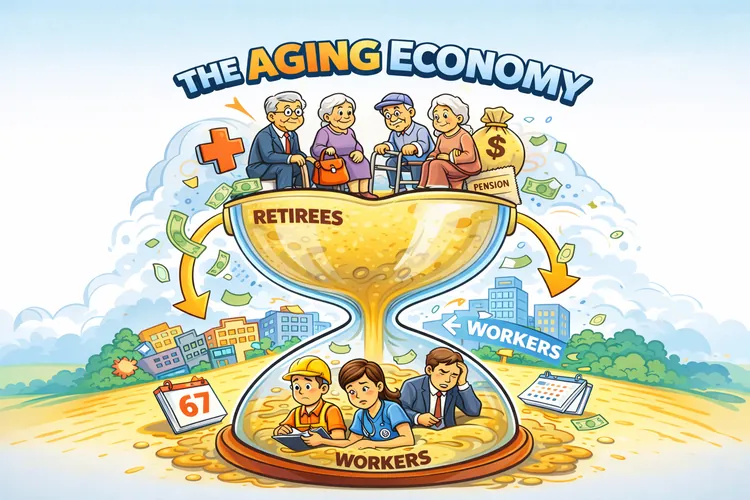
A century ago, living to 65 was an achievement.
Today, it’s normal.
In fact, in countries like the United States and Canada, life expectancy is around 77–82 years.
And for many people, retirement can last 20 years or more.
That’s good news.
But economically, it changes everything.
A World Turning Gray
Let’s start with a simple fact:
People are not just living longer — they are also having fewer children.
This creates a powerful combination:
- fewer young people entering the workforce
- more older people leaving it
In 1980, about 1 in 10 people in the U.S. was over 65.
Today, it’s closer to 1 in 6.
By 2050, it could be 1 in 5.
Canada is following a similar path.
The Dependency Shift
Economists use a term that sounds technical but is easy to understand:
Dependency ratio
It measures how many people are not working (mostly retirees) compared to those who are.
When that ratio rises, the pressure on the economy increases.
Why?
Because fewer workers must support more retirees.
Japan: A Glimpse of the Future
If you want to see where this trend leads, look at Japan.
- Nearly 30% of Japan’s population is over 65
- The total population has been declining for more than a decade
- The workforce shrinks every year
Japan’s economy hasn’t collapsed — but it has slowed.
Growth has been modest.
Labor shortages are common.
Entire industries struggle to find workers.
And yet, Japan has adapted.
The Cost of Living Longer
An aging population changes government budgets.
In the United States:
- Social Security and Medicare already make up a large share of federal spending
- By the 2030s, these programs are expected to grow significantly as more people retire
Healthcare costs rise with age.
Pension systems come under pressure.
Public debt often increases.
Canada faces similar dynamics, especially at the provincial level where healthcare is a major expense.
Where Did All the Workers Go?
Here’s the hidden issue:
When large generations retire (like the Baby Boomers), they don’t just stop working.
They take experience, skills, and productivity with them.
Meanwhile, smaller younger generations replace them.
That creates:
- labor shortages
- upward pressure on wages
- slower business expansion
In some sectors — healthcare, construction, transportation — this is already visible.
Can Technology Fill the Gap?
One response is automation.
If there are fewer workers, machines can help.
Japan is a leader here:
- robots in factories
- automation in logistics
- even robots assisting the elderly
But technology has limits.
Not every job can be automated.
And many services — especially healthcare — still rely heavily on people.
Working Longer
Another response is simple:
Work longer.
Many countries are gradually increasing retirement ages.
In the U.S., full retirement age is moving toward 67.
In Canada, similar pressures exist, even if policy changes are slower.
And culturally, something is shifting:
Retirement is no longer always a full stop.
It’s often a transition.
The Big Trade-Off
Here’s the core economic tension:
People want to live longer, healthier lives — and they are.
But longer lives mean:
- more years consuming resources
- fewer years producing them
Unless something offsets that balance.
A Thought to Leave With
If societies are aging…
And workforces are shrinking…
Then the question isn’t just how to grow the economy.
It becomes:
How do you sustain it?