
The World Cup Comes to America: How Much Will It Cost - and Who Will Profit?
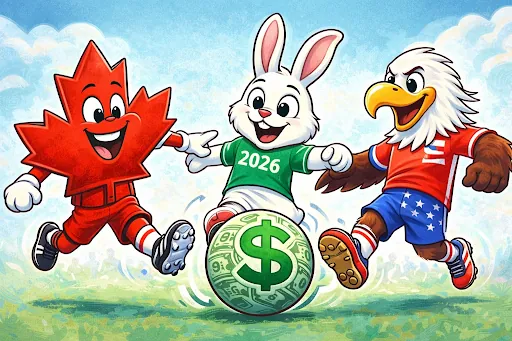
When the FIFA World Cup comes to the United States, the main question isn’t whether stadiums will be full.
They will.
The real economic story is told by two much harder questions:
- How much will it cost to host the tournament?
- Who will capture the value it creates?
The 2026 FIFA World Cup — hosted by the U.S., Canada, and Mexico, with the United States as the main venue — is not just a soccer tournament. It is one of the largest economic projects in global sport.
Question 1: How Much Will It Cost?
Compared to past World Cups, the United States enters the tournament with a major structural advantage: the infrastructure already exists.
Most matches will be played in:
- NFL stadiums
- Modern arenas with large seating capacity
- Cities experienced in hosting mega-events
This dramatically reduces the need for new stadium construction — historically the biggest cost and the biggest economic risk of hosting a World Cup.
Still, the bill is far from zero.
Costs include:
- Stadium upgrades to FIFA standards
- Security and policing
- Transportation and crowd management
- Fan zones and temporary infrastructure
- City services and event operations
Estimates vary, but analysts generally place total U.S.-side costs in the low single-digit billions of dollars, spread across federal, state, and city budgets, alongside private operators.
Crucially, most of this spending is operational rather than capital-intensive, giving the U.S. a very different risk profile compared to hosts that had to build entire stadium networks from scratch.
A Cautionary Comparison: Qatar 2022
To understand how far costs and benefits can drift apart, consider the case of Qatar 2022.
By widely cited estimates, Qatar’s total World Cup–related spending reached around $220 billion, when counting large-scale infrastructure, transport, and urban redevelopment — far beyond stadium construction alone.
At the same time, FIFA generated about $7.6 billion in revenue over the 2019–2022 cycle, driven mainly by global broadcasting rights and commercial partnerships — revenue that was largely centralized at the FIFA level rather than distributed locally.
Even for the host economy, the measurable upside was modest relative to the scale of investment. According to IMF estimates, tourism spending and World Cup-related activity added roughly $2–4 billion, equivalent to about 1% of Qatar’s GDP in gross value terms.
In other words:
> Qatar paid for infrastructure and global visibility.
> FIFA monetized the event itself.
That contrast helps explain why the real economic debate around the World Cup isn’t whether it creates value — but who captures it.
Question 2: How Much Money Will It Generate?
This is where scale matters.
The 2026 World Cup will be:
- The largest World Cup in history
- Expanded to 48 teams
- Spread across dozens of matches in major metropolitan areas
- Hosted in the world’s largest consumer economy
Expected economic inflows include:
- International tourism
- Domestic travel
- Hotel, food, and entertainment spending
- Temporary employment
- Enormous global media exposure
Pre-tournament projections commonly estimate tens of billions of dollars in total economic activity across North America, with the United States capturing the largest share due to the number of matches and host cities.
But economic activity is not the same as profit.
Who Really Makes the Money?
At the top of the value chain sits FIFA, which:
- Controls global broadcasting rights
- Owns sponsorship and licensing deals
- Centralizes most direct tournament revenue
Host cities and countries benefit indirectly through:
- Tourism inflows
- Short-term demand spikes
- Branding and visibility
- Local business activity
Hotels, restaurants, transport providers, and entertainment venues often see real gains.
Public budgets carry most of the risk.
Economically, the World Cup is a high-volume, uneven-return project.
Why the U.S. Case Is Different
In many past hosts, the gamble centered on infrastructure:
> Build first. Hope demand follows.
In the United States, the gamble is different:
- Stadiums already exist
- Demand is highly likely
- The key question is distribution, not feasibility
Who captures the upside?
- FIFA?
- Cities?
- Private operators?
- Local communities?
The answer will vary sharply from city to city.
Beyond Money: Branding and Soft Power
Not all returns show up directly in GDP statistics.
For the United States, the World Cup offers:
- Global visibility ahead of the Olympics
- Deeper integration into the world’s most popular sport
- Long-term positioning as a serious soccer market
These effects are difficult to quantify — but economically meaningful.
So, Will It Be “Worth It”?
From a narrow accounting perspective, the World Cup is rarely an obvious win for public budgets.
From a broader economic perspective — especially in a country like the U.S. — the calculation shifts:
- Lower infrastructure risk
- Massive consumer capacity
- Cities designed to absorb large-scale events
The 2026 World Cup in the United States is less a bet on soccer and more a bet on scale, logistics, and the global attention economy.
Whether that bet pays off won’t be decided on the field — but in hotel occupancy rates, tax receipts, and who ultimately holds the bill.