
The Trillion-Dollar Question: Is the Space Economy Real — or a Bubble?
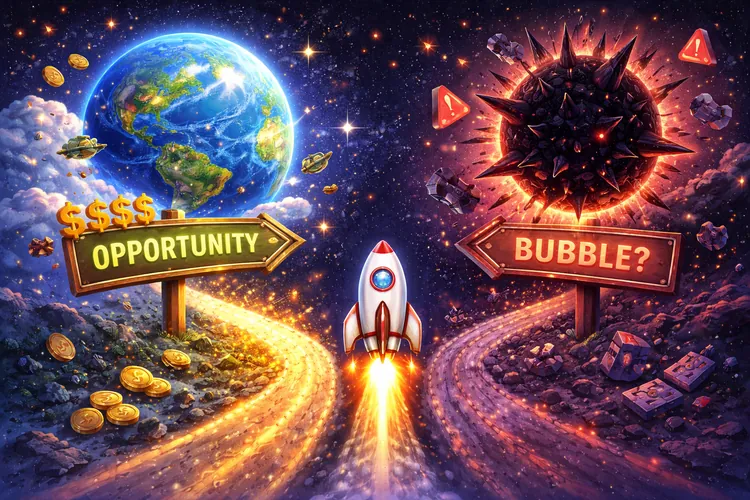
Let’s start with a bold claim.
The space economy could reach $1 trillion within the next two decades.
You’ll hear this number from investment funds, consulting firms, and space startups. It sounds impressive. Inevitable, even.
But here’s the uncomfortable question:
Is this the next great economic frontier — or the next great hype cycle?
Where the Trillion Comes From
To understand whether the number makes sense, we need to break it down.
Today’s space economy — roughly $500 billion — is not built on Moon bases or Mars colonies.
It’s built on things we already use every day:
- satellite TV
- GPS navigation
- weather forecasting
- telecommunications
- Earth observation
In fact, most of the value is not “in space” at all.
It’s on Earth — powered by space infrastructure.
So when analysts talk about a trillion-dollar space economy, they are not imagining sci-fi futures.
They are mostly extrapolating what already works:
- more satellites
- more data
- more connectivity
- more services built on top of space systems
In other words:
The trillion-dollar future might look… surprisingly ordinary.
The Bull Case: Why Space Could Explode
There are strong arguments in favor of massive growth.
1. Launch Costs Are Falling
This is the foundation of everything.
As launch becomes cheaper, more companies can afford to put things into orbit.
Lower cost leads to more access. More access leads to more experiments. More experiments lead to more businesses.
It’s the same pattern we saw with computing and the internet.
2. Data Is the New Oil — and Space Produces It
Satellites generate enormous amounts of data:
- climate monitoring
- agriculture analytics
- logistics tracking
- defense intelligence
This data is increasingly valuable.
And unlike oil, it doesn’t run out.
3. Global Internet from Space
Projects like satellite constellations aim to provide internet access everywhere on Earth.
Remote regions. Oceans. Aircraft.
If successful, this alone could justify hundreds of billions in value.
Not because it’s futuristic — but because it’s practical.
4. Governments Will Keep Spending
Even if private investment slows down, governments are unlikely to abandon space.
Why?
Because space is tied to:
- national security
- communication infrastructure
- technological leadership
In economic terms, space is becoming too important to ignore.
The Bear Case: Why It Might Be Overhyped
Now let’s look at the other side.
Because every boom story has risks.
1. Not Everything Becomes a Business
Some ideas sound exciting — but struggle economically.
- space tourism is still extremely expensive
- asteroid mining is technologically complex and uncertain
- lunar industry has no clear demand (yet)
There’s a difference between what is possible…
…and what people are willing to pay for.
2. Too Much Capital, Too Fast
In recent years, billions of dollars have flowed into space startups.
That sounds like progress.
But it can also lead to:
- unrealistic valuations
- duplicated efforts
- fragile business models
We’ve seen this before in tech bubbles.
And space is not immune.
3. Infrastructure Takes Time
Building in space is slow.
Very slow.
Unlike software, you can’t iterate overnight.
Rockets fail. Missions delay. Costs rise.
This makes returns unpredictable — and often long-term.
4. Regulation Is Unclear
Who owns what in space?
The answer is still evolving.
Without clear rules:
- investments become riskier
- disputes become more likely
- large-scale projects may stall
Markets need rules.
Space doesn’t fully have them yet.
The Most Likely Outcome: Not a Boom, Not a Bust
So what happens next?
Probably something less dramatic than either extreme.
Not a sudden trillion-dollar explosion. Not a collapse of the industry. Instead:
a slow, uneven expansion.
Some sectors will succeed:
- satellite services
- data-driven applications
- defense-related systems
Others will struggle or fail:
- early-stage tourism
- speculative resource extraction
Over time, the winners will become clearer.
And the hype will fade — replaced by real economics.
The Real Transformation
The biggest change may not be the size of the space economy.
It may be its role.
Space is shifting from:
- a prestige project
to
- a foundational layer of the global economy
Much like the internet.
You don’t think about satellites when you use GPS.
You just expect it to work.
That’s the future of space:
invisible — but essential.
So… Bubble or Breakthrough?
The honest answer is:
both.
There is hype.
There is speculation.
There will be failures.
But there is also real demand.
Real technology.
Real economic value.
And those tend to survive.