
The Space Economy: Who Pays for the Final Frontier?
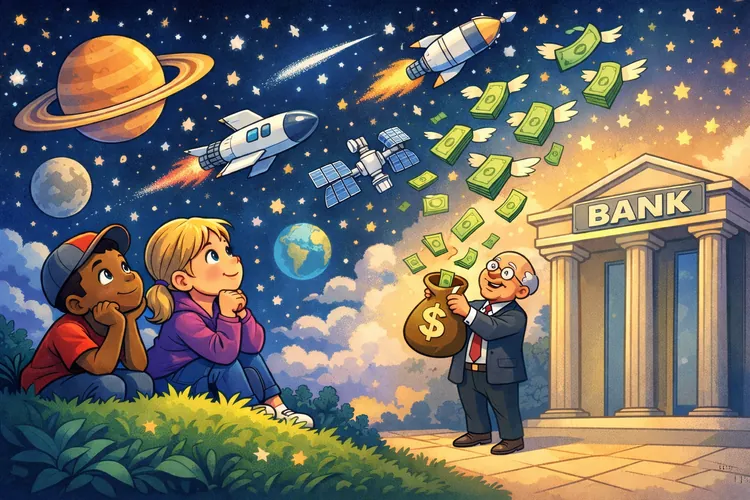
When people hear the phrase space exploration, they often think of rockets, astronauts, and distant planets.
But behind every launch is something much more down-to-earth:
money.
Space is not only a scientific adventure.
It’s also an industry — and a surprisingly large one.
Today the global space economy is estimated at about $500 billion per year.
That includes satellites, launch services, GPS systems, weather monitoring, and even satellite TV.
In other words, space already affects everyday life on Earth far more than most people realize.
And the number is growing fast.
Some analysts believe the space economy could reach $1–2 trillion by the 2040s.
So the real question is not whether space matters economically.
The real question is:
who pays for it — and who profits from it?
From Government Glory to Private Business
For most of the 20th century, space was almost entirely a government project.
The early years of space exploration were dominated by the Cold War rivalry between the United States and the Soviet Union.
Rockets were built not because they were profitable, but because they were politically important.
The Moon landing of 1969 is perhaps the clearest example.
The Apollo program cost the United States roughly $25 billion at the time — equivalent to about $180 billion today.
No private company would spend that kind of money just to plant a flag and bring home rocks.
Governments did it for prestige, science, and geopolitical influence.
For decades, that was the model.
Space was expensive.
Space was risky.
And space was funded mostly by taxpayers.
Then the Billionaires Arrived
In the 21st century, something changed.
Private companies began entering the launch business — and suddenly the economics of space started to shift.
The key innovation wasn’t just rockets.
It was reusable rockets.
For decades, rockets were treated like disposable machines.
Launch once — and they fall into the ocean.
Imagine throwing away a Boeing 747 after every flight.
That was basically the business model.
Reusable rockets changed that.
The result?
The cost of launching payloads into orbit has dropped dramatically.
Two decades ago, launching a kilogram to low Earth orbit could cost around $20,000.
Today, some estimates put the price closer to $2,000 or less.
That’s not just a technological change.
It’s an economic revolution.
Satellites: The Real Money in Space
Ironically, rockets are not where most of the money is.
The biggest profits in the space economy come from satellites.
Thousands of satellites orbit Earth today, providing services we rely on constantly:
- GPS navigation
- weather forecasting
- global internet infrastructure
- television broadcasting
- financial transaction timing
Without satellites, modern civilization would literally stop functioning.
One rapidly growing sector is satellite internet.
Constellations of satellites are being launched to provide global connectivity — even in remote regions.
In other words, the first truly mass-market space product might not be Moon bases or Mars colonies.
It might simply be:
better Wi-Fi.
Governments Are Still the Biggest Customers
Even with the rise of private companies, governments remain central to the space economy.
NASA alone spends about $25–30 billion per year.
But interestingly, NASA increasingly acts less like a traditional space agency and more like a venture customer.
Instead of building everything itself, NASA now often contracts private companies to develop rockets, spacecraft, and lunar landers.
The result is a hybrid model:
- Governments fund major programs
- Private companies build and operate the technology
- Commercial services gradually expand the market
In some ways, space is beginning to look like the early days of aviation.
At first airplanes were experimental and military.
Then they became commercial.
So… Is Space Actually Profitable?
This is the trillion-dollar question.
Right now, only a few areas of the space economy generate reliable profits:
- satellite services
- launch services
- Earth observation
- communication infrastructure
Other ideas — asteroid mining, lunar industry, Mars colonization — remain mostly future possibilities.
But the economic logic is shifting.
Every time launch costs drop, new businesses become possible.
It’s similar to what happened with computers.
At first computers were rare and extremely expensive.
Then they became cheaper.
Eventually they became everywhere.
Space may be following the same path.
The Real Economic Race Has Just Begun
The early Space Race was about politics.
The new space race is about markets.
Countries like the United States, China, India, and Japan are investing heavily in space infrastructure.
Private companies are building rockets, satellite networks, and lunar landers.
And venture capital is pouring billions into space startups.
For the first time in history, space is no longer just a scientific frontier.
It’s becoming an economic one.