
The Robot Economy Is Already Here
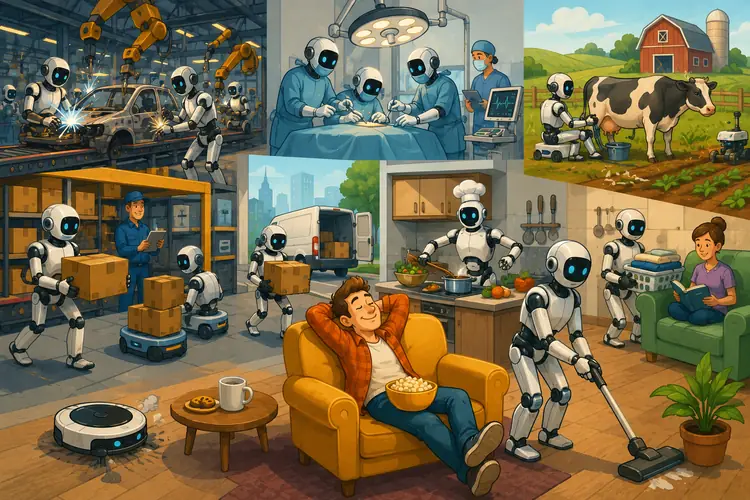
For decades, the robot economy belonged to the future.
Robots would build our cars, clean our homes, deliver our groceries, care for the elderly and perhaps one day take our jobs. They appeared in forecasts, science-fiction movies and anxious conversations about automation.
There is only one problem with this picture. The robot economy is not waiting for us in the future. It is already here.
Robots weld cars in Michigan, move packages through warehouses, assemble electronics in Asia, milk cows, assist surgeons and clean floors. They work behind fences in factories and increasingly beside people in warehouses and workshops.
Most of them do not look like humans. They do not talk. They do not have faces. And that may be why we barely notice them.
The economic revolution began long before robots learned to walk.
The First Robot Wasn't Trying to Be Human
The modern industrial robot has an unusually precise birthday. In 1961, General Motors installed Unimate at its plant in New Jersey.
The machine looked nothing like the robots imagined by Hollywood. It was essentially a large programmable mechanical arm. Its job was equally unglamorous. Unimate handled hot metal parts produced by die-casting machines — repetitive, unpleasant and potentially dangerous work for humans.
That tells us something important about the economics of robotics. The first successful industrial robot was not designed to imitate a person. It was designed to solve a business problem. Manufacturers did not need artificial humans. They needed machines that could perform particular movements repeatedly, reliably and without getting tired.
That principle would shape robotics for the next half-century.
Why Cars Came First
Automobile factories became the natural laboratory for industrial robotics.
The economics was almost perfect. Cars are produced in large numbers. Many operations repeat thousands of times. Components appear in predictable positions. A welding robot can perform essentially the same movement again and again. And automobile manufacturing involves plenty of jobs that humans would happily surrender: welding, painting, lifting heavy components and working near heat, fumes or dangerous machinery.
Robots gradually became faster, more accurate and more reliable.
But there was another economic advantage. A robot could be expensive to purchase, yet once installed it could perform the same operation thousands or millions of times. The more frequently the task was repeated, the easier it became to justify the initial investment.
That is why industrial robotics spread first through industries where scale and repetition mattered most.
The robot did not have to be cheap. It had to become cheaper than the alternative.
The Revolution Nobody Saw
For decades, robotics advanced without generating the public excitement that surrounds artificial intelligence today. There was no dramatic "robot moment." Instead, machines quietly accumulated inside factories.
By 2024, approximately 542,000 industrial robots were installed worldwide in a single year, more than twice the number installed a decade earlier. The global operational stock reached roughly 4.7 million units. Asia accounted for most new installations, with China alone installing about 295,000 industrial robots.
Those numbers tell an interesting story. Robotization is no longer an experiment conducted by a few futuristic factories. It has become part of the basic infrastructure of modern manufacturing.
When you buy a car, smartphone, appliance or electronic component, there is a good chance that robots participated somewhere in its production.
Yet most consumers never see them. The first robot revolution happened behind factory walls.
A Robot Is More Than a Machine
This is also where discussions about robot economics often go wrong.
People ask: How much does the robot cost? But businesses ask a much more complicated question: How much does the robot cost to make useful?
Buying the mechanical machine may be only the beginning. It may require sensors, software, safety equipment, installation, programming, maintenance and integration with the rest of the production line. Sometimes the factory itself must be redesigned.
Then comes training. Then downtime. Then spare parts. Then someone has to keep the entire system running.
This explains one of the paradoxes of robotics.
A robot that costs $50,000 can be more expensive than a robot costing $150,000 if the first requires constant supervision and the second works reliably for years.
The real economic unit is not the price of the machine. It is something closer to the cost per useful task performed.
Cheap Labor Was Always a Competitor
There is another reason robots did not conquer every factory decades ago.
Humans are remarkably versatile machines. A worker can walk across a room, recognize an unfamiliar object, pick it up, change tools, understand instructions and adjust when something goes wrong.
Traditional robots are often terrible at these simple things. They perform spectacularly well when the environment is predictable. Change the environment, and suddenly the cheap human worker may become the more economical solution.
This helps explain why automation historically spread faster in some high-wage industrial economies than in countries where labor was inexpensive. A company paying high wages has a stronger incentive to invest $100,000 in automation than one with access to abundant low-cost labor.
But that equation is changing. Wages are rising in many manufacturing centers. Populations are aging. Companies struggle to find workers for certain repetitive jobs. At the same time, robots are becoming cheaper and more capable.
The two lines are moving toward each other.
China Changed the Equation
No country illustrates this transformation better than China.
For years, China's manufacturing advantage was associated with something simple: lots of workers and relatively low wages. Now China is also the world's largest market for industrial robots. That may sound contradictory. It isn't. As wages rise and the workforce ages, automation becomes increasingly attractive.
At the same time, China wants to move from labor-intensive manufacturing toward higher-value production. Robots are part of that transition.
There is an important lesson here. Automation is not necessarily the opposite of manufacturing employment. Sometimes countries automate precisely because they want manufacturing to remain competitive.
A factory without enough workers does not automatically hire more people. It may automate. Or it may close.
Then the Robots Left the Factory
Something else has happened during the past decade.
Robots have begun escaping from their cages. Warehouses use autonomous mobile robots to move goods. Hospitals use robotic systems for logistics and surgery. Farms deploy machines for milking, harvesting and monitoring crops. Hotels and restaurants experiment with delivery and cleaning robots.
Professional service robots are now a significant commercial market, with transportation and logistics representing the largest application.
This is economically more important than it may appear. The traditional industrial robot lived in a carefully controlled environment. The new robot increasingly has to operate in our environment.
It must navigate around people. Recognize objects. Respond to unexpected situations. Make decisions.
And that is much harder than welding the same piece of metal 10,000 times.
AI Gives the Machine Something New
For most of robotics history, the mechanical side advanced faster than the intelligence. Engineers could build machines capable of extraordinary precision, strength and speed. The difficult part was telling them what to do when the world stopped behaving exactly as expected.
Artificial intelligence may change that equation. Computer vision allows machines to interpret their surroundings.
Modern AI models can process natural-language instructions. Machine learning allows robots to improve complex tasks from data rather than relying entirely on manually written instructions.
The distinction is subtle but economically enormous. The old robot was programmed: Move from point A to point B. Close gripper. Lift object. Rotate 30 degrees. The ambition of the new robot is different: Put these boxes on that shelf.
If machines can reliably make that transition, the cost of deploying robots could fall dramatically.
And suddenly automation becomes interesting far beyond the assembly line.
From Robot Arms to Robot Workers
This is why today's excitement around humanoid robots matters.
Tesla's Optimus, Figure's humanoids, Boston Dynamics' Atlas, Agility Robotics' Digit and rapidly developing Chinese machines are based on an idea that would have seemed economically absurd for much of industrial robotics history. Instead of building a specialized robot for one task, build a machine capable of performing many tasks. Instead of redesigning the workplace around the robot, design the robot around a workplace built for humans. Give it arms because our tools require arms. Give it hands because our objects are designed for hands. And perhaps even give it legs because our factories, warehouses, stairs and buildings were designed for legs.
The industrial robot was a machine. The ambition now is something closer to a worker.
That distinction could change the economics of robotics completely.
The Robot Economy Has Two Histories
We tend to imagine one great robot revolution coming sometime in the future.
There may actually be two. The first began more than sixty years ago. It gave us robotic arms, automated production lines and millions of industrial machines performing specialized tasks. It transformed manufacturing quietly because most people rarely saw it happen.
The second may be beginning now. Its robots will be mobile, increasingly intelligent and potentially capable of switching between tasks.
The first revolution automated movements. The second is trying to automate work. Whether it succeeds is still uncertain.
Humanoid demonstrations are impressive, but demonstrations do not pay salaries, generate returns on capital or keep factories running. A robot that dances beautifully on YouTube may still be a terrible employee. That is why the next stage of robotics will ultimately be decided by economics rather than engineering.
How much does the machine cost? How long can it work? How much human supervision does it require? How quickly can it learn another task? And, finally, the uncomfortable question: Is it cheaper or more productive than us?
For sixty years, robots have been answering that question one repetitive task at a time. Now they are beginning to ask for the whole job.
The robot economy is not coming. It is already here.