
The Productivity Explosion: Why Economists Are Suddenly Excited About AI
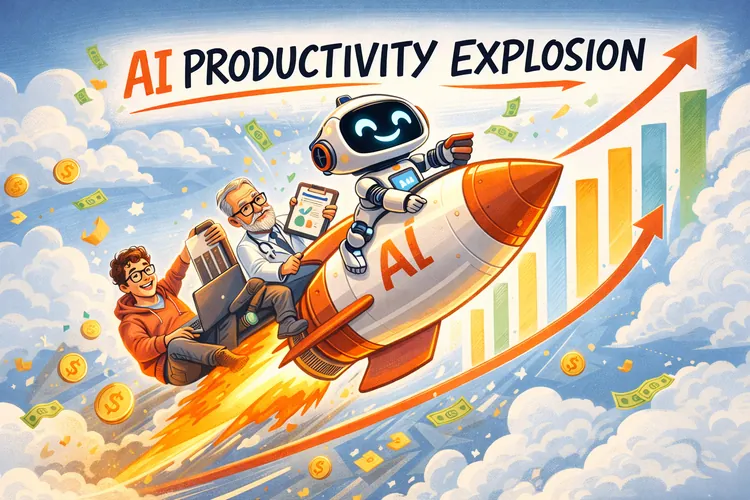
For years, economists had a strange complaint about the modern economy.
Technology seemed to be advancing rapidly — smartphones, cloud computing, streaming, social media, automation — yet the numbers that economists care about most weren’t moving very fast.
Those numbers are called productivity.
And productivity is the quiet force behind prosperity.
Now, with the rise of artificial intelligence, many economists believe something important may finally be changing.
Why Productivity Matters More Than Almost Anything
If there is one statistic that explains why some countries become rich, it is productivity.
Productivity simply means how much value each worker produces.
When productivity rises, several good things tend to happen:
- wages grow
- companies earn more
- prices can fall
- economies expand
In other words, productivity growth is what allows societies to become wealthier without simply working longer hours.
For much of the 20th century, developed economies experienced strong productivity growth.
Between 1950 and 1973, productivity in the United States grew by roughly 3% per year. Western Europe and Canada saw similar trends.
Those decades created the modern middle class.
But then something changed.
The Great Productivity Slowdown
Since the early 2000s, productivity growth across many advanced economies has slowed dramatically.
In the United States, it has averaged roughly 1–1.5% per year.
Canada has seen similar trends, and in some periods even slower growth.
This puzzled economists.
After all, these decades saw the rise of:
- the internet
- smartphones
- cloud computing
- global digital platforms
So why didn’t productivity explode?
The economist Robert Solow once joked:
> “You can see the computer age everywhere but in the productivity statistics.”
For years, that quote seemed surprisingly accurate.
AI Might Change the Equation
Artificial intelligence may be the first digital technology that significantly boosts productivity in knowledge work.
That’s important because modern developed economies are dominated by services and information-based jobs.
Recent studies are starting to show measurable effects.
For example:
- programmers using AI coding assistants can complete certain tasks 30–50% faster
- customer service agents using AI support tools resolve issues much more quickly
- business analysts can process large datasets in minutes instead of hours
Even small improvements like this can have enormous economic consequences.
Imagine millions of workers becoming 20–40% more productive.
Across an entire economy, that is huge.
The “Augmented Worker”
One of the most interesting ideas emerging from AI research is the concept of the augmented worker.
Instead of replacing employees, AI often acts like a powerful assistant.
A marketing professional can generate campaign ideas instantly.
A lawyer can scan thousands of pages of legal documents in minutes.
A doctor can review AI-assisted diagnostic suggestions.
The worker remains in control — but their capabilities expand dramatically.
In this sense, AI may function less like automation and more like a productivity amplifier.
The Surprising Effect on Skill Levels
Early research suggests something even more interesting.
AI tools may benefit less experienced workers the most.
In some studies, junior employees using AI assistance improved their performance dramatically — sometimes approaching the level of more experienced colleagues.
If this trend continues, it could reshape how companies train employees and how quickly workers develop skills.
The economic effects could be profound.
Why Economists Are Watching Carefully
Despite the excitement, economists remain cautious.
Productivity statistics often lag behind technological change.
When electricity was introduced in factories in the late 1800s, productivity didn’t surge immediately. It took decades for businesses to redesign factories around electric power.
Artificial intelligence may follow a similar pattern.
Right now, companies are experimenting.
New workflows are forming.
And millions of workers are still figuring out how to use these tools effectively.
But if AI truly boosts productivity across the economy, the effects could be dramatic.
Higher productivity means faster economic growth — and potentially rising living standards.
However, there is another side to the story.
If AI dramatically increases productivity, the next question becomes unavoidable:
Who captures the gains?
Workers?
Companies?
Or a small number of technology giants?