
The Price of Adaptation: Who Pays to Protect the Economy?
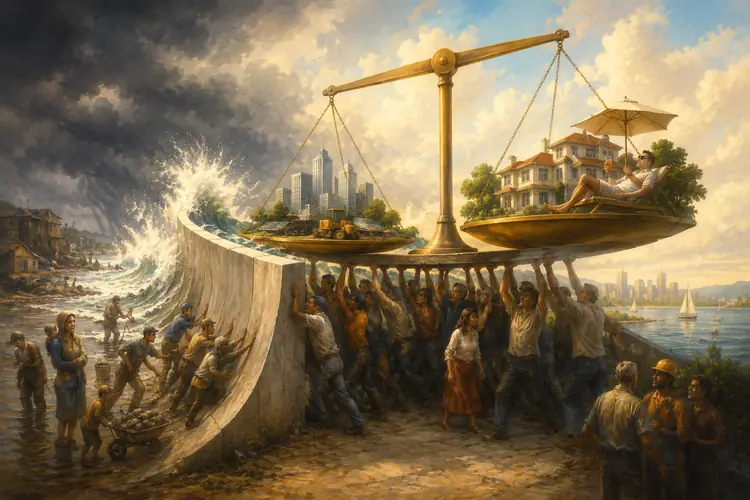
Imagine two identical coastal towns.
Both know that flooding is becoming more dangerous. Both have roads, homes, businesses, power lines, and water systems worth billions of dollars.
The first town spends heavily today: stronger drainage, higher sea walls, redesigned roads, tougher building standards. The second does almost nothing.
For twenty years, the second town looks smarter. Its taxes are lower. Its budgets are easier. Nobody complains about expensive infrastructure projects protecting people from disasters that have not happened.
Then the storm arrives.
Suddenly, the first town's expensive preparations look remarkably cheap.
This is the central economic problem of climate adaptation:
How much should we pay today to avoid a bill that may arrive tomorrow?
And there is an even harder question.
Who should pay it?
Adaptation Is Not the Same as Fighting Climate Change
Climate economics often mixes two very different ideas.
The first is mitigation: reducing greenhouse gas emissions in an attempt to limit future warming.
The second is adaptation: changing homes, cities, infrastructure, agriculture, and businesses so they can function in a warmer and potentially more volatile climate.
The distinction matters.
Building renewable electricity may reduce emissions. Building a sea wall does not. Installing better drainage does not stop global warming. Neither does redesigning a power grid to survive extreme heat.
These investments simply reduce the economic damage caused by changing conditions.
And unlike many debates about future emissions, adaptation tends to be intensely local.
A sea wall in Miami does nothing for Vancouver. A wildfire barrier in British Columbia does little for Texas. A new reservoir in Arizona cannot protect New York from flooding.
Climate may be global. Adaptation is usually paid for one road, one city, one farm, and one building at a time.
The Strange Economics of Paying Before Disaster
Suppose a city can spend $500 million today strengthening flood defenses. If nothing happens for the next decade, voters may conclude that the money was wasted. But suppose the investment prevents $3 billion in damage twenty years from now. Was the original $500 million expensive? Or extraordinarily cheap? Economists deal with this problem using expected losses. A disaster does not need to happen every year to justify protection. If an event has a relatively small probability but an enormous potential cost, reducing that risk can still be economically rational. Insurance works on exactly the same principle. The problem is political psychology. People can see a bridge. They can see a hospital. They can see a new highway. It is much harder to see a flood that never happened. Successful adaptation therefore has a peculiar public-relations problem: when it works perfectly, nothing happens. And governments rarely hold ceremonies to celebrate disasters that did not occur.Who Pays for the Sea Wall?
Now we reach the uncomfortable part. Suppose 10,000 expensive coastal homes need protection from rising flood risk. A sea wall would cost $1 billion. Who should pay? The homeowners? The city? The state or province? The federal government? Or taxpayers living hundreds or thousands of miles away? There is no purely engineering answer because this is really a question about who receives the benefit. If public money protects private property, homeowners receive a potentially enormous subsidy. Their houses remain usable. Their insurance may remain available. Their property values may remain higher than they otherwise would. But the infrastructure protecting those houses may also protect roads, businesses, hospitals, ports, and public utilities. Suddenly the distinction between private benefit and public benefit becomes complicated. This is why adaptation is not merely a climate problem. It is a problem of who owns the risk and who owns the bill.Insurance Can Protect Us — and Mislead Us
Insurance is supposed to transfer risk. But it also communicates information. If insuring a house costs $2,000 a year, that price tells us something about risk. If the premium rises to $8,000, the message is unpleasant but economically useful: Something about owning that property has become more dangerous.Governments understandably dislike this process. A sudden increase in insurance costs can devastate household budgets and damage local real-estate markets. Political pressure to subsidize insurance can become enormous.
But subsidies create a paradox.They make risky places cheaper to occupy.
If the true annual risk of owning a property is $8,000 but the homeowner pays only $3,000 because taxpayers absorb the rest, the market receives the wrong signal. People may continue building, buying, and investing in locations where the underlying economics have deteriorated.
The subsidy solves today's affordability problem.
It may increase tomorrow's adaptation problem.
Sometimes the Cheapest Defense Is to Move
This may be the most politically difficult conclusion in climate economics.
Not everything should be protected forever.
Imagine a small community repeatedly damaged by flooding. Government can build stronger barriers. Then higher barriers. Then larger pumps. Then rebuild roads. Then subsidize insurance.
At some point, the value of what is being protected may become smaller than the cost of protecting it.
Economists have an unpleasant phrase for the alternative: managed retreat.
In ordinary language, it means moving people and infrastructure away from places where maintaining them no longer makes economic sense.
That sounds harsh. But consider the alternative.
If a house worth $300,000 requires $600,000 of public protection over several decades, preserving it at any cost is not necessarily compassion. It may simply be bad arithmetic.
Climate adaptation therefore forces societies to answer a question they generally prefer to avoid:
What is worth saving — and at what price?
Adaptation Is Also a Business
There is another side to this story.
Every new risk creates demand for someone who can reduce it.
Hotter cities need more efficient cooling. Water shortages increase the value of better irrigation and water-management technologies. Wildfire risk creates demand for fire-resistant construction, vegetation management, monitoring, and detection systems. Flood risk increases demand for engineering, drainage, barriers, pumps, forecasting, and sophisticated risk models. Electrical grids may need more capacity and resilience. Buildings may require new materials and designs. Farmers may need different crops, technologies, and irrigation systems.
This means climate adaptation is not simply an expense. It is also becoming an industry.
Money spent protecting one asset becomes revenue for another company. Engineers, insurers, construction firms, technology companies, utilities, agricultural businesses, and data providers can all become part of the adaptation economy.
Climate risk destroys value in some places. The attempt to manage that risk creates value elsewhere.
Markets have always been good at turning problems into industries.
The Rich Can Adapt Faster
There is, however, a major economic asymmetry. Adaptation requires capital.
A wealthy homeowner can install better cooling, improve drainage, reinforce a roof, or move somewhere safer. A large corporation can relocate facilities, diversify suppliers, purchase sophisticated insurance, and invest in backup power. A wealthy city can build barriers and redesign infrastructure.
Poorer households and communities have fewer options. They may live in riskier locations precisely because housing there is cheaper. They may lack insurance. They may not be able to move. They may depend more heavily on public infrastructure that governments cannot easily replace.
This creates one of the most important inequalities in climate economics. The difference may not simply be between those exposed to climate change and those who are not.
Almost everyone is exposed somehow.
The more important difference may be between those who can afford to adapt and those who cannot.