
The Month When the World Eats the Least
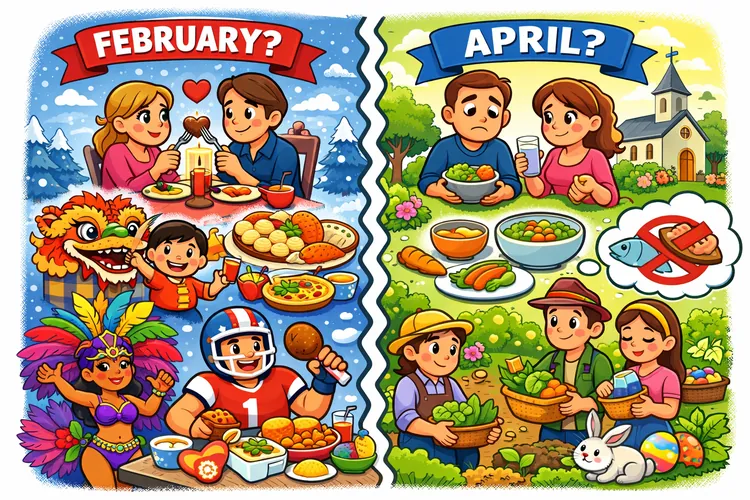
Here’s a small brain teaser that looks simple at first but becomes surprisingly debatable once you start thinking about real life.
The Puzzle
Question: In which month do people in the world eat the least?
Answer: February, because February has fewer days than other months.
The logic seems straightforward. If February has only 28 days (or 29 in a leap year), then people simply have fewer days to eat. Fewer days should mean less total food consumed.
Case closed?
Not so fast.
Once we look beyond the calendar and consider how people actually behave, February might not be the month when the world eats the least. A surprisingly strong candidate could be April.
Let’s examine the clues.
Clue #1: The Calendar Advantage Is Small
The puzzle relies on a neat mathematical trick: February is the shortest month.
But the difference isn’t dramatic.
- February: 28 days (29 in leap years)
- April: 30 days
That’s only a two-day difference — or just one day in leap years.
When we’re talking about the eating habits of eight billion people, such a small difference in the calendar may not determine global food consumption.
Human behavior matters more than arithmetic.
Clue #2: April Is the Season of Fasting
Across many cultures, April often overlaps with major fasting traditions.
One of the most prominent examples is Lent, observed by millions of Christians before Easter.
During Lent many people:
- eat smaller meals
- avoid meat
- give up sweets
- skip certain foods entirely
In Eastern Orthodox traditions the fasting rules can be even stricter, avoiding meat, dairy, and other foods for extended periods.
When millions of people deliberately reduce their food intake, it could significantly lower global consumption during that month.
Clue #3: February Is Full of Feasts
If April encourages restraint, February often encourages the opposite.
Chinese New Year frequently falls in late January or February and involves large family banquets across East Asia.
Valentine’s Day increases restaurant visits and chocolate sales across North America and Europe.
Carnival celebrations — including Mardi Gras and Rio’s Carnival — are historically associated with indulgent meals and festive gatherings.
The word “Carnival” itself comes from the Latin phrase carne vale — “farewell to meat.”
Clue #4: Winter Appetites
Seasonal behavior also plays a role.
Much of the world’s population lives in the Northern Hemisphere, where February falls in the coldest part of winter.
Cold weather often encourages:
- heavier meals
- comfort food
- higher-calorie diets
April, by contrast, marks the beginning of spring in many regions, when people often shift toward lighter meals.
Clue #5: The Super Bowl Effect
There’s also a uniquely American factor.
Super Bowl Sunday — usually held in February — is one of the largest food-consumption events in the United States.
Millions of people gather to eat:
- chicken wings
- pizza
- nachos
- chips and dips
It’s essentially a national snack festival disguised as a football game.
A Puzzle With Two Answers
Mathematically, the puzzle’s answer is still February — fewer days mean fewer meals.
But if we consider real-world behavior, April might actually be the month when global food consumption drops the most due to fasting traditions and seasonal habits.
A Small Puzzle With a Big Lesson
This little riddle illustrates something economists know well:
Human behavior often matters more than simple arithmetic.
At first glance, the shortest month should produce the lowest food consumption.
But once culture, religion, weather, and celebrations enter the picture, the answer becomes far less obvious.
So the next time someone confidently says the world eats the least in February, you might reply:
“Maybe… but April deserves a closer look.”