
The Invisible Economy of Connected Things
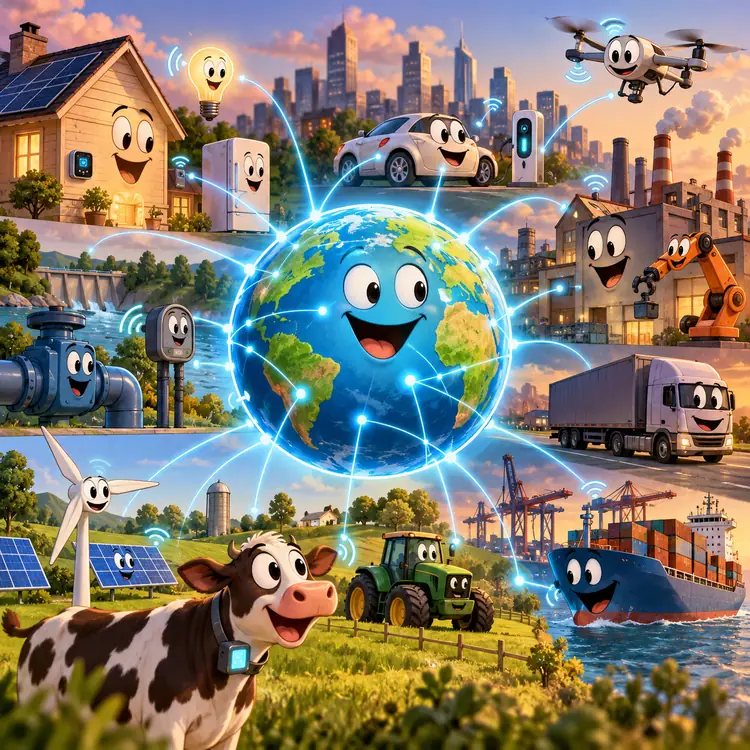
The Internet is full of people. The Internet of Things is full of machines. And the machines may eventually have far more to say to one another than we do.
A shipping container reports its location. A tractor measures soil conditions. A factory motor notices that it is vibrating slightly differently than yesterday. A truck reports fuel consumption. An electricity meter records demand. A refrigerated warehouse notices that one corner is becoming too warm.
None of this is particularly exciting. That may be precisely why it matters. The Internet of Things, or IoT, is becoming one of those technologies that disappears as it succeeds.
We don't marvel at every connected sensor anymore. We simply expect more of the physical world to be measurable, trackable, and increasingly controllable.
Behind that quiet transformation is an enormous economic idea:
Things that once merely existed can now produce information.
And information can change decisions.
From the Internet of People to the Internet of Things
The original Internet connected computers. Then smartphones connected billions of people. The next step was almost inevitable: connect everything else.
Not literally everything, of course. Your coffee mug probably doesn't need an IP address. But many physical objects become economically more useful once they can tell us something about themselves or their surroundings.
Where am I? How hot am I? How much electricity am I consuming? Am I moving? Am I full? Am I damaged? Do I need maintenance?
Those are simple questions. But answering them automatically and continuously can transform the economics of an asset.
Consider a shipping container. For most of its history, the container was essentially a steel box. Once loaded onto a ship, much of what happened to it remained invisible until somebody saw it again. Add sensors and connectivity, and the box can potentially report location, temperature, humidity, movement, or whether its doors have been opened.
The container hasn't become dramatically better at being a box. It has become better at producing information about being a box.
That information is the new product.
When Machines Started Talking to Machines
Long before anyone began filling homes with smart speakers, industry had already discovered something important: machines could communicate without waiting for humans.
This became known as machine-to-machine communication, or M2M.
The basic idea was wonderfully simple. A machine measures something. It sends the information somewhere else. Another system records it, analyzes it, or responds. No employee needs to walk over and read a gauge. No driver needs to telephone headquarters and report a location. No technician needs to inspect every machine every morning just to discover that everything is fine.
Early M2M systems were often specialized and isolated. The Internet, cheaper sensors, wireless networks, cloud computing, and increasingly capable software made the idea vastly more scalable. M2M gradually became part of the much larger IoT world. And economically, something profound happened.
Machines began generating transactions of information without human labor being involved in every step.
A truck could report to a logistics system. A meter could report to a utility. A machine could report to a maintenance platform.
The physical economy had started talking to itself.
The Economics of Seeing
A surprisingly large part of economic activity involves one basic problem:
We don't know exactly what is happening.
A logistics company doesn't know precisely where every shipment is. A farmer doesn't know the moisture level in every section of every field. A factory manager doesn't know the condition of every bearing inside every machine. An electricity utility doesn't know exactly how demand will change over the next few minutes.
Historically, businesses solved this problem with people, inspections, estimates, schedules, paperwork, and large safety margins. IoT offers another possibility:
measure more of the physical world, more often, at lower cost.
That can sound trivial until you realize how expensive uncertainty is.
Companies hold extra inventory because deliveries may be late. Factories replace components early because they don't know exactly when they will fail. Buildings waste energy heating or cooling empty spaces. Farmers may irrigate more land than necessary because soil conditions vary.
Reducing uncertainty doesn't eliminate these costs. But even small improvements, repeated across millions of machines and billions of decisions, can matter enormously.
A Factory That Notices Before You Do
Factories provide perhaps the clearest example.
Imagine a large electric motor operating continuously. Traditionally, a company has several choices. Maintain it according to a fixed schedule. Inspect it regularly. Or wait until something goes wrong. Each approach has a cost. Maintain too early and you replace components that might have worked for months. Maintain too late and the machine can fail unexpectedly, perhaps stopping an entire production line.
Now put sensors on the machine. They monitor vibration, temperature, pressure, sound, or electrical characteristics. The machine begins producing a stream of information about its own condition. Software can search that information for patterns suggesting trouble.
Suddenly maintenance can move from: "It has been six months, so let's inspect it." toward: "Something is changing. Let's inspect it now."
This is predictive maintenance, and its economic promise is not glamorous. It is simply fewer surprises. But in industry, fewer surprises can be worth a lot of money.
The World's Inventory Starts Moving on a Screen
IoT also changes something fundamental about logistics.
The modern economy moves an astonishing quantity of physical objects through warehouses, trucks, trains, ships, ports, and stores.
Every movement creates uncertainty. Where is it? When will it arrive? Was it kept cold? Was it damaged? Is the warehouse running out?
A connected supply chain tries to turn physical movement into digital visibility. A refrigerated shipment of food or medicine can be monitored for temperature. Trucks can transmit location and operating data. Warehouse systems can track goods as they move. Retail shelves can eventually communicate inventory conditions more automatically.
The economic goal isn't to produce more data. It is to reduce the cost of not knowing.
That distinction is important. Data itself isn't necessarily valuable. Useful information delivered before a decision has to be made is valuable.
Even Cows Can Join the Network
One of the amusing things about IoT is how quickly the word thing becomes literal.
The connected object doesn't have to be a machine. It can be a cow. Livestock sensors can monitor movement and behavior, helping farmers detect changes that may indicate health or reproductive conditions. Agricultural sensors can measure soil moisture, temperature, weather conditions, or equipment performance. A farmer can therefore manage a field less like one giant homogeneous piece of land and more like thousands of slightly different economic problems. One area may need water. Another doesn't. One animal may need attention. The others don't.
This illustrates a larger principle. IoT makes mass management more individual.
Instead of treating 10,000 objects identically, you can increasingly respond to the condition of each one.
The Invisible Workforce
There is a temptation to imagine automation mainly as robots replacing workers. But much automation is far less dramatic. It consists of machines eliminating tiny tasks. Reading a meter. Checking a temperature. Recording a location. Counting inventory. Inspecting equipment. Opening a valve. Adjusting a thermostat. Each task may require only seconds or minutes of human attention.
That doesn't sound revolutionary. But economies contain billions of tiny tasks. IoT quietly removes, reduces, or changes some of them.
This creates an invisible workforce: sensors and connected devices performing small acts of observation around the clock. They don't replace every worker. Often they simply allow workers to spend less time checking whether something happened and more time deciding what to do about it.
Then AI Arrived
For years, IoT had an obvious limitation. Sensors could produce enormous amounts of data. Unfortunately, enormous amounts of data can become enormous amounts of noise.
Then AI became much better at finding patterns. That changes the equation. IoT can provide the senses. AI can provide part of the intelligence. Robotics and automated systems can provide the action.
A camera sees. A sensor feels. AI interprets. A machine responds.
This is why the Internet of Things may become more important precisely when people talk about it less. It is becoming part of something bigger.
The Economy Is Growing a Nervous System
Perhaps the best way to understand IoT is not as an Internet filled with refrigerators. Think of it as a primitive nervous system spreading through the physical economy. Sensors are the nerve endings. Networks carry signals. Data platforms collect them. AI increasingly interprets them. Machines act on the results.
Factories begin to feel when equipment is unhealthy. Supply chains begin to see where goods are. Power grids begin to sense changing demand. Farms begin to measure individual patches of soil. Buildings begin to notice when nobody is inside.
The objects themselves haven't suddenly become intelligent. But the economic system surrounding them has become more aware.
And awareness changes behavior. The first Internet connected information. The second connected people. Now we are connecting the physical world.
The really interesting question is no longer whether machines can talk.
It is what happens to an economy when billions of them start listening.