
The Hidden Bill: What Does a Warmer World Actually Cost?
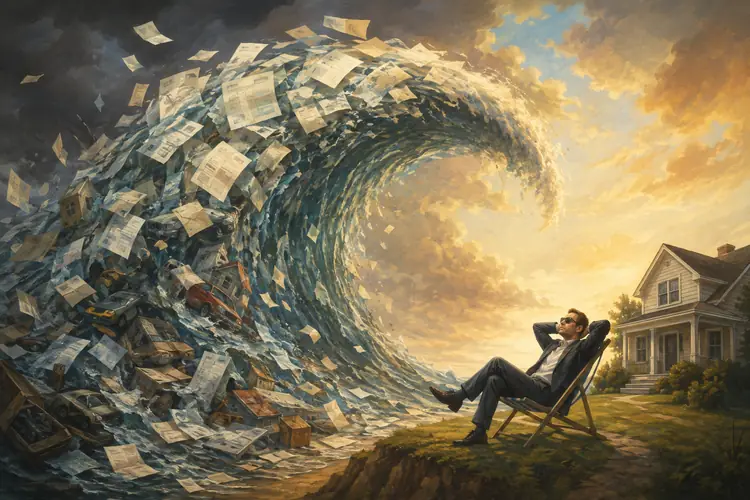
When people hear the words global warming, they usually imagine melting glaciers, rising seas, wildfires, or perhaps a polar bear standing on a shrinking piece of ice.
Economists see something else. They see a bill.
Not one enormous bill arriving at the end of the century, but millions of smaller ones already appearing in electricity payments, insurance premiums, food prices, infrastructure budgets, and property values.
That is what makes the economics of climate change surprisingly difficult to see.
The cost rarely arrives with the words “global warming” printed on the invoice.
Heat Has a Productivity Problem
Modern economies still depend heavily on people working in the physical world.
Construction workers build houses. Farmers harvest crops. Utility crews repair power lines. Warehouse employees move goods. Truck drivers transport them.
And humans are not particularly efficient machines when temperatures become extreme.
As heat rises, outdoor work becomes slower, breaks become more frequent, and some working hours simply become unsafe.
Even offices are not completely protected. Keeping buildings comfortable requires more electricity and larger cooling systems.
For an individual company, the effect may look small. A few lost hours here. A larger electricity bill there.
Multiply that across millions of workers and businesses, however, and temperature becomes a productivity variable.
GDP does not need a hurricane to suffer. Sometimes it just needs a very hot summer.
Food Has a Climate Exposure
Agriculture has always been a strange industry because one of its most important inputs cannot be controlled by the farmer. Weather.
Technology has reduced that vulnerability enormously. Irrigation, fertilizers, improved seeds, machinery, forecasting, and global trade have made modern agriculture extraordinarily productive.
But they have not abolished climate. Too little rain damages crops. Too much rain can do the same. Extreme heat can reduce yields. Changing growing conditions can shift which crops are economically viable in particular regions.
And agricultural problems rarely stay on the farm. If harvests decline in one major producing region, food processors pay more. Retailers pay more. Eventually consumers notice.
Global trade can soften local shortages. A bad harvest in one country can be offset by production elsewhere.
But diversification works best when weather shocks are local. When several important agricultural regions experience problems simultaneously, the protection becomes weaker.
A climate shock in a field can eventually become inflation in a supermarket.
Your House May Be a Climate Asset
For most American and Canadian families, the largest asset they own is not a stock portfolio.
It is their home.
That makes climate risk a financial-market issue.
A house near the ocean may be beautiful, but if flooding becomes more frequent, someone must absorb that risk. Perhaps the homeowner pays through higher insurance premiums. Perhaps the insurer stops offering coverage. Perhaps the government subsidizes insurance. Perhaps taxpayers finance sea walls and drainage systems.
Or perhaps buyers eventually decide that the house simply is not worth as much as it used to be.
The physical building may not have changed at all. The risk around it has.
This is one of the most important economic consequences of a changing climate: assets can be repriced before they are physically damaged.
Markets do not need to wait for the water to arrive.
They only need to believe that someday it might.
Insurance Is Where Risk Gets a Price Tag
Insurance may become one of the clearest places where ordinary households encounter climate economics.
Insurance companies perform a brutally simple calculation. How likely is something bad to happen, and how expensive will it be if it does?
If wildfires, floods, storms, or other hazards become more costly or more frequent in a particular region, premiums eventually have to reflect that risk. Otherwise the insurance business stops working.
This creates an uncomfortable economic signal.
Suppose a homeowner's insurance premium rises sharply. To the homeowner, it feels like another expensive bill. To an economist, it may be something else: a price signal telling people that living in this particular place has become riskier.
Suppress that signal through subsidies, and housing may remain affordable for longer.
But the underlying risk does not disappear. Someone else simply inherits the bill.
Often that someone is the taxpayer.
Cities Were Built for Yesterday's Climate
There is another problem.
Much of today's infrastructure was designed using yesterday's assumptions.
Drainage systems were built for historical rainfall patterns. Roads were engineered for particular temperature ranges. Coastal infrastructure assumed certain sea levels. Electrical grids were designed around historical patterns of demand.
Infrastructure lasts for decades. Climate conditions do not necessarily remain constant for decades.
That creates an expensive mismatch. A city may need larger drainage systems. A power grid may require additional capacity to handle air-conditioning demand during heat waves. Bridges, roads, water systems, and coastlines may require additional protection.
None of this necessarily makes a country richer. Replacing a damaged road with another road increases economic activity, but society has essentially spent money to recover something it already had.
There is an important difference between investment that creates something new and investment required simply to prevent something old from disappearing.
Both can increase spending. Only one clearly makes us wealthier.
Disaster Can Even Make GDP Look Better
This leads to one of the stranger paradoxes of climate economics.
Imagine a major storm destroys thousands of homes. The immediate economic loss is enormous.
Then reconstruction begins. Construction companies become busy. Workers earn wages. Building materials are purchased. Governments spend money rebuilding roads and utilities.
Measured economic activity rises.
GDP may receive a boost from reconstruction. Has society become richer?
Obviously not. It first lost houses, roads, cars, businesses, and infrastructure — and then spent enormous amounts of money trying to restore them.
GDP measures economic activity remarkably well. It does not always distinguish between money spent creating wealth and money spent repairing destruction.
A disaster can therefore produce construction jobs while simultaneously making society poorer.
Economics occasionally has a dark sense of humor.
The Cost Is Not Distributed Equally
There is another reason why calculating one global number for the cost of warming can be misleading.
Climate does not affect every place equally. A farmer and a software engineer do not have the same exposure to heat. A coastal homeowner and someone living inland do not face the same flood risk.
A wealthy city can finance cooling systems, stronger infrastructure, and flood defenses more easily than a poor community. Even neighboring properties may experience dramatically different risks.
This means climate change is not simply an economic growth problem.
It is also a distribution problem.
The average cost may tell us surprisingly little about who actually pays.
The Hidden Bill
Perhaps the most important economic feature of climate change is that there may never be a single moment when someone announces:
"Here is the final cost."
Instead, the bill arrives quietly. A homeowner pays another $800 for insurance. A city spends millions upgrading drainage. A utility builds additional generating capacity. A farmer invests in irrigation. A business pays more for cooling. A government rebuilds a highway after another flood. A supermarket adjusts prices after a poor harvest.
Each transaction has its own explanation. Together they form something much larger.
The economics of a warmer world may therefore be less dramatic than the images we associate with climate change — and more pervasive.
The biggest climate bill may never arrive as a government invoice. It may arrive through thousands of small price increases, investment decisions, insurance premiums, tax bills, and assets that suddenly are not worth quite what we thought they were.
And that raises the next economic question. If climate change is going to cost money anyway, is it cheaper to pay after the damage — or before it happens?
That is where the economics of adaptation begins.