
The Economy in Five Numbers: A Friendly Introduction
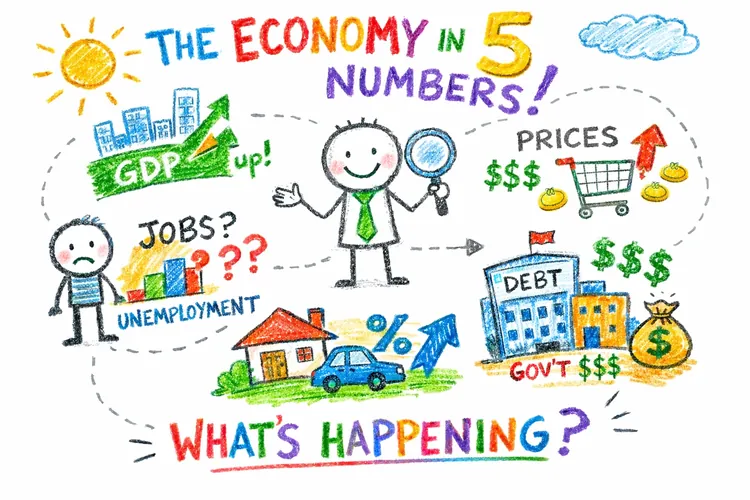
Imagine you are a doctor examining a patient.
You don’t begin by reading the patient’s entire life story.
Instead, you check a few key indicators: temperature, blood pressure, pulse.
From those numbers, you quickly understand whether the patient is healthy.
Economists do something similar with the economy.
Modern economies are enormously complex. Millions of businesses, hundreds of millions of consumers, and trillions of dollars moving every day.
Yet economists often begin by looking at a small set of indicators — the economy’s vital signs.
Why We Need Economic Indicators
Without indicators, talking about the economy would be like describing the weather without temperature or wind speed.
People might say:
- “Things feel slower lately.”
- “Prices seem higher.”
- “Jobs are harder to find.”
But impressions are not enough for governments, businesses, or investors making major decisions.
Economic indicators provide measurable data.
They help answer key questions:
- Is the economy growing or shrinking?
- Are people finding jobs?
- Are prices rising too quickly?
- Are consumers confident enough to spend?
The answers influence everything from mortgage rates to stock markets.
The Five Numbers Economists Watch Most
Although dozens of statistics are published every month, a small group dominates economic discussions.
These are often considered the Big Five indicators.
1. Gross Domestic Product (GDP)
GDP measures the total value of goods and services produced in a country.
If GDP grows, the economy expands.
If GDP shrinks, the economy may be entering a recession.
The United States produces about $27 trillion in GDP annually.
Canada produces roughly $2.2 trillion.
Economists focus primarily on the growth rate, with healthy economies typically expanding around 2–3% per year.
2. Inflation
Inflation measures how quickly prices rise over time.
If inflation rises too quickly, purchasing power declines.
If inflation is too low, the economy may be weak.
Central banks generally aim for about 2% annual inflation.
Inflation is usually measured using indexes like the Consumer Price Index (CPI).
3. Unemployment
The unemployment rate measures the percentage of people actively looking for work but unable to find it.
Typical benchmarks:
- 3–5% unemployment — considered healthy
- 7–10% or higher — signals economic stress
Unemployment rises during recessions and falls during economic expansions.
Because unemployed workers spend less, high unemployment can slow the entire economy.
4. Interest Rates
Interest rates influence nearly every financial decision.
They affect:
- mortgage payments
- car loans
- business investment
- stock market valuations
Central banks adjust interest rates to manage inflation and economic growth.
Rate changes can move global financial markets within minutes.
5. Government Debt
Government debt measures how much a country owes relative to the size of its economy.
Economists usually compare debt to GDP.
Examples:
- U.S. government debt exceeds 100% of GDP
- Canada’s federal debt is significantly lower relative to its economy
Debt itself is not always harmful, but excessive borrowing can limit future policy flexibility.
Why These Numbers Matter
These indicators may seem abstract, but they affect everyday life.
GDP growth influences job opportunities.
Inflation affects grocery prices and rent.
Interest rates determine mortgage payments.
Unemployment shapes community stability.
Together, these numbers define the economic environment in which we all live.
A Dashboard for the Economy
Think of the economy as a complex machine.
You cannot judge its condition from a single gauge.
You need a dashboard.
- GDP shows whether the engine is expanding.
- Inflation signals overheating.
- Unemployment reveals how work is distributed.
- Interest rates act as the control lever.
- Government debt indicates long-term sustainability.
Together, these five numbers form the basic toolkit economists use to understand the economy.