
The Economy Has a Secret Engine — And It’s People
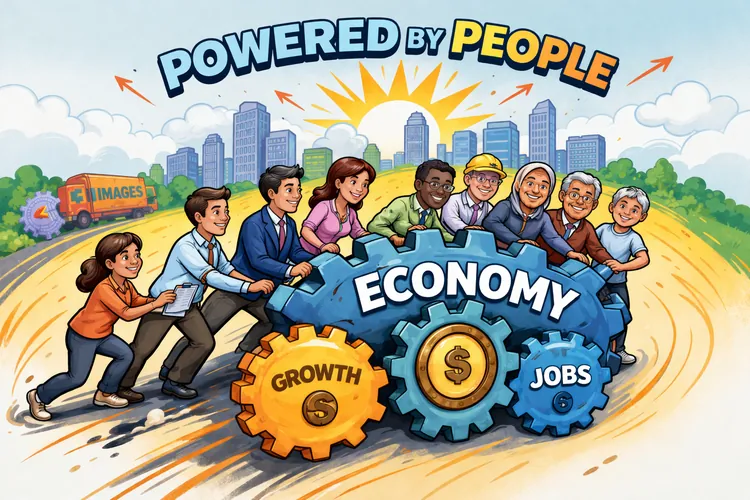
We often think the economy runs on money.
Interest rates go up — markets react.
Oil prices fall — headlines explode.
Tech stocks rise — everyone talks about innovation.
But behind all of this, there’s a quieter force at work.
People.
A Simple Question
Imagine two countries.
- One has a growing population, lots of young workers, expanding cities.
- The other has a shrinking population, aging citizens, and fewer workers every year.
Which economy grows faster?
The answer seems obvious — but the numbers make it real.
The Global Shift
For decades, population growth powered economic expansion.
In 1960, the world had about 3 billion people.
Today, it’s over 8 billion.
That growth helped fuel everything:
- more workers
- more consumers
- more demand
But something has changed.
Fewer Births, Older Societies
In the United States, the fertility rate is now around 1.6 births per woman — well below the 2.1 needed to maintain population levels.
Canada is even lower: about 1.4.
Without immigration, both countries would eventually start shrinking.
And they’re not alone.
Countries like Japan and Italy are already there:
- Japan’s population has been declining since 2010
- Italy loses population almost every year
Why This Matters for the Economy
An economy depends on a simple ratio:
Workers vs. retirees
More workers:
- more production
- more taxes
- more growth
More retirees:
- more healthcare costs
- more pensions
- more pressure on public budgets
In the U.S., there were about 5 workers per retiree in 1960.
Today, it’s closer to 2.8 — and falling.
That shift is massive.
The Hidden Constraint
Here’s the key idea:
Economic growth isn’t just about productivity.
It’s also about how many people are working.
Even if productivity rises, a shrinking workforce creates a ceiling.
That’s why economists increasingly talk about demographics as a long-term constraint on growth.
A Quiet Policy Tool
So how do countries respond?
There are only a few options:
- Increase birth rates (very difficult)
- Extend working lives (raise retirement age)
- Improve productivity (technology, AI)
- Bring in more people
That last one matters more than most people think.
In recent years, Canada’s population growth has been driven almost entirely by immigration, adding over 1 million people in 2023 alone — one of the fastest growth rates in the developed world.
The U.S. also relies heavily on immigration to sustain its labor force.
The Big Idea
The economy isn’t just shaped by markets, policies, or technology.
It’s shaped by something more fundamental:
Who is there to work, spend, and build.
Demographics don’t make daily headlines.
But over time, they quietly decide:
- how fast economies grow
- how governments spend
- and how societies evolve
A Thought to Leave With
If population is slowing…
And aging is accelerating…
Then the biggest economic question may not be:
“How fast can we grow?”
But:
“Who will do the growing?”