
The Economics of Knowing Before It Breaks
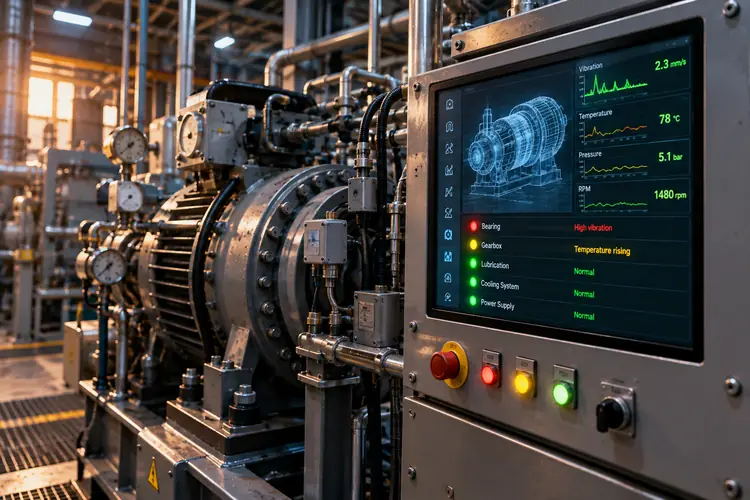
Machines have an annoying habit. They break.
For most of industrial history, we had three ways of dealing with this. Wait until the machine breaks and repair it. Inspect it regularly and hope to notice trouble. Or replace parts according to a schedule, whether they need replacing or not.
All three approaches work. All three are expensive. Then we discovered a fourth possibility:
What if the machine could tell us it was going to break?
That simple question is creating one of the most practical applications of the Internet of Things. It is called predictive maintenance.
And unlike flying cars, household humanoids, or vacations on Mars, it is already here.
The Expensive Sound of Silence
Imagine a factory producing steel, cars, chemicals, or food. Somewhere inside it is a motor. The motor costs $50,000. If it fails, however, the problem may not be the $50,000 motor. The production line stops. Workers wait. Orders are delayed. Other equipment may be damaged. Technicians arrive unexpectedly. Replacement parts need to be shipped urgently.
Suddenly a relatively ordinary component has created a very extraordinary bill.
This is one of the strange realities of industrial economics: the cost of a broken machine can be much larger than the cost of the machine itself.
The valuable thing, therefore, isn't merely repairing equipment cheaply. It is knowing when to repair it.
The Three Old Choices
Traditional maintenance usually falls somewhere between two extremes. At one end is reactive maintenance. Run the machine until something breaks. This is wonderfully efficient right up until the moment it isn't.
At the other end is preventive maintenance. Replace a bearing every six months because experience suggests that bearings tend to fail around then.
This reduces surprises, but creates another problem. What if this particular bearing could have operated safely for another year? You just threw away a perfectly useful component.
Businesses have lived with this trade-off for decades: repair too late and risk failure; repair too early and waste useful life.
Predictive maintenance attempts to escape that trade-off.
Instead of asking: "How old is the machine?" it asks: "How is the machine actually feeling?"
Machines Have Vital Signs Too
A machine cannot tell you that its knee hurts. But it has other ways of complaining.
A bearing may vibrate differently as it wears. A motor may become hotter. A pump may change its sound. Electrical current may behave unusually. Pressure may fluctuate. Lubricants may contain particles indicating wear.
None of these signals necessarily means disaster. But sensors can observe them continuously. That changes maintenance from a calendar problem into an information problem.
A technician inspecting equipment once a month sees a snapshot. A sensor measuring it every few minutes sees a movie. And movies reveal patterns that snapshots miss. Add software and machine learning, and those patterns can increasingly be compared with historical behavior.
The question changes from: "Is the machine broken?" to: "Is the machine beginning to behave like machines that later broke?"
That is a much more valuable question.
The €900,000 Bearing
This isn't theoretical.
At an ArcelorMittal hot-rolling mill in France, vibration monitoring was being used on critical machinery. In June 2021, the system noticed something unusual. Vibration on a reducer bearing in one of the finishing stands had increased dramatically — by about 180%. Further analysis indicated an advanced bearing defect.
The bearing had not yet caused the catastrophic failure everyone feared. So the company could choose when to act. It replaced the bearing preventively. The intervention cost about €30,000. According to the monitoring provider's case study, a catastrophic failure could have caused approximately €930,000 in production losses.
In other words, the valuable product wasn't really the sensor. It wasn't even the software. It was time.
The system transformed an unexpected emergency into a scheduled decision. That is the economics of predictive maintenance in one story.
Buying Time
This is what IoT often sells without saying so. Not data. Not dashboards. Not colorful graphs showing vibration frequencies.
Time.
A warning ten seconds before a machine fails may be useless. A warning three months earlier may be too uncertain. But a sufficiently reliable warning at the right moment creates options. Order the replacement part. Schedule technicians. Move production elsewhere. Wait for the weekend. Coordinate the repair with another shutdown. Finish the current batch.
The physical problem may be exactly the same. But economically, it becomes a completely different problem because managers have time to respond.
Information has created flexibility. And flexibility has value.
Why Not Put Sensors on Everything?
There is an obvious temptation. If sensors can prevent expensive failures, attach them to every machine.
But economics ruins the party again. Sensors cost money. Connectivity costs money. Software costs money. Data storage costs money. Engineers cost money. False alarms cost money too.
Imagine a system that constantly predicts disaster. "Pump 14 looks suspicious." Nothing happens. "Motor 7 may fail." Nothing happens. "Compressor 3 requires immediate attention." Still nothing. Eventually employees stop listening.
Predictive maintenance therefore faces the same problem as medical screening. Detect too little and you miss dangerous problems. Detect too much and you create unnecessary interventions.
The objective isn't maximum prediction. It is economically useful prediction.
A $50 sensor protecting a multimillion-dollar production bottleneck may be an easy decision. A sophisticated monitoring system attached to a cheap, easily replaceable device may make no sense at all.
Sometimes the economically rational maintenance strategy really is: Let it break.
From Factories to Jet Engines
The same logic becomes even more powerful when equipment is extremely expensive.
Modern aircraft engines are packed with sensors measuring parameters such as vibration, temperature, pressure, speed, and fuel flow. Engine manufacturers can analyze this information to detect abnormal behavior and plan maintenance before a problem causes an unexpected grounding. Rolls-Royce's Engine Health Monitoring systems, for example, analyze data from engines and flights to detect abnormalities and recommend maintenance actions.
An aircraft sitting unexpectedly on the ground isn't earning money. So once again, the economic value comes not simply from fixing a component. It comes from knowing when intervention will be necessary.
The machine becomes partly responsible for explaining its own condition.
Maintenance Becomes a Forecast
This represents a subtle change in our relationship with machines.
For centuries, maintenance looked backward. Something broke. We repaired it. Then maintenance became scheduled. Something will probably wear out eventually. We replace it beforehand.
Now maintenance is becoming predictive. Something is changing inside the machine. We estimate what happens next. That turns maintenance into a form of forecasting.
And once businesses learn to forecast the physical condition of equipment, the implications extend far beyond repairs. They can forecast spare-parts demand. Schedule labor more efficiently. Reduce inventories. Extend asset life. Price service contracts differently.
And perhaps even sell machines differently.
What If You Stop Selling the Machine?
There is a fascinating business-model consequence. If a manufacturer becomes very good at predicting when its machines need maintenance, perhaps customers don't need to buy the machine at all. They could buy the outcome.
Instead of selling an engine, sell hours of reliable operation. Instead of selling industrial equipment, sell guaranteed production capacity. Instead of selling a compressor, sell compressed air.
Now the manufacturer has a powerful incentive to keep the equipment running efficiently because breakdowns become the manufacturer's problem too. Sensors make these models easier because performance can be measured continuously.
The Internet of Things therefore doesn't merely change maintenance. It can change what companies sell.
The Most Valuable Sensor Is a Clock
We usually think technology creates value by doing something faster. Predictive maintenance does something stranger. It creates value by telling us something earlier.
The bearing will still wear. The pump will still need replacing. The motor will eventually fail.
IoT doesn't repeal physics. It changes when we know what physics is doing.
And sometimes that difference between knowing today and discovering tomorrow is worth hundreds of thousands of dollars.
The machine hasn't learned how to live forever.
It has learned how to give us a warning.
And in economics, knowing before everyone (or everything) else does has always been valuable.