
The Dollar Has a Score. But What Does It Measure?
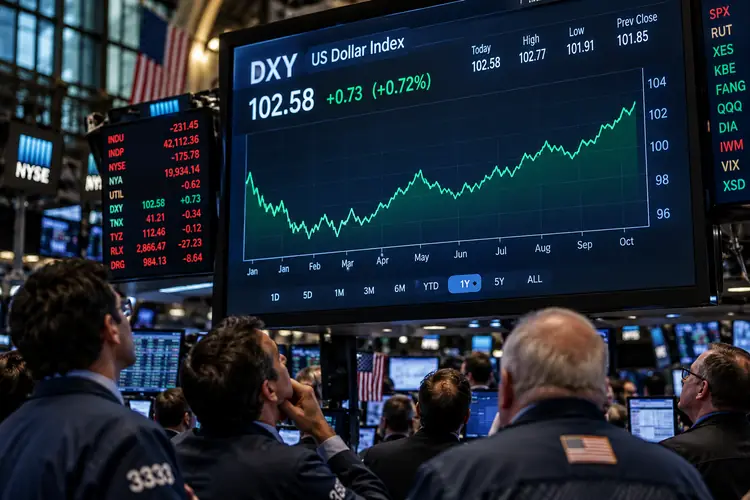
The world's most important currency has a price. Actually, it has several. And that makes things complicated.
How Much Is a Dollar Worth?
Here's a question that sounds almost too simple to ask: how much is one US dollar worth?
In New York, the answer is obvious. One dollar. In Paris, it's worth a certain number of euros. In Tokyo, a certain number of yen. In London, a certain fraction of a pound.
But suppose the dollar rises against the Japanese yen while falling against the euro. Has the dollar become stronger or weaker? Both, apparently.
This is the peculiar problem with currencies. Unlike a barrel of oil or an ounce of gold, a currency has no single international price. Its value depends on what you're comparing it with.
And that creates a problem for economists, investors, and anyone trying to understand what's happening to the world's most important currency.
Fortunately, someone invented a scoreboard.
It's called the US Dollar Index.
Six Currencies, One Number
The US Dollar Index, commonly known as DXY, measures the dollar's value against a basket of six foreign currencies.
Think of it as a financial thermometer. Instead of measuring temperature, it measures the dollar's relative strength.
The index was introduced in 1973, shortly after the Bretton Woods system of fixed exchange rates collapsed. The dollar was no longer tied to gold at a fixed official price, and major currencies were beginning to float against one another.
Suddenly, exchange rates were moving constantly. The financial world needed a way to track the dollar's overall performance. The solution was surprisingly simple: compare it with several important currencies rather than just one.
Today's DXY basket contains:
Currency Weight
Euro 57.6%
Japanese yen 13.6%
British pound 11.9%
Canadian dollar 9.1%
Swedish krona 4.2%
Swiss franc 3.6%
Notice something unusual? The euro accounts for more than half the index.
That means DXY is heavily influenced by what happens between the dollar and the euro. A significant movement in that exchange rate can dominate the entire index.
There's another interesting detail. The index started at 100 in 1973. If DXY reaches 110, it means the dollar is roughly 10% stronger against its weighted currency basket than it was at the starting point, according to the index's calculation. If it falls to 90, the dollar is roughly 10% weaker.
The calculation itself uses a weighted geometric formula, but there's no need to carry that formula around in your head.
The important point is that DXY provides a single number describing the dollar's international performance.
Or at least part of it.
Why Does the Dollar Move?
Currencies don't become stronger or weaker by accident.
Their exchange rates reflect millions of decisions made by banks, companies, governments, investors, and ordinary people.
But a few forces matter more than others. Interest rates are one of them.
Suppose American government bonds offer higher yields than comparable European bonds. International investors may find dollar-denominated assets more attractive.
To buy those assets, they often need dollars. Greater demand can push the currency higher. This is one reason financial markets pay so much attention to the Federal Reserve.
A relatively small change in expectations about US interest rates can move exchange rates around the world.
Inflation matters too. A country with persistently high inflation may see its currency weaken over time, particularly if its central bank fails to maintain confidence.
Economic growth also plays a role. A strong economy can attract international investment, increasing demand for its currency.
But the dollar has another unusual characteristic.
It often becomes stronger when the world becomes more frightened. During financial crises, wars, or periods of extreme uncertainty, investors frequently seek safety in US Treasury securities and other highly liquid dollar assets.
This creates a remarkable paradox. Bad news for the global economy can sometimes be good news for the dollar. And occasionally, even bad news originating in America can increase demand for American dollars.
The world's financial system has some strange habits.
What the Index Doesn't Tell You
Now comes the part that makes DXY more interesting than it first appears.
The index looks authoritative. It has a precise number, a historical chart, and a permanent place on financial trading screens.
But it has limitations. The most obvious is its currency basket.
Where is the Chinese yuan? China is one of the world's largest economies and trading nations. Yet its currency isn't included in DXY.
Neither are the Indian rupee, South Korean won, or Mexican peso. Meanwhile, the Swedish krona represents 4.2% of the index.
This isn't necessarily a mistake. The basket reflects historical choices about important trading partners and currency markets, rather than today's complete structure of global commerce.
But it means DXY shouldn't be confused with a comprehensive measure of the dollar's value against the entire world.
The Federal Reserve publishes broader trade-weighted dollar indexes that include many more currencies and reflect changing trade relationships.
There's another limitation, perhaps even more important.
A strong dollar doesn't necessarily mean Americans are becoming richer.
Suppose DXY rises by 10%. Does that mean a dollar buys 10% more groceries in Chicago? Of course not.
Domestic purchasing power depends primarily on prices inside the United States.
A dollar can strengthen against foreign currencies while losing purchasing power at home because of inflation. In other words, the dollar can be winning internationally while losing domestically.
Both statements can be true at the same time.
A Scoreboard, Not a Verdict
Why, then, do investors watch DXY so closely?
Because exchange rates influence much more than currency trading.
A stronger dollar can make imported goods cheaper for American consumers. It can also make US exports more expensive for foreign buyers.
American multinational companies may find that profits earned overseas translate into fewer dollars.
Countries and companies that borrowed in dollars can face greater repayment burdens when their local currencies weaken.
Commodity markets pay attention too. Oil, gold, and many other internationally traded products are commonly priced in dollars, creating important connections between currency movements and global prices.
A single change in the dollar's value can therefore affect businesses and households thousands of miles from the United States.
Yet none of these effects is automatically good or bad.
A stronger dollar benefits some people and hurts others. A weaker dollar does exactly the same thing, just with different winners and losers.
And this brings us back to our original question. How much is a dollar worth?
The Dollar Index offers an answer, but only to a carefully defined question.
It tells us how the dollar is performing against six other currencies, using a particular set of weights inherited from financial history.
It doesn't tell us whether the American economy is healthy, whether Americans are becoming wealthier, or whether the dollar's global dominance is secure.
Those are much bigger questions.
The dollar has a scoreboard. But a higher score doesn't always mean a better game.
And that may be the most important thing to understand before looking at the next movement in DXY.