
The Business Models of Space: What Actually Makes Money Up There?
Let’s be honest.
When most people think about the space economy, they imagine:
- space tourism
- mining asteroids
- colonies on Mars
It sounds exciting.
It also sounds expensive.
And in many cases, it’s not where the money is — at least not yet.
So if we strip away the hype, a more practical question emerges:
What business models in space actually work today — and which ones are still dreams?
1. Satellite Internet: The First Mass-Market Space Product
If there is one clear winner so far, it’s this:
internet from space.
Satellite constellations are turning orbit into a global telecom network.
The idea is simple:
- thousands of small satellites
- covering the entire planet
- delivering internet anywhere — including remote regions
Why does this matter?
Because billions of people still lack reliable high-speed internet.
And even in developed countries, coverage is uneven.
From an economic perspective, this is powerful:
- recurring subscriptions
- massive potential customer base
- scalable infrastructure
This is not a niche product.
It’s a global utility.
## 2. Launch Services: The “Picks and Shovels” Business
Every space business depends on one thing:
getting into space.
That makes launch providers the equivalent of selling tools during a gold rush.
Instead of searching for gold, they sell access.
This is a classic business model:
- charge per launch
- serve governments and private companies
- benefit from growing demand
As launch costs fall, demand increases.
And as demand increases, launch providers scale.
It’s not glamorous.
But it’s essential.
And essential industries tend to survive.
3. Earth Observation: Selling Data About Earth
Here’s a surprising truth:
Some of the most valuable space data is not about space.
It’s about Earth.
Satellites continuously monitor:
- crops
- oceans
- cities
- supply chains
- climate patterns
This data is sold to:
- governments
- insurance companies
- logistics firms
- agricultural businesses
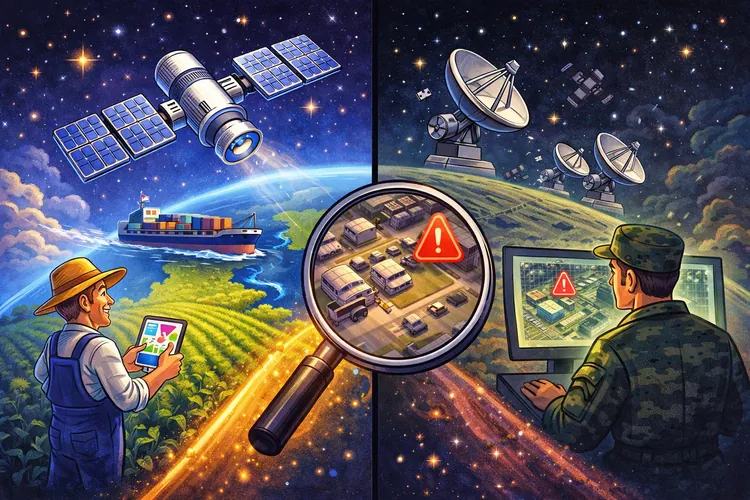
For example:
- farmers use satellite data to optimize yields
- insurers assess disaster risks
- companies track global shipping in real time
- military agencies monitor troop movements, detect infrastructure changes, and analyze activity in strategic regions using high-resolution satellite imagery
This is a quiet but powerful market.
Not flashy — but highly profitable.
4. Navigation and Timing: The Invisible Backbone
You don’t pay for GPS.
But you rely on it constantly.
Navigation systems power:
- smartphones
- aviation
- shipping
- financial transactions
In fact, even banking systems depend on precise timing signals from satellites.
This sector is often government-funded, but its economic value is enormous.
It’s like electricity:
You don’t think about it — until it disappears.
5. Space Tourism: The Luxury Experiment
Now we get to the headlines.
Space tourism exists.
But economically, it’s still a niche.
Right now:
- ticket prices are extremely high
- the number of customers is limited
- operations are complex and risky
This makes it more like:
- luxury yachting
- private jets
…than mass transportation.
Could it grow?
Yes. Will it become a major economic driver soon?
Unlikely. At least not in the next decade.
## 6. Asteroid Mining: The Ultimate “Maybe”
Few ideas capture the imagination like asteroid mining.
The concept:
- extract rare metals from asteroids
- bring them back (or use them in space)
- unlock enormous value
In theory, this could be worth trillions.
In practice, it faces huge challenges:
- extreme technical difficulty
- unclear legal framework
- uncertain demand
Right now, asteroid mining is not a business.
It’s a long-term bet.
7. Lunar Economy: Infrastructure Before Profit
There is growing interest in building a presence on the Moon.
But here’s the key insight:
The Moon is not yet a market.
It’s infrastructure.
Before businesses can operate there, you need:
- transportation systems
- energy sources
- communication networks
- life-support systems
This means early lunar activity will likely be:
- government-funded
- strategically motivated
Private profit may come later.
But first comes investment.
The Pattern: What Works vs What Doesn’t
If we step back, a clear pattern emerges.
What works today:
- services with immediate demand
- data and communication
- infrastructure supporting Earth-based needs
What doesn’t (yet):
- speculative extraction
- luxury experiences at scale
- long-term colonization
In simple terms:
The closer a space business is to solving a problem on Earth, the more likely it is to succeed.
The Quiet Truth About Space Economics
Here’s the part that may surprise you.
The most successful space businesses don’t feel like “space businesses.”
They feel like:
- telecom companies
- data providers
- infrastructure operators
Space is just the platform.
The value is in the service.
A New Kind of Industry
We are not witnessing the birth of a sci-fi economy.
We are witnessing the extension of the existing one.
Into orbit.
Into data.
Into global systems.
And that may be even more important.
Because it means space is not a separate world.
It’s becoming part of the same economic system we already live in.