
The Auction Room Economy: Why Billionaires Keep Fighting Over Paintings
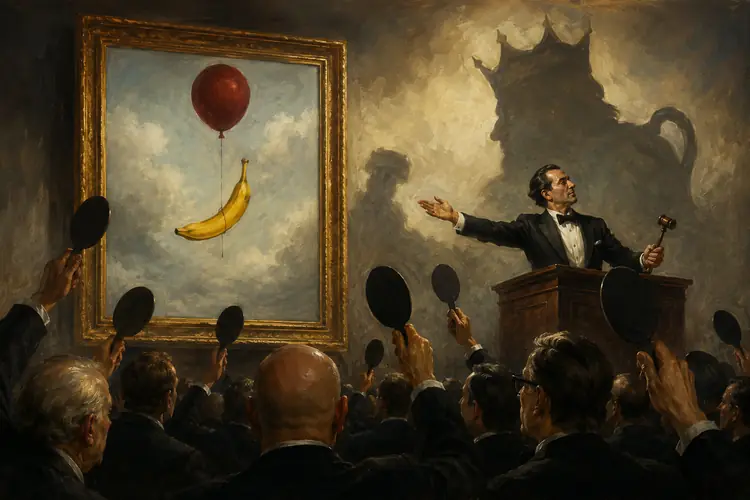
The modern art auction is one of the strangest theaters of capitalism.
A person raises a small paddle for ten seconds… and suddenly spends more money than the annual budget of a small town.
At first glance, the global art market looks absurd:
a banana taped to a wall sells for millions,
a painting becomes more expensive than a skyscraper,
and billionaires compete over canvases most people would walk past in silence at a hotel lobby.
But art auctions are not really about paint.
They are about scarcity. Status. Power. Global wealth. And the human desire to own something nobody else can own.
The numbers behind the industry are enormous.
According to Art Basel & UBS, global public art auction sales reached roughly $25 billion in 2023 even after a slowdown from the post-pandemic boom years.
That makes art auctions not merely a cultural curiosity.
They are a global economic system.
The Three Empires of the Auction World
The high-end auction business is dominated by three major names:
Christie’s,
Sotheby’s,
and Phillips.
Christie’s was founded in 1766. Sotheby’s dates back to 1744.
These companies are older than the United States itself.
Empires disappeared. Currencies collapsed. Entire industries vanished.
But wealthy people competing over rare objects somehow survived everything.
Today these firms operate less like traditional auction houses and more like luxury financial institutions.
Christie’s reported approximately $5.7 billion in sales during 2024.
Sotheby’s reported around $6 billion.
That is larger than the annual revenues of many publicly traded companies people actually recognize.
The market expanded dramatically during the 21st century.
In the early 2000s, globalization created entirely new groups of ultra-wealthy buyers:
Russian oligarchs,
Chinese billionaires,
Middle Eastern royal buyers,
Silicon Valley founders,
crypto millionaires.
Suddenly the competition for rare masterpieces became global.
And when wealthy people compete globally for finite assets, prices stop behaving rationally.
Why Art Prices Became So Extreme
The art market follows a brutal economic formula:
fixed supply + expanding global wealth = explosive prices
There will never be another Picasso. There will never be another Basquiat. There will never be another Van Gogh.
The supply is permanently frozen. But the number of wealthy buyers keeps growing.
That imbalance changed the economics of art completely.
In normal industries, rising prices attract more production.
In art, dead artists stubbornly refuse to increase output.
As a result, the very top of the market became almost disconnected from ordinary economic logic. One painting can suddenly become a global status symbol for billionaires.
And status assets do not behave like normal products. People do not buy them because they are practical. They buy them because they are impossible to replicate.
The $450 Million Painting
Every industry eventually produces one symbolic moment that defines an era.
For the art world, that moment arrived in 2017.
Leonardo da Vinci’s Salvator Mundi sold at Christie’s for approximately $450.3 million — still the highest auction price ever paid for a single artwork. Nearly half a billion dollars. For one painting.
That sale permanently changed public perception of the art market. Suddenly even people completely uninterested in art understood something important:
the ultra-luxury economy operates by very different rules.
At that level, buyers are not comparing paintings to other paintings. They are comparing them to:
private islands,
sports teams,
superyachts,
space companies,
or political influence.
And strangely, within that world, $450 million starts to feel psychologically possible.
Absurd.
But possible.
Auctions Became Entertainment
The 21st century transformed auctions from elite private events into global media spectacles. Twenty years ago, auctions were quiet social rituals for insiders:
paper catalogs,
private rooms,
wealthy collectors who often knew each other personally.
Today a billionaire in Singapore can bid live against a hedge fund manager in New York from a smartphone.
Online bidding exploded after COVID-19.
Digital participation is now normal even for elite sales.
That shift changed the psychology of auctions. Because auctions are no longer merely transactions. They are performances.
Auction houses deliberately create drama: the pauses, the countdown, the rising tension, the rapid bidding. The auctioneer acts somewhere between a financial broker and a casino host. And this matters economically.
Humans become irrational inside competitive environments. Especially wealthy humans. A private negotiation feels analytical. A live auction feels emotional.
And emotional buyers can spend extraordinary amounts of money.
Art as a Financial Tool
This is the uncomfortable part of the conversation.
Many elite collectors are not buying art primarily because they love art. They are buying optionality.
Art has characteristics wealthy investors find extremely attractive: portability, privacy, prestige, scarcity, and international recognition.
A painting can function simultaneously as:
- a luxury object,
- a status symbol,
- a store of wealth,
- and sometimes a tax strategy.
Unlike stocks, it can also hang beautifully on a wall while impressing dinner guests.
That combination is difficult to compete with.
Over time, the auction world increasingly merged with wealth management and alternative investing. Some buyers genuinely love culture. Others simply love owning expensive things that other rich people recognize instantly.
The two motivations often overlap.
Why the Art Market Keeps Crashing — and Recovering
The art market is highly cyclical. When stock markets boom and liquidity floods the economy, art prices usually rise sharply. When financial stress appears, auction sales weaken almost immediately. The 2008 financial crisis demonstrated this clearly.
So did the recent slowdown after the post-pandemic luxury boom.
And yet something interesting keeps happening: the market never truly disappears. It contracts. It freezes. Collectors become cautious.
Then eventually the market returns.
Why?
Because global wealth concentration continues increasing. And wealthy buyers continue searching for scarce assets that feel culturally important. That creates recurring demand even during uncertain economic periods.
In some ways, masterpieces behave almost like financial safe havens for the ultra-rich.
Not because paintings generate cash flow.
But because they combine rarity with prestige.
The Future of Auctions
The definition of collectible wealth keeps expanding.
Auction houses now aggressively sell: luxury watches, rare sneakers, sports memorabilia, NFTs, handbags, jewelry, and collectible design objects.
The future collector may look less like an aristocrat in a tuxedo and more like a technology founder watching an auction livestream from an airport lounge.
The industry is becoming: more digital, more global, more theatrical, and more entertainment-driven.
But beneath all the technology, the psychology remains ancient.
Humans have always attached emotional value to rare objects.
Sometimes cultural value.
Sometimes financial value.
Sometimes symbolic value.
And sometimes all three simultaneously.
That is why auctions survive every technological revolution.
Because beneath the economics lies something far older than capitalism itself:
competition, status, storytelling,
and the desire to own a piece of history before somebody else does.