
The AI Inequality Problem: Who Actually Gets the Benefits?
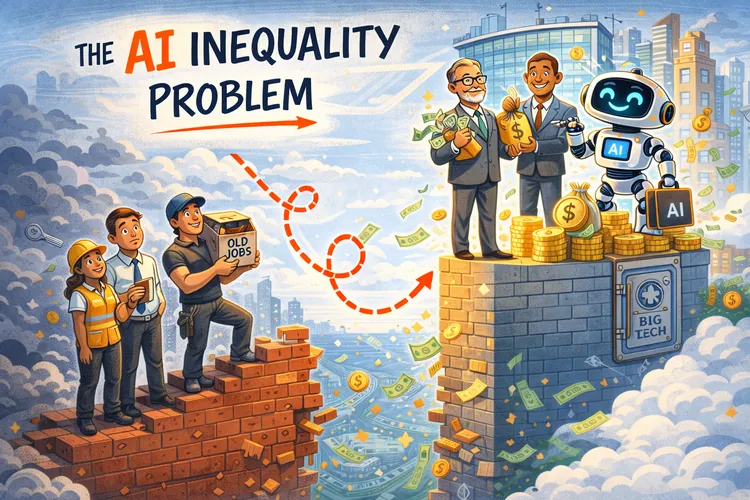
Artificial intelligence could make economies much more productive.
That’s the good news.
But economists are increasingly asking a more uncomfortable question:
Who will actually benefit from this productivity boom?
Because history shows that technological revolutions do not distribute their rewards evenly.
Some people gain enormously.
Others are left behind.
Artificial intelligence may amplify this pattern.
The “Winner-Takes-More” Economy
Many modern technologies tend to create what economists call winner-takes-most markets.
In these markets, a small number of companies dominate globally.
Think about industries shaped by digital technology:
- search engines
- social media
- online retail
- smartphone operating systems
In many of these sectors, a few companies capture a huge share of profits.
Why does this happen?
Because digital products scale extremely well.
Once software is created, it can often be distributed to millions — or billions — of users at very low cost.
Artificial intelligence may reinforce this effect.
Why AI Favors Large Companies
Developing powerful AI systems requires enormous resources.
Companies need:
- massive datasets
- expensive computing infrastructure
- highly specialized engineers
- enormous financial investment
This creates a natural advantage for large technology firms.
Some of the most advanced AI models today cost hundreds of millions of dollars to train.
Few companies in the world can afford that.
As a result, the economic power of large tech companies could grow even stronger in the AI era.
The Superstar Effect
Economists sometimes talk about superstar firms.
These are companies that dominate their industries and capture a disproportionate share of profits.
Artificial intelligence may increase this effect.
If AI allows a single company to operate far more efficiently than competitors, it may rapidly expand its market share.
The same may happen to individuals.
In fields like entertainment, design, or writing, AI tools may allow a few highly skilled creators to produce vastly more content.
That could concentrate income among the most successful professionals.
What Happens to the Middle?
One concern among economists is the potential hollowing out of middle-income jobs.
Many middle-class professions involve structured information processing:
- administrative work
- basic financial analysis
- routine legal tasks
- standard office management
AI may automate parts of these roles.
At the same time, the highest-paid experts and the lowest-paid service workers may remain less affected.
If that happens, income inequality could increase.
The Policy Debate Begins
Because of these risks, policymakers in the United States, Canada, and Europe are beginning to debate how the AI economy should be regulated.
Some ideas being discussed include:
- stronger antitrust enforcement
- public investment in AI research
- education and retraining programs
- rules governing the use of data
The goal is not to stop technological progress.
Few economists believe that is possible — or desirable.
Instead, the challenge is to ensure that the benefits of AI are widely shared.
Technology Still Raises Living Standards
Despite concerns about inequality, it is important to remember something fundamental.
Over the long run, technological progress has consistently raised living standards.
Electricity, automobiles, computers, and the internet all created disruptions.
But they also made societies richer and more productive.
Artificial intelligence may do the same.
The real question is how societies manage the transition.
Because the next stage of the AI economy may not just reshape companies and jobs.
It could reshape entire economic cycles.
And that brings us to the next question in this series.
Could artificial intelligence trigger the next great economic boom?
Post 1
Artificial intelligence could make economies much more productive.
That’s the exciting part.
But economists are starting to ask a harder question.
Who will actually benefit from that productivity?
Because technological revolutions rarely distribute their rewards evenly.