
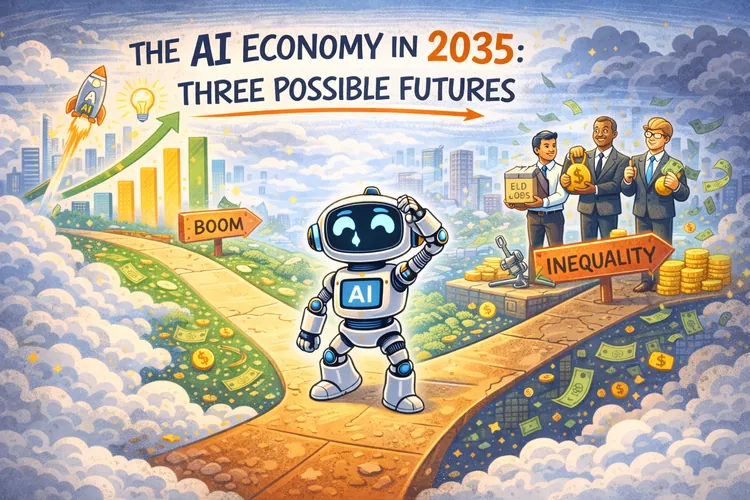
The AI Economy in 2035: Three Possible Futures
Trying to predict the future of technology is a risky business.
In the 1960s, people imagined flying cars by the year 2000.
In the 1990s, many believed the internet would eliminate recessions.
Reality usually turns out to be more complicated.
Artificial intelligence is already changing how people work, how companies operate, and how economies grow. But what the world will look like ten years from now is still uncertain.
Economists and technology experts often think about the future in terms of scenarios — different paths the world might take.
Let’s imagine three possible versions of the AI economy in the year 2035.
Scenario 1: The AI Boom
In the most optimistic scenario, artificial intelligence triggers a powerful wave of productivity.
Companies adopt AI tools across almost every industry.
Doctors diagnose diseases faster.
Engineers design products more efficiently.
Scientists discover new materials and medicines.
Productivity growth accelerates significantly.
Instead of growing at 1–2% per year, advanced economies begin growing closer to 3–4% annually.
That may not sound dramatic, but over time it makes a huge difference.
Higher productivity leads to:
- rising wages
- lower costs for many services
- faster economic growth
Entirely new industries emerge around AI-powered technologies.
Much like the internet boom of the 1990s, the global economy enters a new period of innovation and expansion.
Scenario 2: The Uneven AI Economy
A second possibility is more complicated.
Artificial intelligence improves productivity — but the benefits are unevenly distributed.
Large technology companies dominate AI development. A small number of highly skilled professionals benefit enormously.
But many workers struggle to adapt to the rapid pace of change.
Some office jobs shrink as AI automates routine tasks.
New jobs appear, but not always in the same locations or industries.
In this scenario, economies continue to grow, but political debates intensify around issues such as:
- inequality
- technology regulation
- worker retraining
Artificial intelligence becomes both a powerful economic engine and a source of social tension.
Scenario 3: The AI Plateau
The third possibility is that artificial intelligence turns out to be less transformative than many people expect.
AI tools continue to improve productivity in certain fields, but their broader impact is limited.
Businesses adopt the technology slowly.
Regulation and technical challenges slow development.
Productivity improves, but only modestly.
Economies continue growing at roughly the same pace as today.
In this scenario, AI becomes an important technology — but not the revolutionary force some people predict.
Why the Future Is So Hard to Predict
The truth is that technological revolutions rarely follow a simple path.
Electricity took decades to transform factories.
Computers existed for years before personal computing exploded.
The internet boom arrived long after the first networks were built.
Artificial intelligence may follow a similarly unpredictable timeline.
Its impact will depend not only on technology, but also on:
- business decisions
- government policy
- education systems
- global competition
The One Thing We Can Be Sure About
Even though the exact outcome is uncertain, one conclusion already seems clear.
Artificial intelligence is becoming one of the most important technologies of the 21st century.
It is already reshaping how knowledge work is performed.
Over the next decade, it will influence:
- productivity
- jobs
- inequality
- innovation
In other words, AI is not just a technological story.
It is an economic story.
And like every major technological revolution before it, the most important question is not whether change will happen.
It already has.
The real question is how societies adapt to it.