
The AI Economy Has Already Started — You Just Didn’t Notice
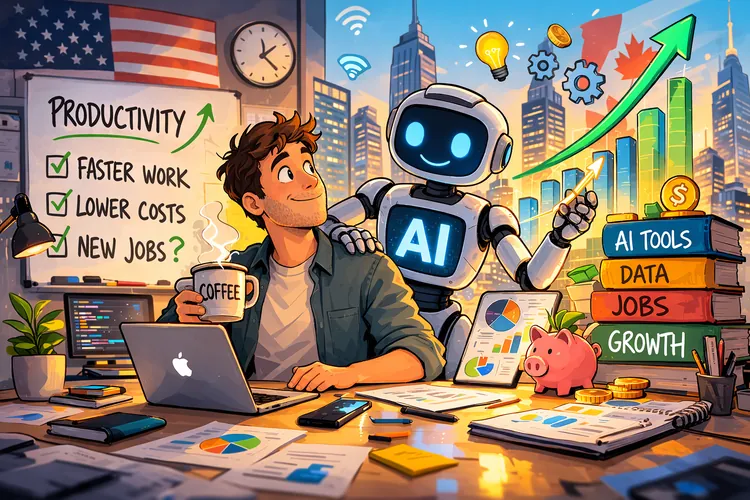
If you ordered food online this week, used Google Maps to avoid traffic, or asked a chatbot to help write an email, congratulations — you participated in the AI economy.
The strange thing about artificial intelligence is that, unlike past technological revolutions, it didn’t arrive with loud announcements or dramatic factory openings. It quietly slipped into everyday tools.
And now it is starting to reshape the economies of developed countries — including the United States and Canada.
But not in the way many people expected.
The Industrial Revolution vs. the AI Revolution
Previous technological revolutions were easy to see.
Steam engines built railroads.
Electricity lit entire cities.
Computers filled office buildings.
Artificial intelligence works differently.
It doesn’t necessarily replace entire industries overnight. Instead, it slowly changes how millions of individual tasks are done.
Think about a marketing manager writing advertising copy.
A lawyer summarizing documents.
A programmer debugging code.
None of these jobs disappear instantly. But if AI tools can do 30–40% of the routine work, something important happens.
The same employee suddenly becomes much more productive.
And productivity is the engine of economic growth.
Productivity: The Secret Behind Wealthy Economies
Economists obsess over one number: productivity — how much output each worker produces.
Why?
Because in the long run, higher productivity means:
- higher wages
- lower prices
- stronger economic growth
For decades, productivity growth in developed countries has been slowing.
From 1950 to 2000, productivity in the U.S. grew roughly 2–3% per year.
Since the early 2000s, that number has been closer to 1%.
Economists have been asking the same question for years:
Where will the next productivity boom come from?
Artificial intelligence might be the answer.
The “Invisible Productivity” Effect
One reason AI is hard to measure is that it improves knowledge work, not just manufacturing.
For example:
- A software engineer with AI tools may complete tasks 30–50% faster
- A customer service department may resolve tickets twice as quickly
- A medical researcher may analyze thousands of papers in minutes
These improvements don’t always show up immediately in GDP statistics.
But across millions of workers, the effect compounds.
A small productivity boost multiplied by 150 million workers in the United States becomes a massive economic shift.
AI Is More Like Electricity Than Like Robots
Many people imagine AI as humanoid robots replacing workers.
But a better analogy may be electricity.
When electricity was first introduced in the late 1800s, factories didn’t immediately become more productive.
It took decades for businesses to redesign processes around electric power.
The same may happen with AI.
Right now, we are in the early stage:
people are experimenting, companies are testing tools, and economists are arguing about what it all means.
The real transformation may take 10–20 years.
A Brief History of AI — and Why the Market Suddenly Exploded
Artificial intelligence sounds like a futuristic invention, but the idea itself is surprisingly old.
Back in the 1950s, scientists were already asking a dangerous question:
Could machines eventually “think”?
In 1956, a group of researchers gathered at Dartmouth College in the United States for a workshop that is now considered the birth of artificial intelligence as a formal field. At the time, computers were enormous, slow, and unbelievably expensive. Yet researchers believed that one day machines might learn language, recognize patterns, and solve problems like humans.
That optimism turned out to be both right and hilariously premature.
For decades, AI mostly lived inside universities, research labs, and science-fiction movies. Computers simply lacked the processing power and data required to make the idea practical. Every few years investors would become excited, spend money aggressively, then lose interest when the technology failed to deliver miracles. Economists later nicknamed these periods “AI winters” — which sounds poetic until you realize billions of dollars quietly disappeared into them.
Then three things changed at once.
First, computing power became dramatically cheaper.
Second, the internet created oceans of data.
Third, companies discovered that machine learning systems improve when trained on massive amounts of information.
Suddenly AI stopped being a laboratory curiosity and became a business tool.
Today the market is crowded with AI products — but not all AI companies are trying to solve the same problem.
Some tools focus on language and communication.
OpenAI’s ChatGPT, Google’s Gemini, Anthropic’s Claude, and Microsoft Copilot help users write, summarize, analyze, brainstorm, and automate office work. In many American and Canadian companies, these systems are already quietly functioning as junior assistants for white-collar workers.
Other AI systems specialize in images and video.
Midjourney, DALL·E, and Adobe Firefly generate illustrations, marketing visuals, and design concepts in seconds. Hollywood studios, advertisers, and even small businesses are experimenting with them because hiring an artist for every draft suddenly looks slower and more expensive.
Then there are industrial and enterprise systems — the less glamorous but potentially more important side of AI.
Amazon uses AI to optimize logistics and warehouse operations.
Tesla applies AI to self-driving systems.
NVIDIA became one of the world’s most valuable companies largely because its chips power modern AI infrastructure.
Meanwhile healthcare companies use AI to analyze medical scans, pharmaceutical firms use it for drug discovery, and banks increasingly rely on AI to detect fraud.
What makes this moment economically unusual is that AI is no longer one industry.
It is becoming a layer beneath many industries — similar to electricity, the internet, or cloud computing.
And like every major infrastructure shift, the biggest winners may not be the companies that invented the technology first.
They may be the companies that learn to use it most effectively.
That is why economists are paying close attention now.
Not because robots are marching through the streets.
But because millions of small productivity improvements are quietly spreading through the economy at the same time.
And history suggests that when that happens, very large economic changes usually follow.
The Big Economic Question
Every technological revolution raises the same fear:
Will machines replace workers?
History gives a complicated answer.
Technology destroys some jobs — but it also creates new ones that were previously unimaginable.
In 1990, nobody was hiring:
- app developers
- social media managers
- cloud infrastructure engineers
Yet today millions of people work in these roles.
Artificial intelligence will almost certainly eliminate some tasks. But it will also create entirely new industries.
The real question is not whether jobs will change.
They always do.
The real question is how fast the transition happens — and whether economies adapt smoothly.
That’s where things get interesting.
Because the next stage of the AI economy may not be about productivity.
It may be about who benefits from it.
And that will shape the politics, wages, and growth of the next decade.