
The 2026 World Cup by the Numbers: Who Really Won Financially?
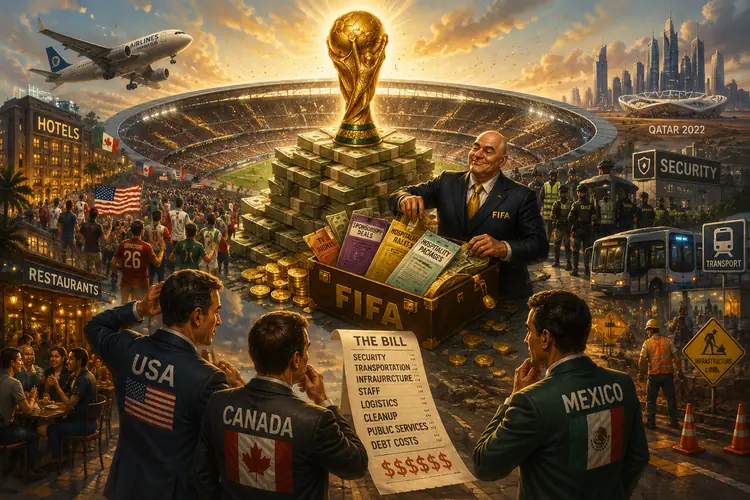
Spain left North America with the trophy. FIFA left with record revenues. Millions of fans left with photographs, credit-card bills, and stories they will probably repeat for decades.
But what did the United States, Canada, and Mexico actually receive in return?
That question is harder to answer than the final score. A World Cup produces several different financial stories at once. FIFA collects revenue from broadcasting rights, sponsorships, tickets, and hospitality. Hotels, restaurants, airlines, and local businesses receive a temporary surge in customers. Governments collect additional taxes—but also pay for security, transportation, stadium improvements, public events, and crowd management.
Everyone participates in the same tournament. They do not necessarily participate in the same profits.
The Biggest World Cup Ever
The 2026 World Cup was designed to break records before the first ball was kicked.
It was the first men’s World Cup with 48 teams rather than 32, the first jointly hosted by three countries, and the first to include 104 matches. Qatar staged 64 matches in 2022. North America staged 40 more.
That expansion changed the economics immediately. More teams meant more supporters, more hotel nights, more flights, more television inventory, and more opportunities to sell tickets. It also meant more security, more transportation, more temporary infrastructure, and a far more complicated tournament spread across 16 stadiums and three enormous countries.
The result was a spectacular attendance record. FIFA reported that more than 6.6 million spectators attended the tournament—almost twice the total recorded in Qatar. The 2022 World Cup attracted more than 3.4 million spectators, with very high stadium occupancy. Part of that difference is simple arithmetic. North America offered 104 matches and many much larger stadiums. Qatar offered 64 matches concentrated in and around Doha.
Still, selling millions of seats across such a vast territory was not guaranteed. High ticket prices, long distances, visa concerns, and expensive domestic travel could all have discouraged supporters. Instead, demand remained strong, and the group stage alone attracted more than 4.6 million people, with FIFA reporting stadium occupancy of 99.7%.
The World Cup did not merely fill stadiums. It demonstrated that soccer could fill American football arenas repeatedly, even when neither Lionel Messi nor the host nation was playing.
The Real Stadium Was the Screen
Physical attendance matters because it creates atmosphere. Television matters because it creates scale.
The Qatar World Cup engaged roughly 5 billion people across television, digital media, social platforms, and FIFA’s own channels. FIFA’s audience report also described an average global live audience of about 175 million viewers per match. A final, methodologically comparable global audience figure for the entire 2026 tournament has not yet been released. That is important. “People reached,” “people engaged,” “unique viewers,” and “average live audience” are different measurements, even though they are often presented as if they were interchangeable.
What we do know is that the tournament produced a major breakthrough in the United States. Nearly 63 million Americans watched Spain defeat Argentina in the final, according to early broadcast figures. Fox attracted 38.9 million English-language viewers, while Telemundo and Peacock added 23.9 million Spanish-language viewers. The combined audience was almost three times the U.S. audience for the 2022 final. That may prove to be one of the tournament’s most important economic legacies.
The United States did not suddenly become a soccer country in the European or Latin American sense. But the World Cup showed broadcasters, advertisers, leagues, and sponsors that elite soccer could compete with America’s largest domestic sporting events.
A World Cup lasts five weeks. A change in the commercial value of soccer could last much longer.
FIFA Was the Clearest Winner
For FIFA, the financial logic was much simpler. Its revised budget projected $13 billion in revenue during the 2023–2026 cycle, a dramatic increase from the previous cycle.
The expanded World Cup was the centerpiece of that commercial plan. That money does not come from one source. FIFA sells global broadcasting rights, sponsorship packages, licensing agreements, hospitality products, and tickets. An expanded tournament creates more of almost everything: more matches to televise, more advertising opportunities, more premium seats, and more national markets emotionally invested in the competition.
Even the prize fund grew. FIFA allocated a record $871 million to participating federations, with the champion receiving $51 million. Argentina had received $42 million for winning in 2022. This is the crucial distinction in World Cup economics: FIFA’s revenues are concentrated and measurable.
The hosts’ benefits are dispersed and debatable. FIFA knows how much it sold a television contract for. A city has a harder time determining whether a hotel room was occupied because of the World Cup, whether the visitor would have come anyway, or whether local residents simply moved their normal spending from one part of the city to another.
The United States: A Large Boost, but Not Free Money
The United States hosted most of the matches and therefore captured the largest share of visitor spending. Hotels filled, restaurants served international crowds, airlines moved supporters between distant cities, and advertisers paid premium prices to reach record audiences.
Some economic estimates placed the World Cup’s short-term contribution to U.S. GDP at approximately $6.1 billion during June and July, with foreign tourism providing the largest channel of impact. Other estimates were much larger, but such numbers should be treated cautiously. Economic-impact studies often count gross activity rather than net benefit. They may include spending that would have happened elsewhere in the economy, apply optimistic multiplier effects, or ignore the public cost of hosting.
For local businesses, the outcome also depended heavily on location. A hotel near a stadium could have an exceptional month. A restaurant outside the main fan routes might see little change. Some residents avoided crowded downtown areas entirely, shifting spending away from businesses that had expected a boom.
The United States probably achieved something more valuable than a five-week consumption surge: it raised the market value of soccer itself. The record final audience, strong advertising demand, and packed knockout matches gave Major League Soccer, broadcasters, sponsors, and future event organizers a larger commercial platform. That is a real benefit, although it cannot be measured accurately the morning after the final.
Canada: History Came with a Billion-Dollar Bill
For Canada, the tournament had enormous symbolic value.
Toronto and Vancouver hosted the country’s first men’s World Cup matches, and Canada reached the knockout stage on home soil.
But the public cost was substantial. Canada’s Parliamentary Budget Officer estimated that federal, provincial, and municipal governments would spend about C$1.066 billion, or roughly US$727 million, to host 13 matches. The federal government was expected to cover C$473 million, with other levels of government providing the remaining C$593 million. That worked out to approximately C$82 million in public spending per match.
Those figures do not automatically mean the tournament was a bad investment. Some spending paid for security, transportation, stadium work, public celebrations, and improvements that may continue to provide value. But Canada illustrates the central problem of mega-events: the cultural benefits are easy to feel, while the financial return is difficult to prove.
A packed stadium is visible. The opportunity cost of C$1 billion is not.
Mexico: Passion Was Stronger Than the Economic Lift
Mexico entered the tournament with advantages the other hosts could not reproduce. It already had deep football culture, internationally known stadiums, experienced supporters, and cities accustomed to major matches. Mexico City’s Estadio Azteca became the first stadium to participate in three men’s World Cups.
Yet early evidence suggests that Mexico’s broader economic payoff was weaker than many had hoped. Mexico hosted 13 matches, but analysts estimated the total impact at around $2 billion, while approximately 100,000 temporary jobs were created—below earlier projections. Tourism and business gains were uneven, and some hotels and restaurants reported results that failed to match the excitement seen inside the stadiums.
That does not mean the tournament produced no benefit. It means a month of football cannot solve deeper economic problems. A World Cup can fill a plaza. It cannot by itself raise productivity, remove trade uncertainty, improve long-term investment, or transform national growth.
Mexico received a celebration. It did not receive an economic miracle.
Was North America More Successful Than Qatar?
In commercial scale, yes. The 2026 tournament had more teams, more matches, more spectators, larger media opportunities, and a much larger FIFA revenue cycle. It was designed as an expanded global entertainment product, and by that standard it succeeded.
But Qatar and North America followed completely different economic models.
Qatar used the World Cup as part of a massive national-development and international-branding strategy. The frequently repeated figure of $200–220 billion includes not only stadiums but also metros, roads, hotels, public spaces, and other infrastructure connected to Qatar’s wider development program. It should not be interpreted as the narrow operating cost of 64 football matches.
North America relied far more heavily on existing stadiums and infrastructure. That made the tournament cheaper in relative terms, but not cheap. Canadian governments spent more than C$1 billion. U.S. cities faced large security and operational bills. Mexico invested in stadiums, transportation, and visitor preparation.
Qatar concentrated enormous spending in one small country. North America dispersed smaller but still significant costs across three nations and 16 host cities. The comparison therefore depends on what we call success. If success means FIFA revenue, 2026 won. If it means stadium attendance, 2026 won. If it means expanding soccer’s commercial position in the United States and Canada, 2026 probably won.
If it means generating a clearly measurable profit for every host city, the answer is much less certain.
So Who Really Won?
Spain won the trophy. FIFA won the most predictable financial victory. Broadcasters gained record audiences. Hotels, airlines, sponsors, restaurants, and ticket platforms gained millions of customers. Soccer gained cultural ground in the United States and Canada. Mexico reminded the world that football there needs no introduction. The host governments received tourism, visibility, public excitement, and a complicated collection of bills.
That is how modern mega-events work. The benefits arrive in different forms and at different times. Some appear immediately in ticket sales and television contracts. Others appear years later in tourism, sporting culture, urban infrastructure, or commercial growth. Some never appear at all.
The 2026 World Cup was undeniably bigger than Qatar. Whether it was more valuable depends on who is doing the accounting.
A player measures the tournament in victories. A supporter measures it in memories. FIFA measures it in revenue. Taxpayers should probably measure it in all three.