
Should You Ever Use a Pawn Shop?
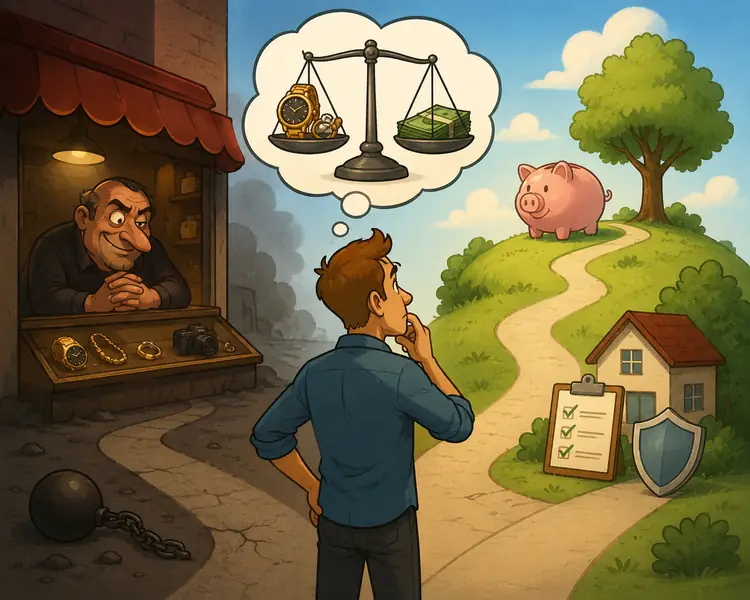
Imagine your car suddenly needs a $900 repair.
Your next paycheck arrives in ten days. Your credit card is already close to its limit. The bank cannot approve a loan quickly enough.
You own a valuable watch that mostly sits in a drawer. Should you visit a pawn shop?
Many people immediately answer, "Absolutely not." Others say, "Of course." Economics offers a different answer: It depends.
A pawn shop is neither a financial trap nor a financial rescue. Like any financial tool, its value depends on when—and why—you use it.
The Wrong Question People usually ask: "Are pawn shops good or bad?"
That is like asking whether a chainsaw is good or bad. The tool itself has no morality.
The important question is whether it is appropriate for the job. Used wisely, a pawn loan can solve a temporary problem at a manageable cost. Used carelessly, it can make an already difficult financial situation even worse.
The difference is often determined before the customer even walks through the door.
When a Pawn Shop Can Make Sense
There are situations where a pawn loan can be surprisingly rational.
Suppose you know with near certainty that money is arriving soon. Perhaps:
- your salary is due next week;
- a tax refund is on its way;
- a client is about to pay an invoice;
- you're waiting for insurance reimbursement.
In those situations, the loan is solving a timing problem rather than an income problem. Economists call this a liquidity problem.
You are not poor. You simply cannot access your money today. A pawn loan may bridge that short gap.
Paying interest for two weeks can be far less expensive than missing work because your car cannot be repaired—or paying hefty overdraft fees.
Sometimes the cheapest solution isn't the one with the lowest interest rate. It's the one that prevents a much larger loss.
When It Probably Doesn't
Now imagine a different situation.
You already struggle every month. Bills exceed income. Credit cards are maxed out. You have no realistic plan for repaying the loan.
In that case, a pawn shop doesn't solve the underlying problem. It merely postpones it. If repayment is unlikely, you may eventually lose the item while still facing the same financial pressures.
The loan delays the crisis. It doesn't remove it. That is why financial decisions should always begin with one uncomfortable question: "How exactly will I repay this?"
Not: "I hope something works out."
Hope is not a repayment plan.
Don't Pawn Something You Can't Afford to Lose
People often focus on the money. They forget about the object.
A pawn loan always carries one possibility:
You may never get the item back.
That means some possessions should probably never become collateral. Family heirlooms. Wedding rings. Items with irreplaceable sentimental value. Objects connected to loved ones.
If losing the item would hurt more than the financial problem itself, another solution may be worth exploring.
Economics measures prices. Life measures value. Those are not always the same thing.
Emotion Is Expensive
Financial stress changes how people think.
Psychologists have repeatedly found that urgency narrows attention. When bills pile up, people naturally focus on today's problem. Tomorrow becomes blurry.
That is exactly when expensive mistakes become more likely. The smartest financial decisions are rarely made in panic. Even pausing for thirty minutes can help.
Ask yourself:
- Do I really need this loan today?
- Is there another option?
- Can I borrow from family?
- Can I negotiate with the company I owe?
- Could I sell something I don't actually care about instead?
A short pause often reveals choices that panic hides.
Selling May Sometimes Be Better
This surprises many people. If you're already convinced you'll never redeem the item, selling it outright may be the smarter decision.
Why? Because buyers generally pay more than pawn lenders can offer as collateral.
Pawn shops must leave room for uncertainty. Private buyers usually don't.
If the item has no sentimental value and you're comfortable parting with it permanently, selling may leave you with more cash and no future repayment obligation.
Sometimes the hardest decision is also the simplest.
Choosing the Right Pawn Shop
Not every pawn shop operates the same way. Before accepting a loan, take a few minutes to compare.
A trustworthy shop should clearly explain:
- interest rates and fees;
- repayment deadlines;
- extension options;
- what happens if the loan isn't repaid;
- how your item will be stored and protected.
If something feels confusing, ask questions. If the answers remain confusing, walk away.
Transparency is usually a good sign. Pressure rarely is.
A Better Emergency Plan
Perhaps the biggest lesson isn't about pawn shops at all. It's about emergency savings.
Financial emergencies become much less stressful when you already have cash available. Even a modest emergency fund can eliminate the need for expensive short-term borrowing.
Of course, building one takes time. Many people begin saving only after experiencing their first financial emergency.
Ironically, pawn shops often remind us why emergency funds matter in the first place.
The Quiet Lesson
Pawn shops are not signs of financial failure. Nor are they magic solutions. They are tools designed for a very specific purpose: solving temporary cash shortages using valuable possessions as collateral.
Sometimes that is exactly the right tool. Sometimes it isn't.
Good financial decisions rarely come from asking, "Is this product good?"
They come from asking, "Is this the right tool for my situation?"
That question applies not only to pawn loans—but to almost every financial decision we make.