
Renewable Energy vs Fossil Fuels: Solar, Wind, Hydro — and the Economics of a New System
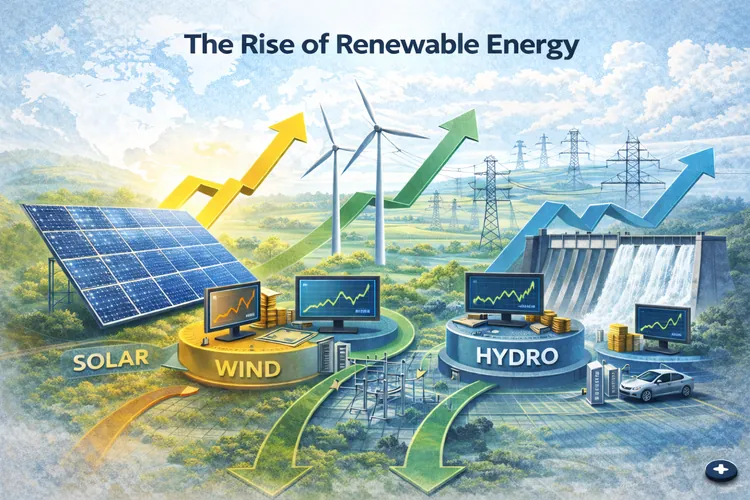
When people talk about alternative energy, they often mean “anything that replaces oil, gas, or coal.”
In economic terms, however, the more precise concept is renewable energy — sources naturally replenished on a human timescale:
- sunlight
- wind
- flowing water
- geothermal heat
- ocean tides and waves
Unlike fossil fuels, the key constraint is not depletion of fuel, but infrastructure, geography, and system integration.
The Three Pillars of Renewable Power
Although many renewable technologies exist, three dominate global electricity generation today.
Hydropower — the mature backbone
Hydropower is the oldest large-scale renewable technology and behaves more like infrastructure than new technology.
Examples:
- Canada: ~58% of electricity generation
- United States: ~5–6%
- Global share: ~15%
Advantages:
- low operating costs
- very long asset lifetimes
- strong grid-balancing capability
Limitations:
- geography
- environmental constraints
- climate variability and drought risk
Hydropower cannot scale quickly — but many renewable-heavy systems depend on it for stability.
Wind — scale and speed
Wind power has become the workhorse of renewable expansion.
Current shares:
- United States: just over 10% of electricity generation
- Canada: about 6% and growing
Economic advantages:
- large-scale projects
- declining turbine costs
- strong performance in suitable regions
Challenge:
Wind power produces electricity when wind is available, not necessarily when demand peaks.
Solar — the fastest-growing source
Solar energy is currently the fastest-expanding renewable technology globally.
Examples:
- United States: roughly 4% utility-scale generation (plus rooftop solar)
- Global share: about 7%, growing rapidly
Solar benefits from:
- steep cost declines
- modular deployment
- scalability from rooftops to large solar farms
Main challenge:
Solar production follows the sun — not electricity demand patterns.
Beyond the Big Three
Several other renewable technologies play smaller but strategic roles.
- Geothermal provides stable baseload power in regions with suitable geology.
- Tidal and wave energy harness ocean movement but remain expensive and limited in deployment.
- Biomass and bioenergy can be renewable but depend heavily on sustainable land use.
These sources are unlikely to dominate globally but can be locally important.
Renewable Energy in Numbers
Globally, renewables (including hydropower) now generate roughly 30% of electricity.
According to projections from the International Energy Agency:
- this share could reach about 46% by 2030
- wind and solar together could approach 30% of global generation
This represents not just a technological shift — but a massive reallocation of capital.
Investment Flows Tell the Real Story
The energy transition has become one of the largest investment trends in the global economy.
Recent estimates suggest:
- global energy investment approaching $3.3 trillion annually
- about $2.2 trillion directed toward clean energy
- roughly $450 billion invested in solar each year
Capital is moving because renewables increasingly behave like competitive infrastructure assets.
The Real Bottleneck: Integration
Building renewable generation is becoming easier.
The main constraints now lie elsewhere:
- electricity grids
- transmission capacity
- storage technologies
- system flexibility
Economic value is shifting from generation hardware to:
- grid networks
- balancing assets
- software
- market design
Renewables are not replacing fossil fuels one-for-one —
they are restructuring the entire energy system.
The Political Cooling of Renewables — and Why the Story Isn’t Over
Over the past decade, renewable energy seemed unstoppable.
Solar installations expanded rapidly. Wind farms appeared across vast stretches of North America. Investors, governments, and corporations all talked about the energy transition as if its direction had already been decided.
Yet in recent years, something interesting has happened in the United States.
The enthusiasm has cooled.
Not because solar panels suddenly stopped working.
Not because wind turbines became less efficient.
And not because the economics of renewable generation completely reversed.
The reasons are more complicated.
Part of the shift is political. Energy policy has become increasingly tied to broader debates about industrial policy, government spending, national security, and economic competitiveness. What was once presented primarily as an environmental issue is now also a question of jobs, manufacturing, supply chains, and geopolitics.
Part of the shift is economic. Higher interest rates have made large infrastructure projects more expensive to finance. Renewable energy depends heavily on upfront capital investment. When borrowing costs rise, project economics become less attractive.
There is also a practical reality that many early advocates underestimated.
Building solar farms and wind parks is only part of the challenge.
Modern economies still need reliable electricity during cloudy days, windless periods, heat waves, winter storms, and peak demand hours. As renewable penetration rises, questions about storage, transmission, backup generation, and grid stability become more visible.
In other words, the transition has entered a more difficult phase.
The easy part was adding renewable capacity.
The harder part is redesigning an entire energy system around it.
This has led some observers to argue that the renewable revolution was overhyped.
That conclusion may be premature.
Historically, major infrastructure transitions rarely move in straight lines.
Railways experienced investment booms and crashes.
Electric grids took decades to build.
The internet survived the dot-com collapse before transforming the global economy.
Energy systems evolve in a similar way.
Even if political priorities shift from one administration to another, several long-term forces remain intact:
- electricity demand continues to grow,
- data centers require enormous amounts of power,
- electrification of transportation is expanding,
- and many developed economies continue pursuing lower-carbon energy systems.
For these reasons, renewable energy is increasingly viewed not as a temporary trend but as a foundational technology.
The debate today is no longer whether solar, wind, and other renewable sources will remain part of the future.
The debate is about how large their role will become, how quickly the transition will occur, and how much the supporting infrastructure will ultimately cost.
That may sound less exciting than the headlines of a decade ago.
But it is probably a more realistic description of how energy transitions actually happen.
The Takeaway
Renewable energy is no longer a niche alternative.
It is a central pillar of modern energy economics.
But it does not eliminate hydrocarbons overnight, nor does it automatically guarantee cheap and stable energy.
Instead, it transforms scarcity:
less about fuel in the ground
more about infrastructure, coordination, and resilience.
Renewable energy is not just a new source of power —
it is a new architecture of the energy system.