
Quantitative Easing: The Day Money Stopped Feeling Real
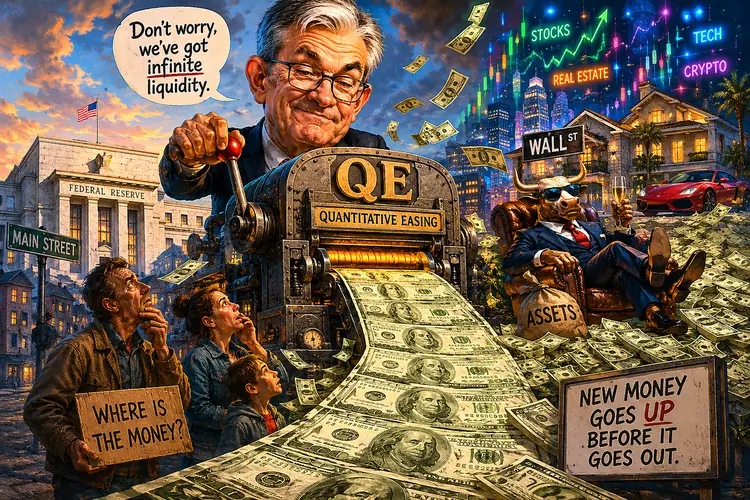
The Strange Moment When Money Became Abstract
There was a time when the phrase “printing money” sounded dramatic. It suggested giant machines, government panic, inflation spirals, and perhaps someone in a dark room sweating over an economic catastrophe.
Then came 2008.
And suddenly, the most powerful central banks in the world discovered something remarkable: you didn’t even need the printers anymore.
You could create trillions with keyboards. Quietly. Digitally. Almost invisibly.
And that was the moment money started feeling less like a physical thing and more like a policy tool floating somewhere inside computer systems.
The official name was Quantitative Easing — QE.
It sounded technical enough to calm the public. That was probably not an accident.
Because “Emergency Trillions Created Out of Thin Air” would have been harder to sell during evening news broadcasts.
---
## What QE Actually Is
In simple terms, quantitative easing is when a central bank creates new money electronically and uses it to buy financial assets — mostly government bonds.
The idea is straightforward:
- central banks inject money into the financial system
- interest rates fall
- borrowing becomes cheaper
- banks lend more
- companies invest more
- consumers spend more
- the economy recovers
At least in theory.
In the United States, the Federal Reserve became the star of this experiment after the 2008 financial crisis. The financial system was collapsing. Banks distrusted each other. Markets froze.Entire institutions looked ready to disappear.
So the Fed stepped in and began buying massive amounts of assets. Not millions. Not billions.
Trillions.
And this is where the psychology of money quietly changed.
Because once people realize trillions can appear relatively quickly during emergencies, they start asking uncomfortable questions:
Why was money supposedly “limited” before?
---
## The Era of Financial Gravity Suspension
Before 2008, markets still carried a certain fear.
Investors knew crashes could happen. Companies could fail. Bad decisions could have consequences.
Then central banks discovered a new superpower: they could soften almost every major financial panic with liquidity.
Suddenly, markets began acting differently.
Every major drop created expectations of rescue.
Bad news became good news because investors assumed central banks would respond with more stimulus.
At times, Wall Street seemed less concerned about profits than about the emotional mood of the Fed. The old market logic started changing:
- recession fears?
→ stimulus may come
- markets crashing?
→ liquidity may come
- growth slowing?
→ rates may fall
It was as if financial gravity itself had become negotiable.
And once investors begin believing that large declines will always trigger intervention, risk starts feeling strangely artificial.
---
## Cheap Money Changes Human Behavior
Low interest rates sound boring until you realize they quietly reshape almost everything.
When money becomes cheap:
- investors take bigger risks
- corporations borrow aggressively
- housing prices rise
- speculative assets explode
- future profits become more valuable than present reality
This partly explains why the post-2008 world saw extraordinary booms in:
- tech stocks
- venture capital
- cryptocurrencies
- luxury assets
- real estate
Money was everywhere. And when money becomes abundant, people stop asking whether something is profitable today. They start asking whether someone else will pay more tomorrow.
That is how bubbles begin to feel normal.
A generation of investors grew up in a world where central banks constantly cushioned markets.
For many younger traders, aggressive intervention became the default setting of capitalism itself.
Some investors even began joking: “Don’t fight the Fed.”
It was a joke. But also not really a joke.
---
## Why Regular People Often Felt Confused
One of the strangest things about QE is that many ordinary people never felt rich during this enormous monetary expansion.
This confused everyone. If trillions were being created, where was the money?
The answer is uncomfortable: new money usually reaches financial assets first.
It enters:
- banks
- bond markets
- stock markets
- investment funds
So people who already owned assets often benefited the most.
If you owned:
- stocks
- expensive real estate
- investment portfolios
you probably experienced one version of the post-2008 economy.
If you mainly depended on wages and savings accounts, you may have experienced another.
This helped widen the psychological gap between Wall Street and ordinary households.
The wealthy saw rising asset values.
Many middle-class families saw:
- stagnant affordability
- expensive housing
- rising debt
- inflated education costs
QE did not “cause” every inequality problem. But it absolutely amplified the feeling that modern money increasingly flows upward before it flows outward.
---
## The Pandemic Changed Everything Again
If 2008 introduced QE, 2020 normalized it. During COVID, governments and central banks reacted with astonishing speed.
Stimulus packages exploded across the developed world. The Fed expanded its balance sheet dramatically. Governments sent checks directly to citizens. Businesses received emergency support. Markets were stabilized almost immediately.
And for a brief moment, many people realized something extraordinary: when governments truly panic, they suddenly discover unlimited flexibility.
For years, politicians had argued endlessly over budgets.
Then a crisis appeared.
And suddenly trillions arrived at high speed.
This created a dangerous new public expectation: if enormous money creation is possible during emergencies, why not use it more often?
That question now quietly sits underneath modern politics.
---
## The Inflation Problem Arrives Late
For years after 2008, many economists argued QE would eventually produce major inflation.
Yet inflation remained surprisingly calm for a long time.
This made central banks appear almost magical. It looked as if they had discovered a financial cheat code: create money without consequences.
Then came the inflation surge after the pandemic. And suddenly the world remembered something important: you can delay economic consequences longer than expected, but not forever.
Inflation returned aggressively across many developed economies.
The same governments that once feared deflation suddenly faced rising prices in:
- housing
- food
- energy
- transportation
Central banks then had to reverse course by raising interest rates rapidly. Which revealed another uncomfortable truth: economies had become deeply addicted to cheap money.
---
## The Addiction Nobody Wants to Discuss
Low rates and QE function a bit like economic painkillers.
They reduce stress. They calm markets. They stabilize panic.
But over long periods, economies adapt to them. Governments borrow more easily. Corporations refinance endlessly. Consumers take larger loans. Asset prices rise around permanently low financing costs.
Then, when rates rise again, the system suddenly feels fragile. Markets react violently. Debt becomes expensive. Housing slows. Speculation weakens.
The withdrawal symptoms appear immediately. Modern economies increasingly resemble patients permanently attached to monetary support systems. And central banks now face an impossible balancing act:
- print too much → inflation
- print too little → recession fears
- keep rates too low → bubbles
- raise them too fast → instability
The era of “normal money” may already be behind us.
---
## Did QE Save Capitalism — or Change It Forever?
Supporters of QE argue central banks prevented catastrophe. And they are probably right.
Without intervention in 2008 and 2020, the global financial system might have suffered devastating collapses. But critics ask a different question: what happens when markets no longer believe failure is possible?
Capitalism traditionally depended on risk, discipline, and consequences. QE softened many of those forces.
The system survived. But it also changed character.
Markets became increasingly dependent on:
- central bank signals
- liquidity expectations
- interest-rate psychology
In theory, we still live in free markets. In practice, investors often spend enormous energy trying to predict the emotional state of central bankers.
That is a very strange evolution for capitalism.
---
## The Day Money Became Psychological
Perhaps the biggest consequence of quantitative easing is not financial.
It is psychological.
For decades, money felt solid. Limited. Grounded in something tangible.
QE changed that perception. Money started feeling flexible. Expandable. Negotiable.
More like software than substance.
And once society realizes money can be created at enormous scale during crises, people begin viewing economics differently forever.
Debt feels less frightening. Deficits feel more political. Markets feel less natural. Governments feel more powerful.
The old image of money as something fixed and scarce quietly fades away.
What replaces it is still unclear.
But one thing is certain: after quantitative easing, money stopped feeling completely real.
---