
One Divides, the Other Chooses: The Small Rule Behind Big Economic Deals
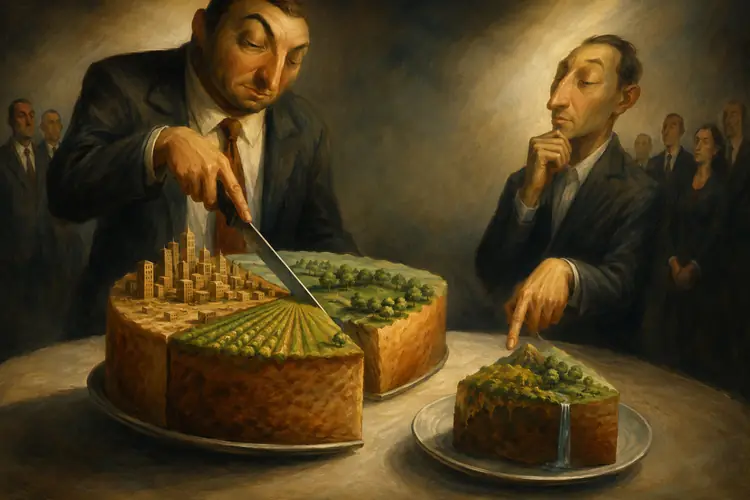
Economics often looks complicated. We talk about markets, taxes, regulations, incentives, and billion-dollar negotiations. Yet some of the most useful economic ideas can be explained with a piece of cake.
Imagine two children sharing dessert. One child cuts the cake. The other chooses which piece to take.
Suddenly, the child doing the cutting becomes extremely careful.
Why? Because if one piece is larger, the other child will take it.
This simple principle — one divides, the other chooses — may be one of the oldest lessons in fairness. Surprisingly, versions of it appear throughout modern economics.
Fairness Through Incentives
Most people think fairness requires a referee.
Economics often suggests something different.
Instead of relying on an outside judge, it is often possible to design a system where people have a reason to behave fairly on their own.
The child cutting the cake does not become fair because they suddenly become generous. They become fair because the rules make fairness the smartest strategy.
Economists love systems like this because they reduce conflict.
The less people argue about whether a decision was fair, the less time, money, and energy are wasted.
Business Partnerships
Suppose two business partners decide to separate and divide their company.
One partner proposes how the assets should be split.
The other partner chooses which share to take.
Immediately, the first partner has a strong incentive to make the proposal balanced.
If they try to keep the better portion for themselves, the other partner will simply choose it.
Many negotiations work best when both sides know they might have to live with the offer they make.
That possibility often creates surprisingly reasonable behavior.
Real Estate and Family Inheritance
Similar ideas appear when families divide property.
Imagine two siblings inheriting land.
One suggests how the property should be divided. The other chooses first.
The process may not create perfect equality, but it often creates something equally important: acceptance.
People are much more willing to accept an outcome when they participated in creating it.
In economics, perceived fairness can matter almost as much as actual fairness.
International Trade
Even trade negotiations between countries contain echoes of the same principle.
When one side proposes terms, it must consider whether the other side will accept them.
An offer that benefits only one country is unlikely to survive.
The most durable agreements are usually those where both sides feel they received something valuable.
Just like the cake, a deal works better when neither side feels cheated.
Why Economists Like This Idea
The genius of the rule is not that it guarantees perfect equality.
It doesn't.
Different people value things differently. One person may prefer cash. Another may prefer land. A third may value control or future opportunities.
The real achievement is that the rule aligns incentives.
Instead of forcing fairness, it encourages it.
And that distinction matters.
Throughout history, many economic systems have struggled because they relied on people being unusually honest, unusually wise, or unusually selfless.
The "one divides, the other chooses" principle assumes none of those things.
It assumes people act in their own interest.
Then it uses that fact to produce a better outcome.
The Bigger Lesson
Economics is often described as the study of money.
In reality, it is often the study of rules.
The right rule can transform conflict into cooperation.
A simple dessert-sharing trick teaches a surprisingly powerful lesson: when people must live with the consequences of their own proposals, they usually become much more careful about what they consider fair.
And sometimes, the smartest economic solution is not finding better people.
It's finding better rules.