
Oil Is Not Fuel. It’s a Portfolio
Ask a random person what oil is for, and you’ll likely hear a simple answer:
Gasoline. Cars. Energy.
That answer is intuitive.
It’s also wrong in a surprisingly important way.
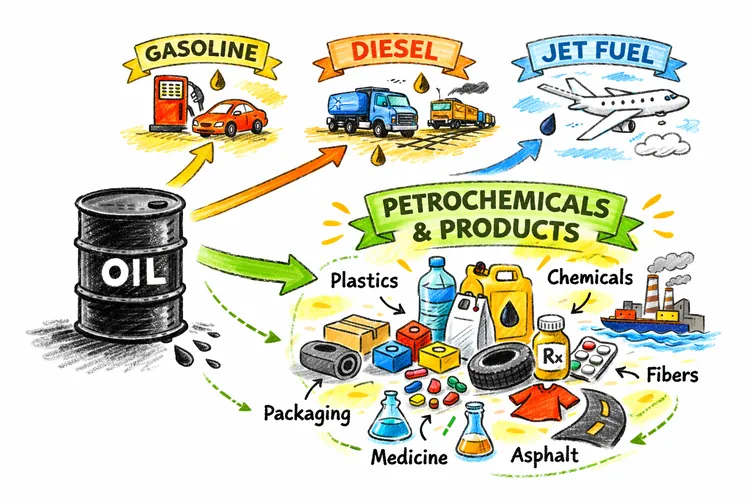
Oil is not a single-purpose fuel.
It’s a portfolio of products, and fuel is only the most visible part of it.
Once you see that, a lot of debates about oil—especially about its “end”—start to sound very different.
The Illusion of “Burning a Barrel”
A barrel of oil is often treated as if it were a unit of energy.
Burn one barrel, get energy.
Burn fewer barrels, save the planet.
Reality is messier.
When oil enters a refinery, it doesn’t come out as “fuel.” It comes out as many things, split, upgraded, blended, and optimized.
Refineries don’t ask:
“How do we turn this barrel into gasoline?”
They ask:
“How do we maximize value across a whole slate of products?”
That slate is the portfolio.
To see why the “burning a barrel” idea breaks down, look at what actually comes out of one.
In a typical U.S. refinery, a single 42-gallon barrel of crude oil turns into more than 40 gallons of different products—not one fuel, but a mix.
Roughly speaking:
- about 20 gallons become gasoline, mostly for cars and light trucks,
- around 12–13 gallons turn into distillates, primarily diesel for trucking, rail, industry, and some heating,
- roughly 4–5 gallons become jet fuel, powering aviation.
That already covers the obvious fuels. But the barrel doesn’t stop there.
Fuel Is the Headline, Not the Whole Story
Yes, a large share of oil still ends up as fuels:
- gasoline for cars,
- diesel for trucks and industry,
- jet fuel for aviation.
That’s what people see. That’s what they pay for at the pump.
But oil also quietly becomes:
- plastics and packaging,
- synthetic fibers in clothes,
- solvents, lubricants, waxes,
- asphalt under roads,
- chemicals inside medicines, electronics, and food supply chains.
You don’t “burn” most of these.
You live inside them.
Beyond fuels, a barrel quietly produces a long list of smaller streams that rarely make headlines but matter enormously to the economy.
These include:
- petroleum coke used in heavy industry,
- refinery gas (“still gas”) that powers refineries themselves,
- liquefied petroleum gases,
- residual fuels,
- and petrochemical feedstocks, such as naphtha and other light oils.
Individually, these streams look secondary. Collectively, they explain why oil is embedded far beyond transportation.
Why This Changes the Energy Transition Story
Here’s where the portfolio view matters.
Electric vehicles can reduce gasoline demand.
Efficiency can reduce fuel consumption.
But none of that automatically eliminates:
- petrochemical demand,
- aviation needs,
- heavy transport,
- industrial feedstocks.
So when people say:
“We’re switching to renewables, oil demand will collapse,”
they’re usually thinking about one slice of the portfolio, not the whole thing.
Oil demand doesn’t disappear all at once.
It rebalances.
Less here.
More there.
The Hidden Growth Engine
In recent years, one part of the oil portfolio has been doing a lot of the heavy lifting: petrochemicals.
This is why, in recent years, petrochemical feedstocks have become one of the most important drivers of oil demand growth.
Industry analysts increasingly point out that future oil demand is less about driving and more about materials—plastics, chemicals, packaging, and industrial inputs that scale with income and consumption, not mileage.
From an investment perspective, this matters: even when fuel demand slows, the portfolio doesn’t collapse—it reallocates.
As incomes rise globally:
- people buy more packaged goods,
- more electronics,
- more synthetic materials,
- more things that quietly rely on oil-based inputs.
This is why oil demand can keep growing even when fuel efficiency improves.
The barrel doesn’t vanish.
It just changes its job.
The Third Big Takeaway
If oil were just fuel, the future would be simpler.
But it’s not.
Oil is not gasoline.
Oil is a portfolio.
And portfolios don’t end.
They shift weights.
Understanding oil means understanding not just how much we burn—but what we turn it into.
That’s the part of the oil story that rarely makes headlines, yet quietly shapes its future.