
NHL Economics, Part 2: Why Arenas Matter More Than You Think
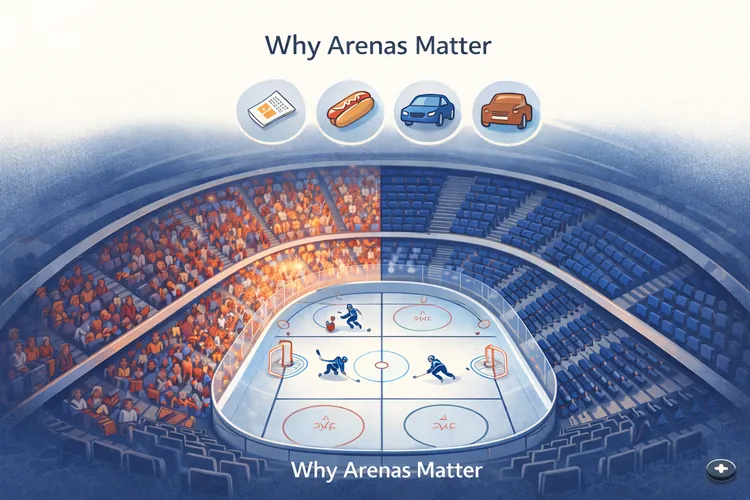
If Part 1 is about currencies, Part 2 is about buildings.
Unlike the NFL or NBA, the NHL still lives and dies by the arena.
Gate-driven economics
Each NHL team plays:
- 41 regular-season home games,
- plus preseason and potential playoff games.
That creates a business model where:
- ticket sales,
- suites and premium seating,
- food and beverage,
- parking,
- and in-arena sponsorships
are central to survival.
National TV money helps — but it doesn’t replace full seats.
Capacity tells the story
Look again at our two example teams:
- Scotiabank Arena
Capacity (hockey): ~19,800
- Madison Square Garden
Capacity (hockey): ~18,000
Sell out consistently, and the math works.
Miss a few thousand seats per game, and losses compound quickly.
In hockey, empty seats hurt more than bad TV ratings.
Playoffs: the real upside
Regular-season games keep the lights on.
Playoff games generate upside.
Each extra home playoff game means:
- premium pricing,
- higher concession sales,
- intense local attention,
- and revenue with relatively fixed costs.
For mid-market teams, a deep playoff run can materially change the season’s financial outcome.
Why local economies matter so much
Because the arena is central, NHL teams are deeply exposed to:
- local income levels,
- corporate sponsorship demand,
- downtown accessibility,
- and competition from other entertainment.
A strong local economy shows up immediately in attendance.
A weak one does too.
This is why identical teams under identical league rules can face very different financial realities.
The discipline trade-off
The NHL chose:
- a hard salary cap,
- cost control,
- and reliance on real, local cash flow.
The price of that choice:
- fewer global megastars,
- less explosive media growth.
The benefit:
- long-term league stability,
- fewer financial implosions,
- and a system that forces economic realism.
Final thought
The NHL may not dominate global sports headlines.
But as an economic system, it is unusually honest.
It ties success not just to talent and branding,
but to currencies, cities, and people actually walking through arena doors.
In a sports world increasingly detached from local reality,
hockey remains stubbornly grounded.