
NHL Economics, Part 1: One League, Two Currencies
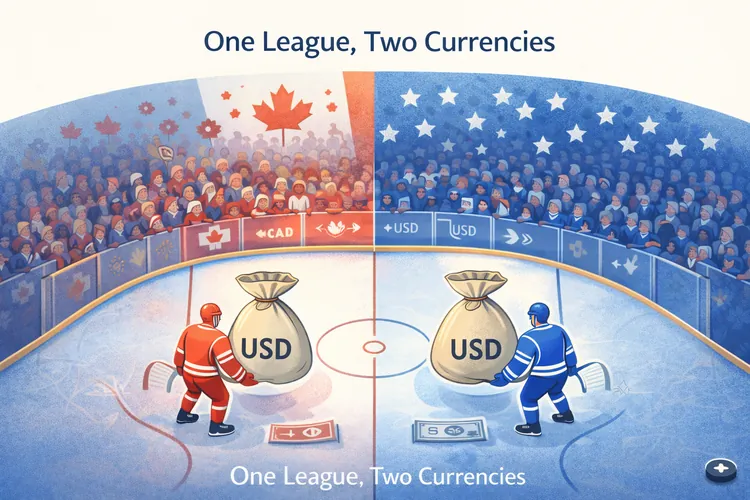
The National Hockey League is often described as a single, unified competition.
Same rules.
Same salary cap.
Same trophy.
Economically, however, it operates across two national economies — and that matters more than most fans realize.
Two countries, one payroll currency
The NHL spans the United States and Canada, but player contracts are effectively denominated in U.S. dollars.
That creates a structural asymmetry:
- U.S.-based teams earn most of their revenue in USD and pay salaries in USD.
- Canadian teams earn a large share of revenue in Canadian dollars, but pay salaries in USD.
When the Canadian dollar weakens, Canadian teams face an immediate cost shock — even if attendance and performance stay the same.
This is macroeconomics with skates on.
A concrete comparison: Toronto vs New York
Take two flagship franchises:
- Toronto Maple Leafs (Canada)
- New York Rangers (USA)
Both are among the NHL’s most valuable teams.
Player payroll (approximate, recent seasons):
- Maple Leafs: ~$85–90 million USD
- Rangers: ~$85–90 million USD
On paper — identical.
But the Leafs must generate the CAD equivalent of that USD payroll. A weaker Canadian dollar effectively raises their real cost base, squeezing margins even in sold-out seasons.
Star salaries: big — but contained
NHL superstar contracts are substantial, but disciplined compared to other leagues.
Examples:
- Auston Matthews: ~$13 million per year
- Connor McDavid: ~$12.5 million per year
These are elite salaries — but far below NBA or MLB megadeals.
That gap is not about talent.
It’s about league revenue structure.
Why currency risk doesn’t disappear
Revenue sharing and league mechanisms soften the blow, but they don’t eliminate it.
Canadian teams often compensate by:
- maximizing attendance,
- leaning into premium pricing,
- controlling costs more aggressively.
The result is a quiet but persistent tension:
some of the NHL’s most passionate markets operate with the thinnest financial buffers.
The economic takeaway
The NHL is one of the few major sports leagues where:
- exchange rates matter,
- national borders affect competitiveness,
- and macroeconomic trends can influence roster decisions.
This alone makes it a fascinating case study.
But currency is only half the story.
The other half is much more physical.