
Natural Gas: The Fuel That Doesn't Travel Like Oil
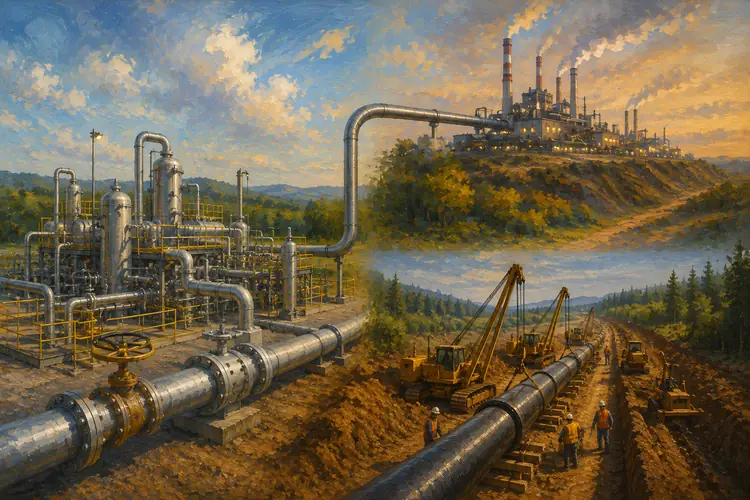
Most people think of natural gas as simply another fossil fuel. It heats homes, powers factories, generates electricity, and cooks dinner. It sits beside oil and coal in conversations about energy.
But economically, natural gas behaves very differently from oil. A barrel of crude oil can be loaded onto a tanker almost anywhere in the world and sold to whichever buyer offers the best price.
Natural gas usually cannot. For most of its history, natural gas has been one of the least mobile commodities on Earth. It can only move where expensive infrastructure allows it to move. Pipelines, compressor stations, storage facilities, and, more recently, liquefied natural gas (LNG) terminals determine not only where gas flows—but also how much people pay for it.
Oil follows markets. Gas follows maps. That simple difference explains why two countries can sit on the same planet, consume the same fuel, and pay dramatically different prices.
A Fuel That Doesn't Like to Travel
Moving oil is surprisingly easy. Pump it into a pipeline, railcar, truck, or tanker, and it can travel thousands of miles with relatively modest cost.
Gas is another story. At normal temperature and pressure, natural gas occupies an enormous volume. Transporting it long distances requires either dedicated pipelines or cooling it to about −162°C (-260°F) until it becomes a liquid.
For most of the twentieth century, liquefying gas was too expensive for widespread international trade. Pipelines became the obvious solution.
But pipelines create a unique economic reality. Unlike roads or shipping lanes, they connect very specific places. Once built, they cannot simply be redirected toward another customer. Building a major international gas pipeline can cost tens of billions of dollars and take years to complete.
Investors recover those costs only if gas continues flowing for decades. In other words, pipelines are long-term relationships disguised as steel.
Three Markets Instead of One
For decades, the world did not have a single global gas market. Instead, it had several regional ones.
North America developed around abundant domestic production and extensive pipeline networks.
Europe relied on pipelines from Norway, Russia, North Africa, and later increasing volumes of LNG.
Asia, particularly Japan and South Korea, depended heavily on imported LNG because geography made pipelines impractical.
Since these markets were only weakly connected, prices often moved independently. The same molecule of methane might be worth three or four times more in one region than another.
Imagine wheat selling for $6 per bushel in one country and $20 in another—not because demand differed dramatically, but because almost no efficient transportation existed between them.
That was normal in natural gas.
Pipelines: Expensive to Build, Cheap to Use
Pipelines illustrate one of economics' oldest lessons. Fixed costs can be enormous, while operating costs remain relatively low. Once a pipeline exists, moving another unit of gas through it costs relatively little.
The difficult part is building it. A cross-border pipeline requires engineering, environmental studies, financing, political agreements, land rights, compressor stations, monitoring systems, and years of construction. Because these investments are so large, buyers and sellers usually sign contracts lasting ten, twenty, or even thirty years.
The pipeline itself becomes part of the economic relationship. A factory may depend on that pipeline. A city may depend on it. An entire country's energy security may depend on it.
Gas pipelines are not simply transportation projects. They are strategic infrastructure.
Why Oil Prices Used to Matter So Much
One of the most surprising facts about natural gas is that, historically, its price often had little to do with the gas market itself. Instead, many long-term gas contracts were linked directly to the price of oil.
At first glance, this seems strange. Oil and gas are different products. They have different transportation systems, different customers, and different supply chains. So why connect their prices?
The answer lies in history. For decades there was no transparent global benchmark for natural gas. Oil, however, traded actively on international markets and had well-established pricing mechanisms. Using oil as a reference point gave both buyers and sellers a stable formula for long-term contracts.
Another reason was competition. In many industries, factories could choose between burning oil or burning gas. If oil became much more expensive, gas naturally became more attractive. Linking gas prices to oil helped keep the two fuels economically competitive.
Many contracts therefore included formulas tied to oil benchmarks such as Brent crude or oil products like fuel oil and gasoil. In effect, companies buying gas were often watching oil prices just as closely.
Today, this practice has become less common in markets with active gas trading hubs such as North America and much of Europe, where prices increasingly reflect supply and demand for gas itself.
However, oil-indexed contracts still play an important role in parts of Asia and in some long-term LNG agreements. Even in today's more flexible market, the legacy of oil pricing has not disappeared.
Who Sells the World's Gas?
Natural gas production is spread across many countries, but a relatively small group dominates international trade.
The United States has become one of the world's largest producers, thanks largely to the shale revolution.
Russia possesses some of the largest reserves ever discovered and has historically been a major pipeline supplier.
Qatar built an energy strategy around LNG exports.
Norway has become Europe's dependable offshore supplier.
Australia emerged as an LNG powerhouse serving Asian markets.
Algeria and Nigeria remain important exporters to Europe and beyond.
Canada holds enormous gas resources as well and is now expanding LNG export capacity from its Pacific coast, allowing future shipments directly to Asian customers without passing through the Panama Canal.
Each exporter has a different advantage. Some rely on geography. Others rely on infrastructure. Some rely on technology.
Who Buys It?
The world's largest gas importers share one characteristic. They need more energy than they can produce themselves.
Japan imports enormous volumes because it has limited domestic resources.
South Korea faces similar constraints.
China continues expanding gas consumption while balancing domestic production with imports.
India's growing economy is steadily increasing demand.
Europe imports substantial amounts despite domestic production because consumption exceeds available supplies.
These countries are not simply buying fuel. They are buying reliable energy for homes, factories, hospitals, data centers, and transportation.
Gas is often invisible to consumers. Its absence is impossible to ignore.
Why Gas Prices Can Be So Different
Unlike oil, natural gas does not have one universally accepted world price. Instead, several important benchmarks reflect regional markets.
Henry Hub in Louisiana serves as the main pricing point for North America.
TTF (Title Transfer Facility) in the Netherlands has become Europe's most influential gas benchmark.
JKM (Japan Korea Marker) represents spot LNG prices delivered to Northeast Asia.
These prices can diverge dramatically. One region may enjoy abundant production and full storage facilities while another competes aggressively for imported cargoes.
Transportation constraints amplify these differences. A ship carrying LNG can change course. A pipeline cannot.
As a result, natural gas prices often reflect infrastructure almost as much as geology.
The Shock That Changed Everything
The energy disruptions beginning in 2022 demonstrated how rapidly gas markets could change.
Europe dramatically reduced pipeline imports from Russia.
LNG shipments increased sharply. New import terminals were built in record time. Trade routes shifted across oceans. American LNG exports expanded significantly. Countries that once depended mainly on pipelines began competing for cargoes arriving by sea.
The crisis did not eliminate geography. It simply made flexibility more valuable.
Infrastructure that once seemed permanent suddenly became subject to change. The global gas market became more connected than ever before—but it also reminded everyone that energy security carries a price.
Geography Still Wins
Technology has made natural gas more mobile than it was twenty years ago. New pipelines continue to appear. LNG connects continents that pipelines never could. Digital trading platforms improve transparency.
Yet one fact remains unchanged. Natural gas still depends on physical infrastructure more than almost any other major commodity. You cannot redirect a pipeline with a phone call. You cannot build an LNG terminal overnight. And you cannot ignore geography.
Oil largely follows whoever is willing to pay the highest price.
Natural gas still asks a different question first: "Can I get there?" That question has shaped energy markets for generations. And despite remarkable technological progress, it continues to shape them today.